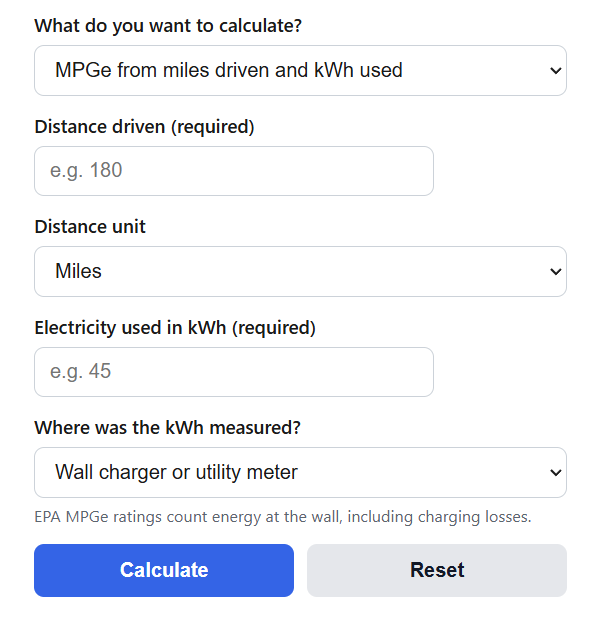
Calculate MPGe from miles driven and kWh used, convert MPGe to mi/kWh and kWh per 100 miles, and find your EV cost per mile and the gas MPG it matches.
MPGe Formula
MPGe = 33.7 * mi / kWh
Cost per mile = (33.7 * Pe) / MPGe
Gas MPG cost match = (MPGe * Pg) / (33.7 * Pe)
- MPGe is the miles per gallon of gasoline equivalent
- mi is the distance driven in miles
- kWh is the electricity consumed over that distance, in kilowatt hours
- 33.7 is the EPA energy equivalence of one gallon of gasoline, in kWh (33.705 kWh before rounding)
- Pe is the electricity price in dollars per kWh
- Pg is the gasoline price in dollars per gallon
The first formula drives the trip mode of the calculator. Enter the distance you drove and the kWh you used, and it returns your MPGe along with the same efficiency expressed as miles per kWh, kWh per 100 miles, Wh per mile, kilometers per kWh, and kWh per 100 km. If your kWh number comes from the car trip meter instead of the wall charger, the calculator divides it by your charging efficiency first, since the trip meter only sees energy leaving the battery. EPA ratings count energy drawn at the wall, so this adjustment makes your result comparable to the window sticker. The estimated wall to wheels figure equals the battery to wheels figure multiplied by the charging efficiency percentage.
The convert mode applies the same 33.7 kWh equivalence in reverse. Any one of the six efficiency units fixes all the others, so entering a value in one unit returns the full set.
The cost mode uses the second and third formulas. Cost per mile is your electricity price multiplied by the energy your EV needs per mile. The gas MPG cost match tells you what fuel economy a gasoline car would need to run at the same cost per mile given current gas prices. It is the most direct way to translate an MPGe rating into money.
MPGe Conversion Chart and Cost Equivalents
The table below converts common MPGe ratings into the other efficiency units used on EV window stickers and in car trip computers. Ratings for 2026 model year EVs span roughly 60 MPGe for heavy electric trucks to 146 MPGe for the Lucid Air Pure RWD, the most efficient EPA rated vehicle on sale.
| MPGe | Miles per kWh | kWh per 100 miles | Wh per mile |
|---|---|---|---|
| 60 | 1.78 | 56.2 | 562 |
| 70 | 2.08 | 48.1 | 481 |
| 80 | 2.37 | 42.1 | 421 |
| 90 | 2.67 | 37.4 | 374 |
| 100 | 2.97 | 33.7 | 337 |
| 110 | 3.26 | 30.6 | 306 |
| 120 | 3.56 | 28.1 | 281 |
| 130 | 3.86 | 25.9 | 259 |
| 140 | 4.15 | 24.1 | 241 |
| 146 | 4.33 | 23.1 | 231 |
MPGe compares energy, not money, so a 120 MPGe EV does not cost the same to run as a 120 MPG gas car would. This table shows what fuel economy a gasoline car would need to match each MPGe rating on cost per mile, using the mid 2026 United States averages of $0.18 per kWh for home electricity and $3.80 per gallon for regular gasoline.
| MPGe | Cost per mile at $0.18/kWh | Cost per 100 miles | Gas MPG cost match at $3.80/gal |
|---|---|---|---|
| 60 | 10.1¢ | $10.11 | 37.6 MPG |
| 80 | 7.6¢ | $7.58 | 50.1 MPG |
| 100 | 6.1¢ | $6.07 | 62.6 MPG |
| 120 | 5.1¢ | $5.06 | 75.2 MPG |
| 140 | 4.3¢ | $4.33 | 87.7 MPG |
Prices change the picture quickly. The same 100 MPGe EV charged on a DC fast charger at $0.45 per kWh costs about 15.2 cents per mile, which matches a gas car getting only about 25 MPG. Charging at home off peak for $0.10 per kWh drops it to 3.4 cents per mile, a match for a 113 MPG gas car. Run your own rates through the cost mode of the calculator to see where your charging mix lands.
Example Problems
Example 1. You drive 180 miles and your wall charger reports 45 kWh delivered to recharge the battery. Your efficiency is 180 / 45 = 4.0 miles per kWh. Applying the formula, MPGe = 33.7 * 180 / 45 = 134.8 MPGe. That is equivalent to 25 kWh per 100 miles.
Example 2. Your EV is rated at 115 MPGe, you pay $0.18 per kWh, and gas in your area costs $3.80 per gallon. Energy use is 3370 / 115 = 29.3 kWh per 100 miles. Cost per mile = (33.7 * 0.18) / 115 = $0.053, or $5.27 per 100 miles. The gas MPG cost match = (115 * 3.80) / (33.7 * 0.18) = 72 MPG, so a gasoline car would need to average 72 MPG to run this cheaply. Over 12,000 miles per year, charging costs about $633.
Frequently Asked Questions
Why is my calculated MPGe lower than the EPA rating on my window sticker?
Two different measurements are usually being compared. Your car trip meter counts energy leaving the battery, while the EPA rating counts energy drawn from the wall, which includes charging losses of roughly 8 to 15 percent for home AC charging. Cold weather, high speeds, and climate control use also cut real world efficiency well below the laboratory based rating. If you compute MPGe from trip meter kWh, use the trip meter setting in the calculator so the charging loss adjustment is applied and the result is comparable to the sticker.
Is the 33.7 kWh per gallon figure exact?
The EPA equivalence is 33.705 kWh per gallon, derived from the roughly 115,000 BTU of energy in a gallon of regular gasoline. Window stickers and most published ratings round it to 33.7 kWh, which is what this calculator uses, and the difference changes results by less than 0.02 percent. Note that the figure is an energy equivalence only. It says nothing about what the two fuels cost.
Does a higher MPGe always mean lower running costs than a gas car?
No. MPGe compares energy content, and electricity and gasoline are priced very differently per unit of energy. A 120 MPGe EV charged at home at average 2026 rates runs at about the cost of a 75 MPG gas car, which beats any gasoline vehicle on sale. The same EV relying on expensive DC fast charging can cost as much per mile as an ordinary 30 MPG sedan. Higher MPGe always means less energy per mile, but whether it means lower cost depends on your electricity price, so check your own numbers with the cost mode.