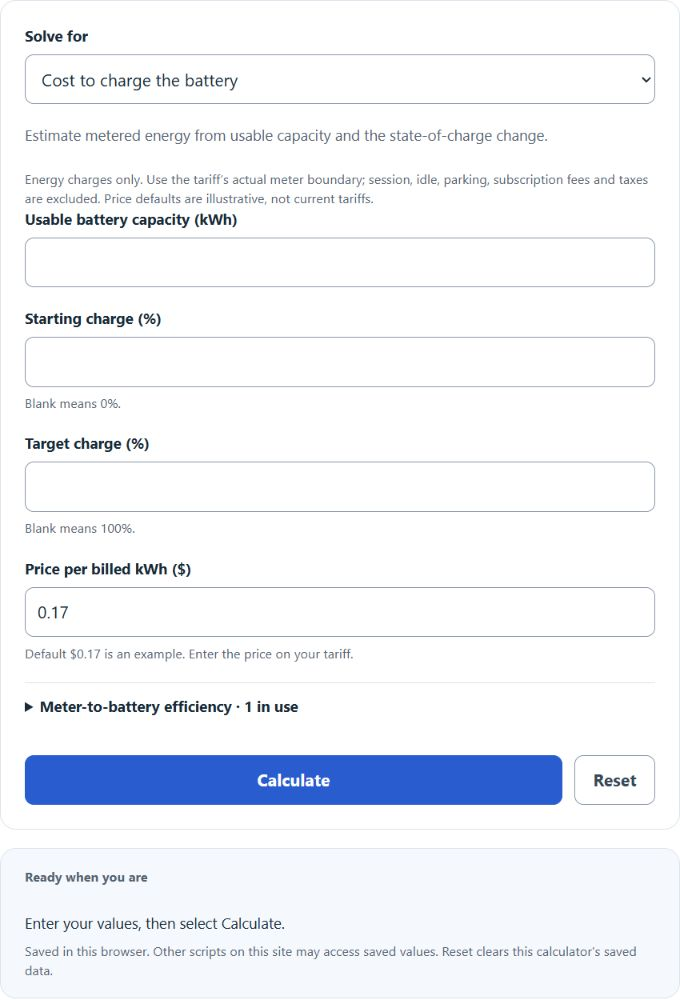
Calculate the cost to charge an EV at home or on public chargers, including cost per full charge, cost per mile, and monthly charging cost with losses included.
EV Charging Cost Formula
CC = BC * (SOC2 - SOC1)/100 / (CE/100) * P
DC = D * EC/100 / (CE/100) * P
- CC is the cost to charge the battery ($)
- BC is the battery capacity (kWh)
- SOC1 and SOC2 are the starting and ending state of charge (%)
- CE is the assumed percentage of billed energy stored in the battery; used for battery-side inputs only
- P is the electricity price ($/kWh)
- DC is the cost to drive a distance ($)
- D is the distance driven (miles)
- EC in the divided-by-CE distance formula is battery-side consumption in kWh/100 miles. For EPA wall-energy consumption, omit division by CE.
Battery-charge mode estimates usable energy added from capacity and SOC, then divides once by the assumed meter-to-battery efficiency. Distance and monthly modes distinguish battery-side in-car consumption from wall/billed-energy figures. EPA label consumption and MPGe already include charging losses, so those figures are not divided by charging efficiency again. Monthly home share is the share of billed energy, and the two tariffs must use comparable meter boundaries. Session, idle, parking and subscription charges and taxes are excluded.
Illustrative Charging Price Scenarios
The following prices are illustrative scenarios, not current US tariffs. Costs assume 28 battery-side kWh per 100 miles and a stated 90% meter-to-battery efficiency. If 28 kWh/100 miles instead comes from an EPA wall-energy label, multiply that value directly by the tariff; dividing by 0.90 again would double count charging losses.
| Charging location | Example price per kWh | Cost per 100 miles |
|---|---|---|
| Home, standard rate | $0.17 | $5.29 |
| Home, off-peak TOU plan | $0.10 to $0.13 | $3.11 to $4.04 |
| Public Level 2 | $0.25 to $0.40 | $7.78 to $12.44 |
| DC fast charger | $0.45 to $0.50 | $14.00 to $15.56 |
When starting from energy actually added to the battery, billed energy can be higher because of losses and auxiliary use between the tariff meter and the battery. This worked table assumes 90% of billed energy is stored and a hypothetical $0.17/kWh rate. A different meter boundary or measured efficiency changes the result.
| Energy added to battery | Energy billed by the meter | Hidden loss cost |
|---|---|---|
| 40 kWh | 44.4 kWh | $0.76 |
| 60 kWh | 66.7 kWh | $1.13 |
| 80 kWh | 88.9 kWh | $1.51 |
| 100 kWh | 111.1 kWh | $1.89 |
Charging efficiency depends on equipment, power, conditions and the meter boundary. Use a measured or otherwise supported assumption. A DC station’s billed energy is not necessarily its upstream grid input, so do not apply AC wall-to-battery loss assumptions without checking the tariff boundary.
Example Problems
Example 1: Charging at home. You have an EV with a 75 kWh battery, you charge from 20% to 80% at a home rate of $0.17/kWh, and charging efficiency is 90%. The energy added to the battery is 75 * (80 – 20)/100 = 45 kWh. The energy billed from the grid is 45 / 0.90 = 50 kWh. The cost is 50 * $0.17 = $8.50. A full 0 to 100% charge would cost 75 / 0.90 * $0.17 = $14.17.
Example 2: A road trip. For 500 miles at 28 EPA wall-energy kWh/100 miles and an illustrative $0.48/kWh, billed energy is 140 kWh and energy cost is $67.20. If 28 kWh/100 miles instead measures battery-side consumption and meter-to-battery efficiency is 90%, billed energy is 155.56 kWh and energy cost is $74.67. These are different input boundaries, not competing answers to the same assumptions.
FAQ
Why can billed energy exceed energy added to the battery? Conversion, cabling and vehicle auxiliary use can consume energy between the billing meter and storage. Define efficiency at that meter boundary. EPA wall-energy consumption already incorporates charging losses; do not add them a second time. Separate fees can also increase the bill.
How should I compare home and public charging? Enter the actual energy tariffs and compare their meter boundaries, then account separately for session, time, idle, parking, subscription and tax rules. No fixed price ratio between home charging and public fast charging is assumed here.
How is monthly energy cost estimated? At 1,100 miles and 28 EPA wall kWh/100 miles, billed energy is 308 kWh. With 80% of that energy at an illustrative $0.17/kWh and 20% at $0.40/kWh, cost is $66.53. For a battery-side 28 kWh/100 miles reading and 90% efficiency, billed energy would instead be 342.22 kWh and cost $73.92. This excludes separate fees.