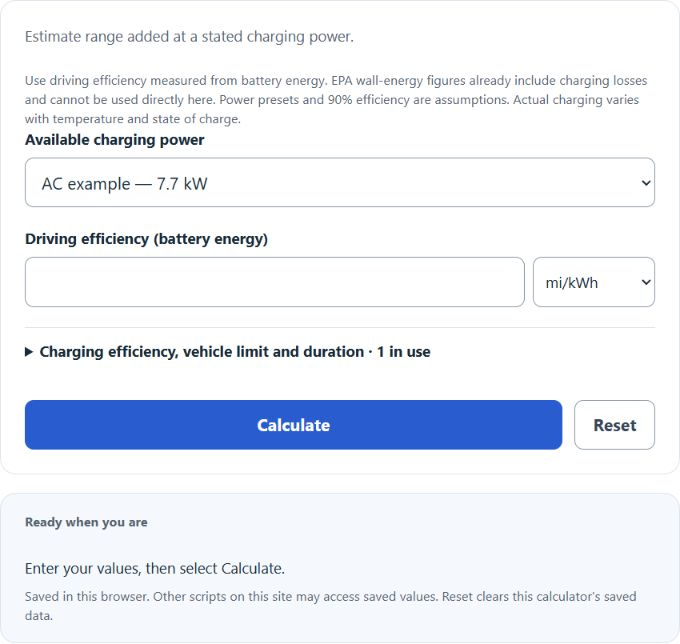
Use this EV charging speed calculator to estimate range added per hour or minute at a stated power, and optional totals over a duration. Enter battery-side driving efficiency, not an EPA wall-energy label that already includes charging losses.
EV Charging Speed Formula
Range added per hour equals battery power multiplied by battery-side distance per kWh. The calculator limits available input power to an optional vehicle limit of the same AC/DC type and measurement boundary, then applies an explicitly assumed input-to-battery efficiency. Charger ratings and vehicle limits are ceilings; use a supported average power to model a session.
Pb = min(P, Pcap) * e
 Range per hour = Pb * d
 Range per minute = Range per hour / 60
Variables:
- P is the charger power in kilowatts (kW)
- Pcap is the vehicle’s maximum charging power in kW; if left blank there is no cap
- e is the charging efficiency as a decimal, so 90 percent is 0.90
- Pb is the effective power delivered to the battery in kW
- d is the vehicle efficiency expressed as distance per kWh (mi/kWh or km/kWh)
- Range per hour is the driving range added for each hour of charging
If your efficiency is shown in another unit, convert it to distance per kWh first: from kWh per 100 miles, d = 100 / value; from watt-hours per mile, d = 1000 / value; the kilometer units convert the same way. The distance unit of the answer follows the unit you entered, so a mile-based efficiency returns miles per hour and a kilometer-based efficiency returns kilometers per hour.
Note that this is charging speed, not charge time. Charging speed tells you how much range you gain per hour; it does not tell you how many hours are needed to reach a target state of charge, which depends on your battery size and starting level.
Range Added Per Hour by Charger
This illustrative table assumes 3.5 battery-side mi/kWh, 90% input-to-battery efficiency and no vehicle limit. Its power settings and efficiency are scenarios, not guaranteed equipment performance. Results represent a constant rate at the stated power.
| Charger | Charger power | Power to battery | Miles per hour | Miles per 30 min |
|---|---|---|---|---|
| Level 1 (120V) | 1.4 kW | 1.26 kW | 4.4 | 2.2 |
| Level 2 (240V, 32A) | 7.7 kW | 6.93 kW | 24 | 12 |
| Level 2 (240V, 48A) | 11.5 kW | 10.35 kW | 36 | 18 |
| DC Fast | 50 kW | 45 kW | 158 | 79 |
| DC Fast | 150 kW | 135 kW | 473 | 236 |
The DC examples show rates at the stated input power. Actual acceptance depends on vehicle, temperature and state of charge and usually falls as charging progresses. The calculator does not predict a charging curve or cap totals by remaining battery space.
Example Problems
Example 1: Overnight Level 2 charging at home.
Assume 11.5 kW input, no lower vehicle limit, 3.5 battery-side mi/kWh and 90% input-to-battery efficiency. Battery power is 10.35 kW and range rate is 36.225 mi/h, or 0.60375 mi/min. Eight hours at that unchanged power would add 289.8 miles and 82.8 kWh, only if the battery has enough available space and charging does not taper or stop.
Example 2: A DC fast-charging stop.
Assume 150 kW input, 3.5 battery-side mi/kWh and an explicitly chosen 90% efficiency from that power boundary to stored battery energy. The modeled battery power is 135 kW and rate is 472.5 mi/h. Twenty minutes at that unchanged power would add 157.5 miles. This is not a prediction of an actual fast-charging stop; acceptance and losses vary.
Frequently Asked Questions
How many miles per hour does a Level 2 charger add?
At the same assumed 3.5 battery-side mi/kWh and 90% efficiency, 7.7 kW input gives 24.255 mi/h and 11.5 kW gives 36.225 mi/h, before any lower vehicle limit. Actual range per hour depends on both charging conditions and driving consumption.
Why is DC fast charging so much faster?
DC charging bypasses the vehicle’s onboard AC charger and can support higher power when the vehicle and station permit it. Check the vehicle’s separate AC and DC acceptance limits. A station rating alone does not establish the power the car will sustain.
Does charging speed stay constant?
Charging power can vary with battery state of charge, temperature and vehicle limits. DC charging usually slows as the battery fills. This calculator uses a constant input power and efficiency, so it describes the rate at those assumptions rather than a complete charging session.