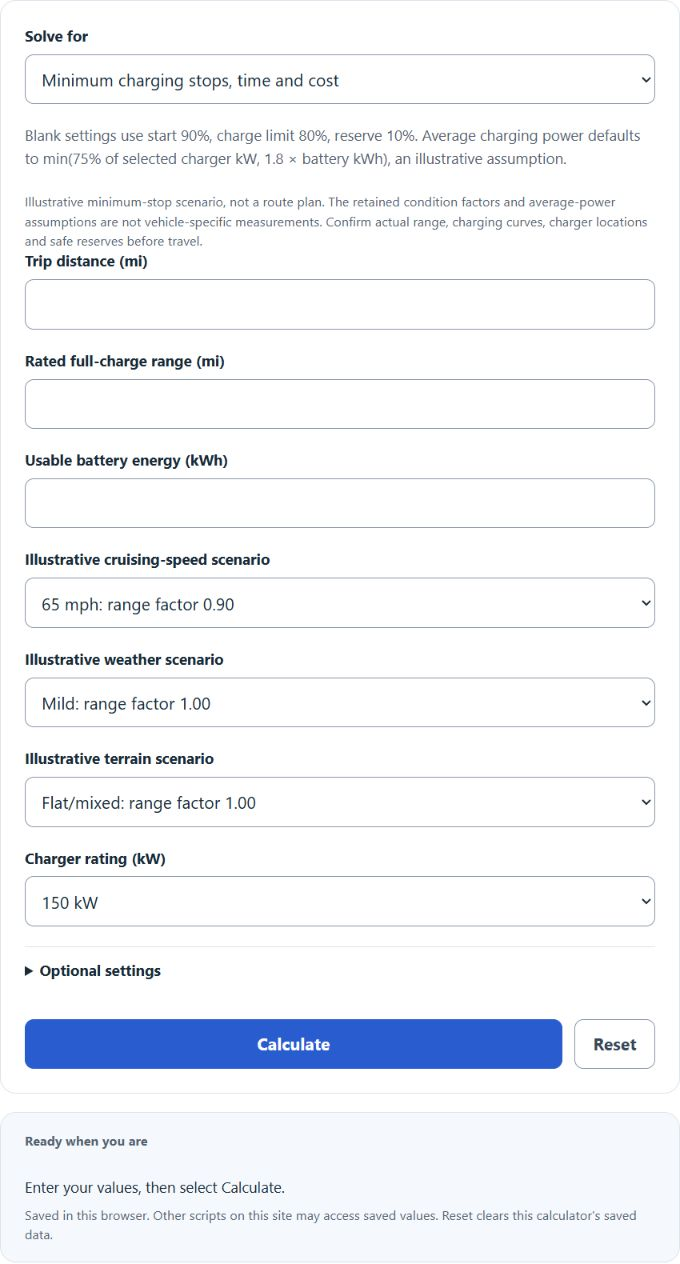
Calculate how many charging stops your EV road trip needs, plus charging time, total trip time, and cost, from your range, battery size, and charger speed.
EV Road Trip Charging Stops Formula
Stops = max(0, ceil((D - R*(S-B)/100) / (R*(C-B)/100)))
- D is the total trip distance (miles)
- R is modeled full-charge range, equal to rated range multiplied by the selected illustrative condition factors
- S is the starting charge (%)
- C is the charge level you charge to at each stop (%, typically 80)
- B is the reserve buffer you keep in the battery (%, typically 10)
The first term inside the formula, R*(S-B)/100, is the distance you can cover on your starting charge before dropping to the reserve buffer. Every later leg covers R*(C-B)/100 miles, assuming intermediate charging stops reach C percent. The final stop may add less energy so the trip ends at the reserve. The positive remaining distance divided by the leg distance, rounded up, is the theoretical minimum number of charging stops; otherwise no stop is needed. Chargers are assumed to be ideally located.
Charging time is estimated from the energy you add on the road:
Charging Time (min) = Minimum Energy Added (kWh) / Assumed Average kW * 60
By default, assumed average power is the lesser of 75% of charger rating and 1.8 times usable battery kWh. These inherited coefficients are illustrative assumptions, not universal charging-curve or vehicle-acceptance facts. Enter a vehicle-limited average-power override when known. Time excludes charging losses, detours, queues and connection overhead.
The calculator has two modes. The default mode applies the formulas above to your trip and returns stops, leg distances, charging time, total trip time, and optional on-road charging cost and a separately scoped whole-trip gas cost. Initial battery energy is excluded from the on-road EV figure, so these figures do not establish total-cost savings. The second mode solves the stops formula backward for R: you enter the trip distance and how many stops you are willing to make, and it returns the modeled range you need, plus the rated-range input implied by these assumptions in your selected conditions. That reverse mode is useful when choosing which EV or rental can handle a route.
Charging Stops by Trip Distance and Real-World Range
This table shows the number of charging stops the formula predicts for common trip lengths, assuming a 90 percent starting charge and charging from 10 to 80 percent at each stop. Find your modeled range, not your rated range, in the header row.
| Trip distance | 180 mi range | 220 mi range | 260 mi range | 300 mi range |
|---|---|---|---|---|
| 300 miles | 2 | 1 | 1 | 1 |
| 500 miles | 3 | 3 | 2 | 2 |
| 750 miles | 5 | 4 | 3 | 3 |
| 1000 miles | 7 | 6 | 5 | 4 |
For an illustrative scenario, multiply rated range by the assumed factors below. They are not validated vehicle-specific corrections. For example, a 300-mile rated EV driven at 70 to 75 mph in freezing weather has a modeled range of about 300 x 0.80 x 0.75 = 180 miles.
| Condition | Range factor |
|---|---|
| 55 to 60 mph | 1.00 |
| 65 mph | 0.90 |
| 70 to 75 mph | 0.80 |
| 80+ mph | 0.70 |
| Cold weather (30 to 50 F) | 0.85 |
| Freezing weather (below 30 F) | 0.75 |
| Hot weather with AC (above 90 F) | 0.90 |
| Hilly terrain | 0.92 |
| Mountainous terrain | 0.85 |
Example Problems
Example 1: How many stops for a 600-mile trip?
You are driving 600 miles in an EV with a 300-mile EPA rated range and a 75 kWh battery, starting at 90 percent charge, cruising at 70 to 75 mph in mild weather on flat terrain, and using 150 kW fast chargers.
Real-world range: 300 x 0.80 = 240 miles. First leg: 240 x (90 – 10)/100 = 192 miles. Each later leg: 240 x (80 – 10)/100 = 168 miles. Stops: ceil((600 – 192)/168) = ceil(2.43) = 3 stops. Efficiency is 240/75 = 3.2 mi/kWh, so the remaining 408 miles require about 127.5 kWh of charging. At an average of 112.5 kW (75 percent of 150 kW), that is about 68 minutes of total charging, or roughly 23 minutes per stop. With about 8 hours 13 minutes of driving, the full trip takes about 9 hours 21 minutes.
Example 2: What range do you need to make 500 miles with one stop?
Using the reverse mode, enter 500 miles, 1 stop, and a 100 percent starting charge. The required modeled range is 500 / ((100 – 10)/100 + 1 x (80 – 10)/100) = 500 / 1.6 = 312.5 miles. At 65 mph in mild weather, that corresponds to an EPA rated range of about 312.5 / 0.90 = 347 miles, under the selected assumptions. This does not establish route feasibility or recommend a particular vehicle.
Frequently Asked Questions
Why does the calculator charge to 80 percent instead of 100 percent?
Charging power varies with state of charge, battery temperature, vehicle and charger limits, and often tapers at higher charge. An 80% limit and 10% reserve are configurable scenario defaults, not a universal optimal strategy. Actual charger spacing and vehicle charging curves determine suitable limits.
How is this different from a route planner like A Better Routeplanner or in-car navigation?
Route planners pick specific charging stations along a mapped route. This calculator uses a simplified energy-budget scenario with distance, range, battery size and assumed condition factors. That makes it faster for feasibility questions, such as whether a trip needs two stops or three, how much time winter will add, or what range a rental EV needs. Use a route planner or your car’s navigation to choose the actual stations, since real stops land where chargers exist rather than at perfect intervals.
How much does winter change the number of stops?
The freezing-weather scenario assumes a 25% range reduction; actual cold-weather effects depend on vehicle, temperature and heating demand. For a 500-mile trip in an EV rated at 300 miles driven at 65 mph, the calculator predicts 2 stops in mild weather (270 miles of modeled range) but 3 stops with its freezing-weather factor (about 202.5 modeled miles). Preconditioning the cabin while plugged in, using seat heaters instead of cabin heat, and choosing a heat pump equipped EV all soften the penalty.