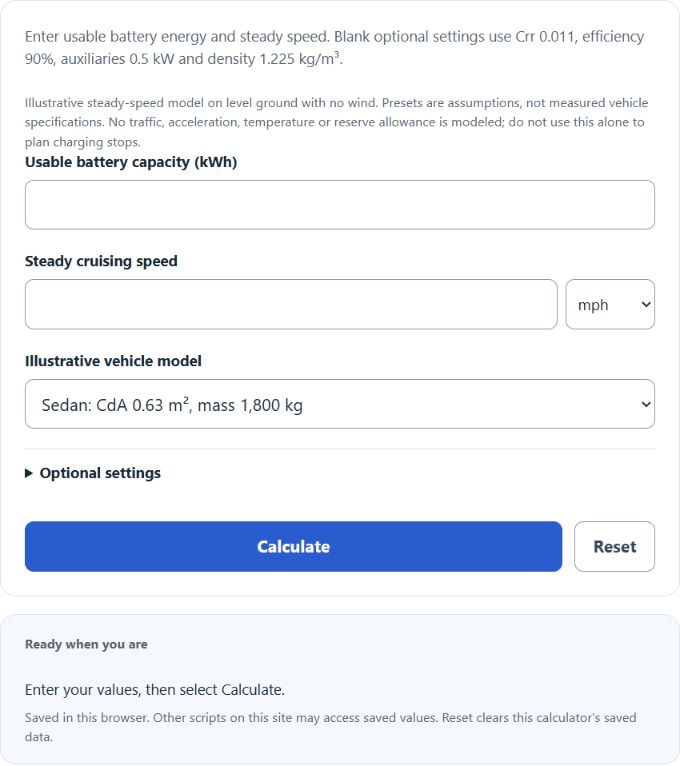
Calculate EV range at speed with this physics model. Enter battery size, cruising speed, and vehicle type to see how highway driving cuts your electric range.
EV Range at Speed Formula
The calculator estimates how far an electric car can travel at a chosen steady cruising speed by modeling the two forces it must overcome — aerodynamic drag and rolling resistance — and turning the power required into an energy consumption rate and a range. It starts with the aerodynamic drag force, which grows with the square of speed:
Fa = 0.5 * rho * CdA * v^2
Next it finds the rolling resistance force, which stays roughly constant with speed:
Fr = Crr * m * g
The mechanical power needed at the wheels is the total resisting force multiplied by speed. The power drawn from the battery adds drivetrain losses and the auxiliary or climate load:
Pw = (Fa + Fr) * v
 Pb = Pw / eff + Paux
In one hour of cruising the car covers a distance equal to its speed while drawing Pb watt-hours, so the consumption per unit distance and the total range are:
Wh/mi = Pb / speed_mph
 Range = (kWh * 1000) / (Wh/mi)
Variables:
- Fa is the aerodynamic drag force, in newtons
- rho is the air density; the default 1.225 kg/m3 is an illustrative standard-atmosphere assumption
- CdA is the drag area, the drag coefficient Cd multiplied by the frontal area A in square meters
- v is the cruising speed converted to meters per second
- Fr is the rolling resistance force, in newtons
- Crr is the rolling resistance coefficient; 0.011 is the illustrative model default
- m is the vehicle mass in kilograms and g is gravity, 9.81 m/s2
- Pw is the wheel power and Pb is the battery power, both in watts
- eff is the drivetrain efficiency as a fraction and Paux is the auxiliary or climate load in watts
- Range is the estimated distance on the usable battery capacity, entered in kWh; for km/h speeds the same formula uses Wh/km and returns kilometers
Pick an illustrative vehicle preset or choose Custom to enter your own Cd, frontal area and mass. The presets are model assumptions, not measured specifications. Drag power rises with the cube of steady speed, but acceleration, traffic and regenerative braking are outside this model.
Estimated Range vs Speed
This table shows the estimated consumption, range, and efficiency for a 60 kWh compact sedan (CdA 0.63, mass 1800 kg) using the default rolling resistance, 90 percent drivetrain efficiency, and a 0.5 kW auxiliary load. Use it as a quick reference for how much steady cruising speed changes range.
| Cruising speed | Consumption | Range | Efficiency |
|---|---|---|---|
| 45 mph | 185 Wh/mi | 324 mi | 5.40 mi/kWh |
| 55 mph | 221 Wh/mi | 271 mi | 4.52 mi/kWh |
| 65 mph | 266 Wh/mi | 226 mi | 3.76 mi/kWh |
| 75 mph | 319 Wh/mi | 188 mi | 3.14 mi/kWh |
| 85 mph | 379 Wh/mi | 158 mi | 2.64 mi/kWh |
Holding 45 mph instead of 85 mph roughly doubles the range of the same battery, because the energy spent fighting air drag climbs steeply with speed.
Example Problems
Example 1: Range for a 60 kWh sedan at 65 mph.
Convert the speed to meters per second: 65 x 0.44704 = 29.06 m/s. With CdA 0.63 and rho 1.225, the drag force is Fa = 0.5 x 1.225 x 0.63 x 29.06^2 = 326 N. The rolling force is Fr = 0.011 x 1800 x 9.81 = 194 N. Wheel power is Pw = (326 + 194) x 29.06 = 15,112 W, and battery power is Pb = 15,112 / 0.90 + 500 = 17,291 W, about 17.3 kW.
Consumption is 17,291 / 65 = 266 Wh/mi, so the range is 60,000 / 266 = 226 miles, an efficiency of 3.76 mi/kWh.
Example 2: The same car at 75 mph.
At 75 mph (33.53 m/s) the drag force rises to about 434 N while the rolling force stays at 194 N. Battery power climbs to roughly 23,900 W, so consumption is 319 Wh/mi and the range falls to 60,000 / 319 = 188 miles. Adding just 10 mph drops the range from 226 to 188 miles, a loss of about 38 miles, or roughly 17 percent.
Frequently Asked Questions
Why does EV range drop at high speed?
Aerodynamic drag rises with the square of speed, and the power needed to push through the air rises with the cube of speed. At city speeds most energy goes into rolling resistance and accelerating, but on the highway drag dominates. Going faster means the motor draws far more power for each mile, so the same battery covers fewer miles.
What speed gives the best EV range?
There is no universal best speed. Aerodynamic energy per distance grows with speed squared, while auxiliary energy per distance rises as speed falls. The balance depends on the vehicle and climate load; maximizing range also differs from minimizing total trip time. Drive within posted limits and safely for conditions rather than treating a model optimum as a road-speed recommendation.
How much range do you lose at 75 mph vs 65?
For the 60 kWh sedan modeled above, range falls from about 226 miles at 65 mph to about 188 miles at 75 mph, a loss of roughly 17 percent for a 10 mph increase. This is a result of the stated assumptions, not a measured range penalty for other electric cars.