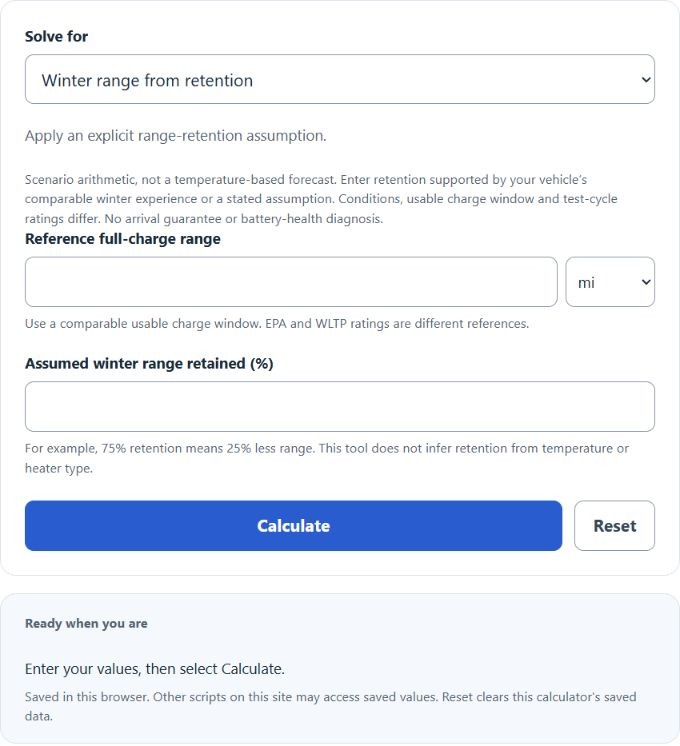
Calculate winter-range scenarios from an explicit retention assumption, estimate a reference range for a trip with a chosen reserve, or compare measured full-charge winter range with a reference. This tool does not predict retention from temperature or heater type.
EV Cold Weather Range Loss Formula
WR = R * RET
RR = D / (RET * (1 - B/100))
L = (R - A) / R * 100
- WR is the estimated winter range (miles or km)
- R is a positive full-charge reference range. EPA, WLTP and comparable measured references are different baselines.
- RET is the explicitly entered retention percentage divided by 100. No temperature coefficient, floor or condition multiplier is inferred.
- RR is the rated range required for a winter trip (miles or km)
- D is the winter trip distance (miles or km)
- B is the charge reserve buffer on arrival (%)
- L is your actual range loss (%), where A is the real range you get from a full charge in the cold
Winter-range mode multiplies the reference by the chosen retention fraction. Trip mode divides trip distance by retention and the usable fraction after the chosen arrival reserve, assuming departure at full usable charge and no charging stops. Measured-loss mode compares actual and reference full-charge range after unit conversion. It cannot isolate cold weather as the cause or diagnose whether a vehicle is performing normally. The former automatic temperature/heater slopes, condition multipliers and ±5% claim were unsupported and are not used.
Illustrative Retention Assumptions
The following percentages are arithmetic scenarios, not temperature-based predictions or a calibrated dataset. Columns A and B provide alternative retention assumptions and their corresponding loss. Choose retention using comparable vehicle experience or clearly state it as an assumption.
| Scenario | Assumption A retained (loss) | Assumption B retained (loss) |
|---|---|---|
| Scenario 1 | 92.5% (7.5%) | 89.8% (10.2%) |
| Scenario 2 | 83.5% (16.5%) | 77.6% (22.4%) |
| Scenario 3 | 77.5% (22.5%) | 69.4% (30.6%) |
| Scenario 4 | 72.5% (27.5%) | 62.6% (37.4%) |
| Scenario 5 | 67.5% (32.5%) | 55.8% (44.2%) |
| Scenario 6 | 62.5% (37.5%) | 49.0% (51.0%) |
The next table applies selected retention assumptions above to a 100-mile trip with an illustrative 15% arrival reserve. These conditional arithmetic results do not establish whether a vehicle can complete a real trip. The reserve is a user choice, not a validated safety margin.
| Scenario | Reference miles needed for 100-mile trip (A) | Reference miles needed for 100-mile trip (B) |
|---|---|---|
| Scenario 2 | 141 | 152 |
| Scenario 3 | 152 | 169 |
| Scenario 5 | 174 | 211 |
| Scenario 6 | 188 | 240 |
Example Problems
Example 1: Winter-range scenario. Enter 300 miles reference range and an assumed 77.5% retention. Scenario winter range is 300 × 0.775 = 232.5 miles. Range loss is 22.5%, or 67.5 miles. The 77.5% is an input assumption, not a prediction for a temperature or heater.
Example 2: Reference range for a trip. For a 120-mile trip, assumed 62.6% retention and 15% reserve, required reference range is 120 / (0.626 × 0.85) = 225.5215 miles. The result is conditional on those assumptions, full departure charge and no en-route charging. It does not guarantee arrival.
FAQ
Why can EV range change in cold weather? Cabin and battery heating consume energy, while battery thermal behavior, speed, road conditions and driving patterns also affect range. Their effects vary by vehicle and conditions. This calculator uses your retention assumption rather than assigning a universal temperature loss rate.
How much does a heat pump help? Heating technology can affect cold-weather energy use, but the effect depends on vehicle design, operating conditions and temperature. No universal heat-pump advantage or automatic range multiplier is asserted here. Use comparable observations or supported vehicle-specific information.
Does a winter-range comparison measure permanent battery degradation? No. A range comparison combines operating conditions and the selected reference; it cannot isolate permanent capacity loss. Plugged-in preconditioning can reduce battery energy spent on initial heating, but this tool assigns it no fixed percentage benefit. Use the vehicle manufacturer’s guidance for operation and battery condition.