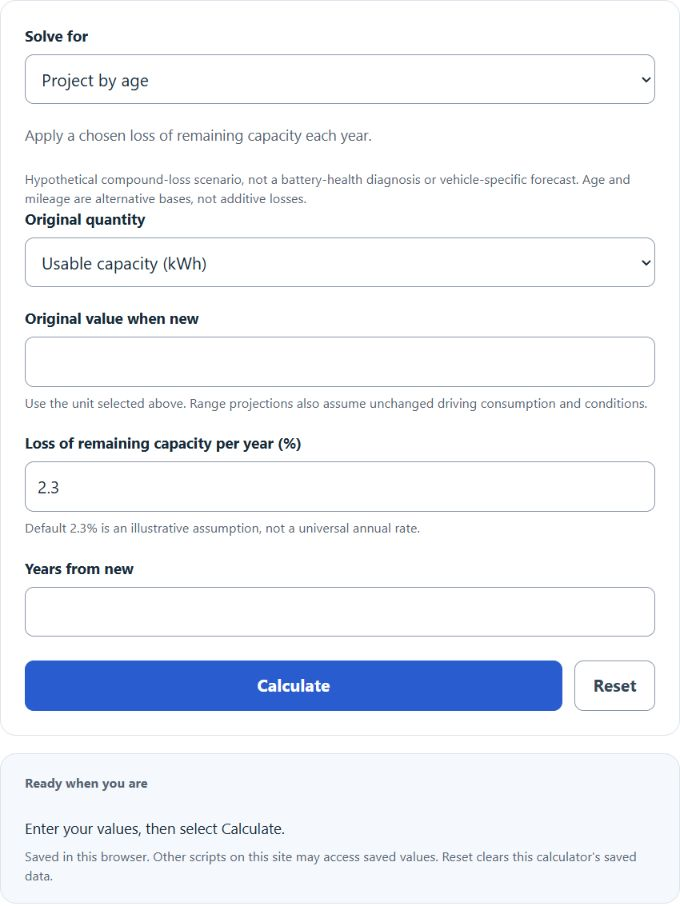
Explore hypothetical remaining usable capacity or driving range using a user-selected compound loss per year or per 10,000 miles. These scenarios do not predict an individual battery’s future or diagnose its state of health.
EV Battery Degradation Formula
The scenario applies a constant fractional loss of remaining capacity each period. It is an accounting model, not a fitted battery-aging model. The formula is:
Cap(t) = Cap0 * (1 - r)^t
For capacity inputs, projected state of health is remaining usable capacity divided by the comparable original usable capacity. For range inputs, this ratio is range retained and is not a direct health measurement:
SoH% = Cap(t) / Cap0 * 100
Variables:
- Cap(t) is the projected remaining capacity (or driving range) after t periods
- Cap0 is the original capacity or range when the battery was new
- r is the degradation rate expressed as a decimal fraction per period (for example a 2.3 percent annual rate is r = 0.023)
- t is the number of periods: the number of years in age mode, or miles divided by 10,000 in mileage mode
- SoH% is the state of health, the share of original capacity still available
A linear model removes r × t of the original capacity, while this compound model applies r to the remaining quantity each period. Neither generic curve is established as a universal battery-aging law. Actual calendar and cycling degradation depend on chemistry, temperature, state of charge, usage and prior history. This calculator treats age and mileage as alternative scenario bases, not independent losses to combine.
Enter the original figure either as capacity in kWh or as driving range in miles or kilometers, choose age or mileage mode, and the calculator returns the remaining capacity or range, the state of health percentage, and the amount lost at your chosen horizon.
Projected Capacity Retention by Year
This worked example assumes 2.3 percent loss of remaining capacity per year. It is an illustrative scenario, not a universal real-world average. The right column applies that assumed retention to a 75 kWh usable pack.
| Age (years) | Remaining capacity (%) | 75 kWh pack |
|---|---|---|
| 1 | 97.7% | 73.3 kWh |
| 2 | 95.5% | 71.6 kWh |
| 3 | 93.3% | 69.9 kWh |
| 5 | 89.0% | 66.8 kWh |
| 8 | 83.0% | 62.3 kWh |
| 10 | 79.2% | 59.4 kWh |
| 12 | 75.6% | 56.7 kWh |
| 15 | 70.5% | 52.9 kWh |
At the assumed 2.3 percent compound annual rate, retention reaches 70 percent after ln(0.70) / ln(0.977) ≈ 15.33 years. A modeled retention threshold is not a safety or warranty determination; terms differ by vehicle and market.
Example Problems
Example 1: Project remaining capacity by age.
A new EV has a 75 kWh battery and you assume 2.3 percent degradation per year. To see where it stands after 8 years, raise the retention factor to the eighth power:
Cap(8) = 75 * (1 – 0.023)^8 = 75 * 0.83014988 = 62.3 kWh. That is a state of health of about 83 percent, meaning roughly 12.7 kWh has been lost.
Example 2: Project remaining range by mileage.
Suppose a vehicle originally offered 250 miles of range and, purely as a scenario, retained 99 percent of its capacity per 10,000 miles. With unchanged consumption and conditions, after 60,000 miles the exponent is 60,000 / 10,000 = 6:
Range = 250 × 0.99^6 ≈ 235.37 miles, or 94.148 percent of the original range, with about 14.63 miles lost. Range retained alone is not a battery state-of-health measurement.
Frequently Asked Questions
How much do EV batteries degrade per year?
There is no universal yearly rate for an individual EV. Aging depends on chemistry, storage and cycling conditions, temperature, state of charge and usage history. The default is an illustrative scenario; comparable usable-capacity measurements are needed to estimate observed capacity retention.
How long until an EV battery hits 70%?
In the illustrative 2.3 percent compound annual scenario, 70 percent retention occurs at about 15.33 years. This does not establish when a particular battery will reach that level, whether it remains suitable for a use, or whether warranty coverage applies.
What speeds up battery degradation?
Temperature, state-of-charge history, charge and discharge rates, cycling and storage all affect aging; the relationships depend on the cell chemistry and system. Follow the vehicle manufacturer’s charging guidance rather than applying a universal state-of-charge or fast-charging rule. Temporary cold-weather range reduction is separate from permanent capacity degradation.