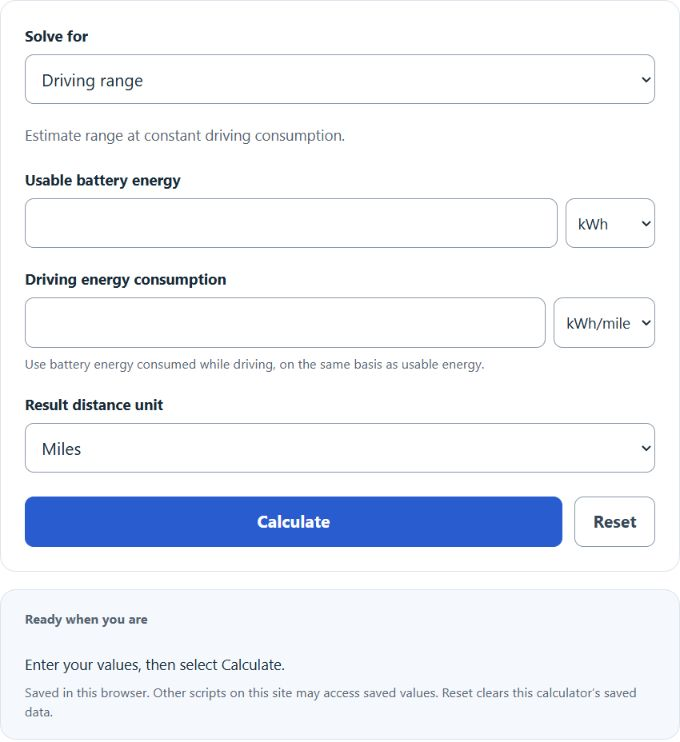
Calculate EV range, battery energy, or efficiency from two inputs in kWh, MJ, BTU, Wh/mile, Wh/km, miles, or kilometers with unit conversion.
EV Range Formula
The EV range calculator uses battery energy and energy consumption efficiency to estimate driving range. The base units used in the calculation are kilowatt-hours for battery energy, kilowatt-hours per mile for efficiency, and miles for range.
- R = EV range
- E = usable battery energy
- C = energy consumption efficiency
To calculate battery energy when range and efficiency are known:
To calculate efficiency when battery energy and range are known:
- Battery energy is the amount of electrical energy available, usually entered in kWh. The calculator also accepts MJ and IT Btu and converts them to kWh.
- Efficiency is the energy used per unit of distance. Lower values mean the vehicle uses less energy to travel the same distance.
- EV range is the estimated distance the vehicle can travel using the entered battery energy and efficiency.
Choose the value to solve for, enter the two required quantities, and select Calculate. Use usable battery energy and driving consumption on the same energy basis; wall-energy ratings include charging losses and should not be combined directly with battery energy.
Illustrative EV Consumption Values
Driving consumption depends on the vehicle and conditions. The following values are illustrative inputs, not validated vehicle-category ratings; use your vehicle’s measured driving consumption when available.
| Illustrative condition | Illustrative consumption | Same value in kWh/mile |
|---|---|---|
| Lower consumption | 220 to 280 Wh/mile | 0.220 to 0.280 kWh/mile |
| Moderate consumption | 280 to 350 Wh/mile | 0.280 to 0.350 kWh/mile |
| Higher consumption | 400 to 600 Wh/mile | 0.400 to 0.600 kWh/mile |
| Cold weather or highway driving | Consumption may increase | Higher kWh/mile means shorter range |
Battery Energy and Estimated Range
This table shows estimated range for common battery sizes at different consumption rates.
| Battery energy | At 0.25 kWh/mile | At 0.30 kWh/mile | At 0.40 kWh/mile |
|---|---|---|---|
| 40 kWh | 160 miles | 133.3 miles | 100 miles |
| 60 kWh | 240 miles | 200 miles | 150 miles |
| 75 kWh | 300 miles | 250 miles | 187.5 miles |
| 100 kWh | 400 miles | 333.3 miles | 250 miles |
EV Range Calculation Examples
Example 1: Calculate EV range
You have a 75 kWh battery and the vehicle uses 0.30 kWh per mile.
The estimated EV range is 250 miles.
Example 2: Calculate required battery energy
You want 300 miles of range, and the vehicle uses 280 Wh per mile.
First convert 280 Wh/mile to kWh/mile:
Then calculate battery energy:
You need about 84 kWh of usable battery energy.
FAQ
What is the difference between battery capacity and usable battery energy?
Battery capacity is often the total size of the battery pack. Usable battery energy is the portion available for driving. EVs usually reserve some energy at the top and bottom of the pack to protect battery life. For a more realistic range estimate, enter usable battery energy if you know it.
Why does real EV range differ from the calculated range?
The calculation assumes a constant efficiency value. Real range changes with speed, outside temperature, cabin heating or cooling, elevation, tire pressure, cargo weight, wind, and driving style. Highway driving and cold weather usually reduce range because energy use per mile increases.
Is a lower kWh per mile value better?
Yes. A lower kWh/mile or Wh/mile value means the EV uses less energy to travel one mile. For the same battery energy, lower consumption gives a longer estimated range.