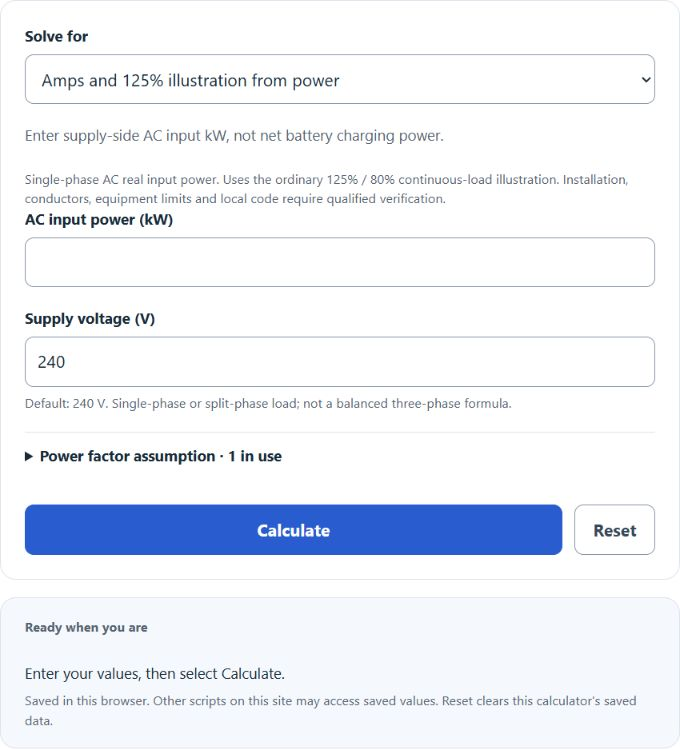
Convert single-phase AC input kW, voltage and current, and explore the ordinary 125% / 80% continuous-load arithmetic. This is an illustration, not an installation design or code-compliance approval.
EV Charging Amps Formula
For single-phase AC, real input power is voltage × current × power factor. With unity power factor, current is kW × 1000 / voltage. This is a power relationship, not Ohm’s resistance law. Use supply-side AC input kW rather than net battery charging kW; a balanced three-phase system needs a different formula:
I = P * 1000 / V
For an ordinary continuous-load illustration, multiply configured current by 1.25. Manufacturer instructions show, for example, 48 A charging paired with a 60 A circuit for the North American Gen 3 Wall Connector. The correct installation also depends on equipment listing, settings, load management and locally adopted requirements; arithmetic alone does not establish suitability:
Breaker >= 1.25 * I
The inverse of the illustrated 1.25 factor is 0.8. This gives a modeled current limit and single-phase real input power, using the selected power factor:
I(max) = 0.8 * Breaker
 P = V * I / 1000
Variables:
- I is the continuous charging current, in amps (A)
- P is single-phase real AC input power in kilowatts; the displayed simple formula assumes unity power factor
- V is the supply voltage, in volts (typically 120, 208, or 240 V)
- Breaker is the circuit breaker rating, rounded up to a standard size (15, 20, 30, 40, 50, 60, 70, 80, 90, or 100 A)
- 1.25 and its inverse 0.8 are the ordinary continuous-load arithmetic illustrated here; equipment listings and locally adopted requirements must be checked separately
Power mode gives continuous input amps and the 125% arithmetic. Breaker mode applies the ordinary 80% relationship; current mode applies 125% directly. The next value in the displayed reference list is informational, not a recommended installation. Custom positive voltages are accepted. No conductor gauge is inferred from breaker rating alone.
Common Level 2 EV Charger Circuits
These illustrative 240 V single-phase, unity-power-factor examples pair continuous current with approximate AC input power and 125% arithmetic. They do not account for site wiring, equipment listings or local requirements; have a qualified electrician verify an installation.
| Charger current | Voltage | Charger power | 125% illustration |
|---|---|---|---|
| 16 A | 240 V | 3.8 kW | 20 A |
| 24 A | 240 V | 5.8 kW | 30 A |
| 32 A | 240 V | 7.7 kW | 40 A |
| 40 A | 240 V | 9.6 kW | 50 A |
| 48 A | 240 V | 11.5 kW | 60 A |
Example Problems
Example 1: Size the circuit for a charger by power.
You have an 11.5 kW charger on a 240 V home circuit. First find the continuous current:
At unity power factor, I = 11.5 × 1000 / 240 ≈ 47.9167 A. Multiplying the unrounded current by 1.25 gives about 59.8958 A; the next value in this calculator’s reference list is 60 A. This arithmetic does not authorize rounding a configured equipment current or choosing a circuit without installation checks.
Example 2: Find the maximum charger for an existing breaker.
You already have a 50 A breaker on a 240 V circuit and want to know the biggest charger it can run. A continuous load may use 80 percent of the breaker:
I(max) = 0.8 * 50 = 40 A, and P = 240 * 40 / 1000 = 9.6 kW. So the 50 A breaker supports a charger drawing up to 40 A, or about 9.6 kW.
Frequently Asked Questions
What size breaker do I need for a 48-amp EV charger?
In the ordinary 125% illustration, 48 × 1.25 = 60 A. Tesla’s North American Gen 3 Wall Connector instructions show 48 A maximum output with a 60 A circuit. Verify the particular equipment, wire, terminals, installation method and locally adopted requirements with a qualified electrician.
Why can a charger only use 80 percent of the breaker rating?
The 80% relationship is the inverse of 125%: 1 / 1.25 = 0.8. It is used here as the ordinary continuous-load illustration, not a universal approval rule for every assembly or installation. Listings, equipment settings, managed loads and adopted code requirements must be checked separately.
What voltage do home EV chargers use?
Most home Level 2 chargers run on a 240 V circuit, the same type used for an electric range or dryer. Basic Level 1 charging uses a standard 120 V outlet but is much slower. Commercial and multi-family installations often use 208 V, which delivers slightly less power than 240 V at the same current.