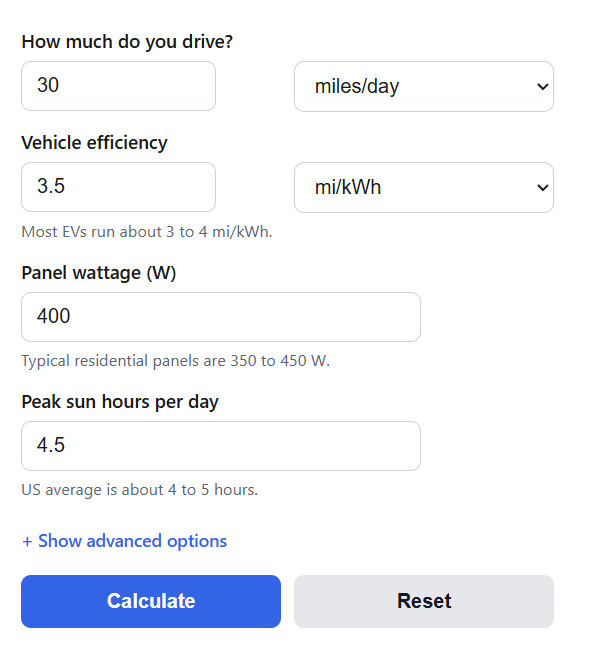
Use this solar panels to charge an EV calculator to find how many panels and how large a solar array in kW you need to power your car’s charging from the sun.
Solar Panels to Charge an EV Formula
The calculator sizes a solar array in three steps. First it works out how much energy the system must generate each day to charge the car, including charging losses:
Eev = (M * Em) / Ce
Next it finds how much energy a single panel produces on an average day, after system losses:
Ep = (Pw / 1000) * Sh * PR
Then it divides the two and rounds up to a whole number of panels, and converts that to an array size in kilowatts:
N = ceil( Eev / Ep )
 A = N * Pw / 1000
Variables:
- Eev is the daily solar energy the system must generate to charge the EV, in kWh
- M is the distance driven per day, in miles or km (weekly and yearly amounts are converted to a daily average)
- Em is the energy the car uses per unit of distance, in kWh per mile or per km (the reciprocal of an efficiency in mi/kWh)
- Ce is the charging efficiency as a decimal, such as 0.90 for 90 percent
- Ep is the energy one panel produces per day, in kWh
- Pw is the panel wattage, in watts
- Sh is the peak sun hours per day for your location, typically 4 to 5 in the US
- PR is the performance ratio, equal to 1 minus the system losses (0.80 for 20 percent losses)
- N is the number of panels, rounded up to the next whole panel
- A is the total array size, in kW
Enter your driving amount and its period at the top, then your vehicle efficiency, panel wattage, and peak sun hours. Open the advanced options if you want to change the system losses or charging efficiency. The result shows the number of panels, the array size in kW, the daily energy the EV needs, the energy each panel makes per day, and the total daily output of the array.
Panels Needed by Daily Miles
This table shows the panels and array size for common daily driving distances, assuming 3.5 mi/kWh efficiency, 400 W panels, 4.5 peak sun hours, a performance ratio of 0.80, and 90 percent charging efficiency. Use it as a quick reference before you enter your own numbers.
| Daily driving | Daily kWh needed | Panels needed | Array size |
|---|---|---|---|
| 20 miles/day | 6.35 kWh | 5 | 2.0 kW |
| 30 miles/day | 9.52 kWh | 7 | 2.8 kW |
| 40 miles/day | 12.70 kWh | 9 | 3.6 kW |
| 50 miles/day | 15.87 kWh | 12 | 4.8 kW |
Fewer panels are needed in sunny regions with more peak sun hours, and more are needed where sun hours are lower or where the car is less efficient.
Example Problems
Example 1: A typical commuter.
You drive 30 miles per day in an EV that gets 3.5 mi/kWh, using 400 W panels with 4.5 peak sun hours, 20 percent system losses, and 90 percent charging efficiency.
Energy per mile is 1 / 3.5 = 0.286 kWh, so the car uses about 30 * 0.286 = 8.57 kWh at the battery. Dividing by 0.90 charging efficiency gives Eev = 9.52 kWh of solar to generate. Each panel makes Ep = (400 / 1000) * 4.5 * 0.80 = 1.44 kWh per day. Then N = ceil(9.52 / 1.44) = ceil(6.61) = 7 panels, an array of 7 * 400 / 1000 = 2.8 kW.
Example 2: A higher-mileage driver with larger weekly distance.
You drive 250 miles per week (about 35.7 miles per day) in an EV that gets 3.0 mi/kWh, using 350 W panels with 5 peak sun hours and the same losses and charging efficiency.
Energy per mile is 1 / 3.0 = 0.333 kWh, so daily use is 35.7 * 0.333 = 11.90 kWh at the battery, and Eev = 11.90 / 0.90 = 13.23 kWh. Each panel makes Ep = (350 / 1000) * 5 * 0.80 = 1.40 kWh. Then N = ceil(13.23 / 1.40) = ceil(9.45) = 10 panels, an array of 10 * 350 / 1000 = 3.5 kW.
Frequently Asked Questions
How many solar panels does it take to charge an EV?
For an average driver covering about 30 miles a day in a car that gets 3.5 mi/kWh, roughly 7 standard 400 W panels, or about a 2.8 kW array, cover the charging over a year in a location with 4.5 peak sun hours. The exact number depends on how far you drive, how efficient the car is, your panel wattage, and how much sun your roof gets, which is why the calculator lets you enter all of those.
Can I charge my EV directly from solar?
You can, but panels only produce while the sun is up, so direct daytime charging works best if the car is home during the day or you have a charger that follows the available solar output. Most owners instead let the panels feed the home and grid during the day and charge the car whenever it is parked, using net metering or a home battery to bridge the timing gap.
Do I need a battery to charge my EV with solar?
No. A grid-tied system without a battery can still cover your driving on an annual basis by exporting surplus solar during the day and pulling power back at night, as long as your utility offers net metering. A home battery adds resilience and lets you charge on stored solar after dark, but it is not required for the panel counts this calculator produces.