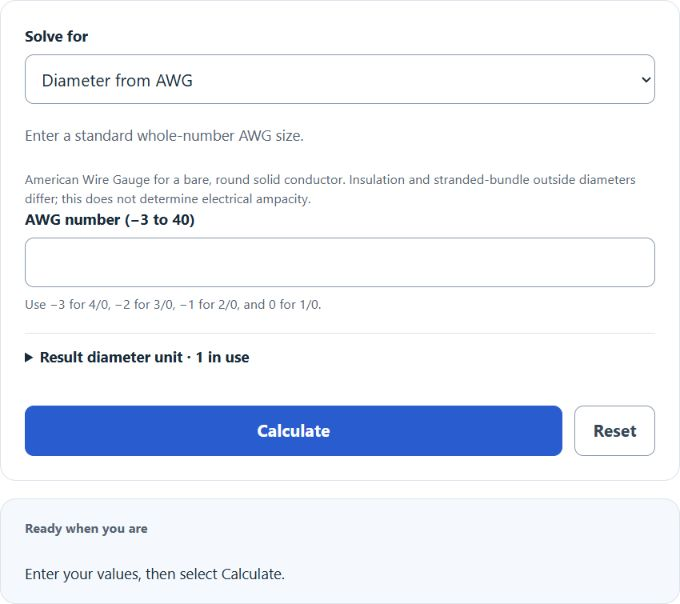
Convert American Wire Gauge to bare solid-wire diameter, or reverse a measured diameter to decimal AWG, with millimeters, inches, mils, cross-sectional area and circular mils. Standard comparisons cover 4/0 through 40 AWG and use distance on the logarithmic gauge scale.
- gauge to decimal Converter
- amp to gauge Converter
- Gauge To Inches Calculator
- Mm To Fraction Calculator
- All Unit Converters
Gauge to Diameter Formula
The American Wire Gauge system defines wire diameter on a logarithmic scale. The following formulas are used to convert a gauge value into its approximate diameter in millimeters or inches.
Variables:
- dmm is the wire diameter in millimeters
- din is the wire diameter in inches
- G is the American Wire Gauge (AWG) number
To calculate the wire diameter, substitute the gauge number into the formula. A smaller AWG value produces a larger diameter, while a larger AWG value produces a smaller diameter.
Because the AWG scale is geometric, equal changes in gauge create the same percentage change in diameter. Each step changes diameter by a factor of 921/39, and 36 AWG is defined as 0.127 mm (0.005 in).
What is Gauge to Diameter Conversion?
Gauge to diameter conversion is the process of turning an American Wire Gauge number into a physical wire size. In the AWG system, a smaller gauge number means a thicker wire, which is the opposite of how direct measurements such as millimeters or inches work.
This geometric conversion helps compare bare solid-wire sizes and manufacturer data. It does not determine ampacity, insulation thickness, stranded-bundle outside diameter, or installation suitability. Using the standard AWG formula lets you quickly find the corresponding wire diameter without looking up a large reference table.
How to Calculate Gauge to Diameter?
The following steps outline how to calculate the wire diameter from a gauge value.
- First, determine the American Wire Gauge value G.
- Next, choose whether you want the diameter in millimeters or inches.
- Substitute the gauge value into the appropriate formula: d(mm) ≈ 0.127 × 92(36 − G)/39 or d(in) ≈ 0.005 × 92(36 − G)/39.
- Evaluate the expression to find the approximate wire diameter.
- After inserting the values and calculating the result, check your answer with the calculator above.
Example Problem:
Use the following example to test your understanding of the conversion.
Gauge (G) = 12
Diameter = 2.053 mm = 0.0808 in
Gauge to Diameter Conversion Table
The table below shows approximate diameters for several common AWG sizes using the standard formulas above.
| Gauge (AWG) | Diameter (mm) | Diameter (in) |
|---|---|---|
| 8 | 3.264 mm | 0.1285 in |
| 10 | 2.588 mm | 0.1019 in |
| 12 | 2.053 mm | 0.0808 in |
| 14 | 1.628 mm | 0.0641 in |
| 16 | 1.291 mm | 0.0508 in |
| 18 | 1.024 mm | 0.0403 in |
| 20 | 0.813 mm | 0.0320 in |
Published AWG tables may show different rounding. The inverse uses the same logarithmic definition; diameters outside the 4/0–40 comparison range are explicitly identified, and an endpoint is not presented as a matching size. Understanding the formula makes it easier to estimate wire size and compare gauge values with real-world measurements.