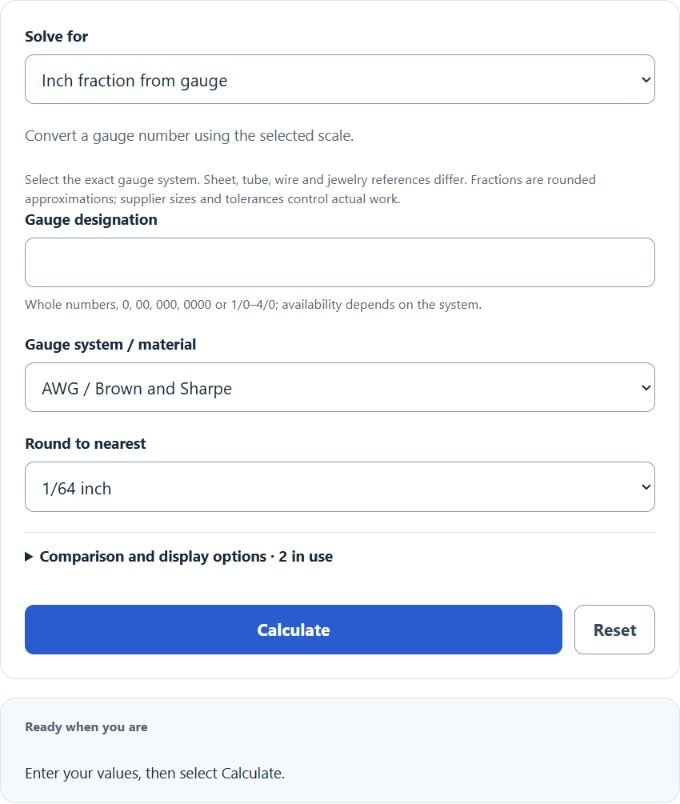
Convert a listed AWG, sheet steel, stainless, galvanized, BWG or common nominal jewelry gauge to a rounded inch fraction, or find the nearest listed gauge from a dimension. Systems are separate references; supplier dimensions and tolerances may differ.
- All Unit Converters
- Mixed Fraction Calculator – Add, Subtract, Simplify
- Yardage Calculator: How Much Fabric Do I Need?
- Surface Speed (SFM) Calculator
- Tip Speed Calculator
- RPM to Angular Velocity Calculator
- mph to rpm Converter
Gauge to Fraction Formula
American Wire Gauge follows the geometric formula below. Other systems use separate nominal lookup tables; common jewelry sizes use a discrete supplier-dependent millimeter reference. All systems then use the same inch-fraction rounding step.
Variables:
- din is the wire diameter in inches
- dmm is the wire diameter in millimeters
- n is the AWG gauge number
- D is the chosen fraction denominator, such as 16, 32, or 64
- f is the rounded fractional inch value
Choose the exact gauge system, then obtain the dimension from the AWG equation or that system’s listed table. Convert inches to millimeters as needed and round to the selected fraction. The result includes the signed rounding difference; very small positive dimensions are identified below half a rounding step rather than displayed as an exact zero.
What is Gauge to Fraction Conversion?
Gauge to fraction conversion is the process of taking an American Wire Gauge size and expressing the wire diameter in more familiar forms, including decimal inches, millimeters, and fractional inches. This is useful when comparing wire sizes with drawings, drill references, shop measurements, and general specifications that use inch fractions instead of AWG numbers.
Because AWG sizes are based on a geometric scale, each step in gauge changes the wire diameter by a constant ratio rather than by a fixed linear amount. Once the decimal diameter is known, it can be rounded to a practical inch fraction for quick reference.
How to Calculate Gauge to Fraction?
The following steps outline how to calculate the gauge to fraction conversion.
- First, select the exact gauge system and enter a listed whole gauge designation; do not silently round a fractional gauge number.
- For AWG, calculate diameter with d (in) = 0.005 × 92(36 − n)/39; for other systems, use their listed nominal table values.
- Convert the result to millimeters by multiplying the inch diameter by 25.4.
- Choose a fraction denominator such as 16, 32, or 64.
- Finally, round the decimal inch value to the nearest fraction using round(d × D) / D.
- After calculating the result, check your answer with the calculator above.
Example Problem:
Use the following values as an example problem to test your knowledge.
Gauge (AWG) = 12
Fraction Denominator (D) = 64
Diameter in Inches ≈ 0.0808
Diameter in Millimeters ≈ 2.0525
Nearest Fraction ≈ 5/64 in
Gauge to Fraction Conversion Table
The table below lists common AWG sizes, their approximate diameters in inches and millimeters, and the nearest inch fraction when rounded to the nearest 1/64 inch.
| Gauge (AWG) | Diameter (in) | Diameter (mm) | Nearest Inch Fraction (1/64 in) |
|---|---|---|---|
| 10 | 0.102 | 2.59 | 7/64 in |
| 12 | 0.081 | 2.05 | 5/64 in |
| 14 | 0.064 | 1.63 | 1/16 in |
| 16 | 0.051 | 1.29 | 3/64 in |
| 18 | 0.040 | 1.02 | 3/64 in |
In practice, engineers, technicians, and fabricators often move between decimal inches, millimeters, and fractional inches when reading specifications and comparing component sizes. Converting AWG to a fractional inch format makes those references easier to interpret in everyday use.