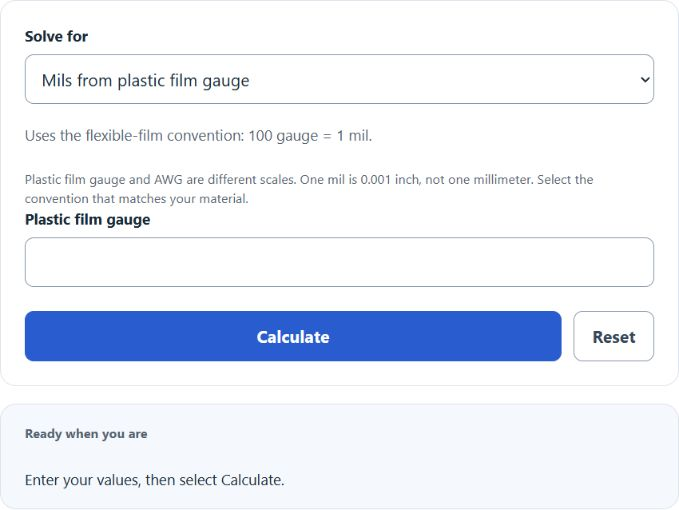
Convert plastic film gauge to mils and back using 100 gauge = 1 mil, or select the separate AWG wire task. The converter also reports inches, millimeters and micrometers; these gauge conventions are not interchangeable.
- All Unit Converters
- mm To Thousandths Calculator
- Ear Gauge to mm Converter
- GSM To mm Calculator
- Blow Up Ratio Calculator
Gauge to Mil Formula
For flexible plastic film, mils = film gauge / 100 and film gauge = mils × 100. For example, 400 film gauge = 4 mil = 101.6 µm. The separate AWG wire tasks use the following geometric formulas; wire gauge does not use the film rule.
Variables:
- G is the AWG gauge number
- d(in) is the wire diameter in inches
- mils is the wire diameter in thousandths of an inch
To calculate the diameter in mils, first determine the wire diameter in inches from the AWG equation, then multiply the inch value by 1000.
What is Gauge to Mil Conversion?
Gauge to mil conversion requires identifying the material’s gauge convention first. Plastic film commonly uses 100 gauge per mil; AWG describes bare solid-wire diameter geometrically. One mil equals 0.001 inch, 0.0254 mm, or 25.4 µm. Because AWG is a logarithmic system, each change in gauge corresponds to a constant ratio in wire diameter rather than a fixed linear difference. Lower AWG numbers indicate thicker wires, while higher AWG numbers indicate thinner wires.
These dimensional conversions help compare supplier specifications. AWG output is a bare solid-wire geometric reference and does not determine ampacity, insulation thickness or stranded-bundle outside diameter. Converting between them makes it easier to compare charts, data sheets, and installation requirements.
How to Calculate Gauge to Mils?
The following steps outline how to convert an AWG gauge number into mils.
- First, determine the AWG gauge number G.
- Next, calculate the wire diameter in inches using the formula d(in) = 0.005 × 92(36 − G) / 39.
- Then, convert the diameter in inches to mils using mils = d(in) × 1000.
- After inserting the values and calculating the result, check your answer with the calculator above.
Example Problem:
Use the following value as an example problem to test your knowledge.
Gauge Number (G) = 10
Diameter in Inches = 0.1019 in
Diameter in Mils = 101.9 mils
Gauge to Mil Conversion Table
The following table lists example conversions for several common wire sizes using the standard AWG relationship.
| Gauge (AWG) | Diameter (mils) | Diameter (inches) |
|---|---|---|
| 10 | 101.9 mils | 0.1019 in |
| 12 | 80.8 mils | 0.0808 in |
| 14 | 64.1 mils | 0.0641 in |
| 16 | 50.8 mils | 0.0508 in |
| 18 | 40.3 mils | 0.0403 in |
| 20 | 32.0 mils | 0.0320 in |
For example, a 10 AWG wire has a diameter of about 0.1019 inches. Multiplying that value by 1000 gives approximately 101.9 mils. The same wire diameter can also be expressed in millimeters by multiplying the inch value by 25.4.
Understanding this relationship is useful whenever wire sizing data is presented in different forms. Knowing the AWG equation allows you to move easily between gauge, inches, mils, and millimeters.