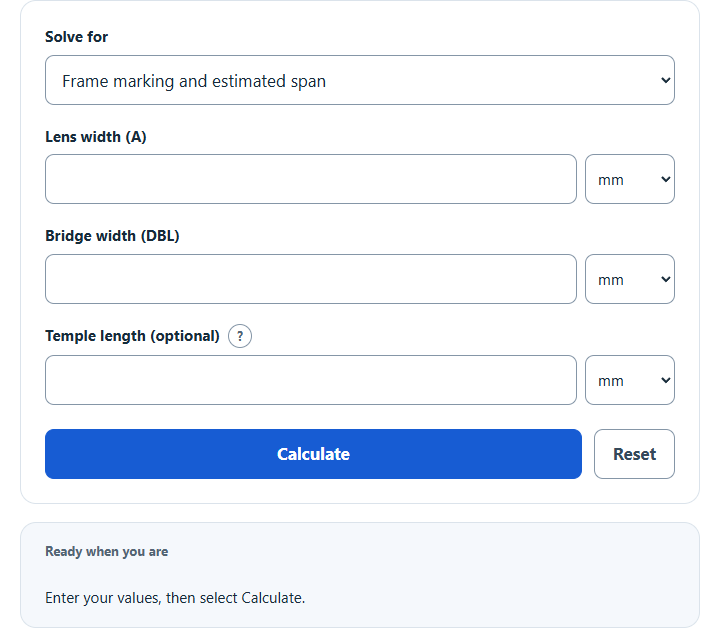
Find your glasses frame size from the arm numbers: lens width, bridge and temple length give the frame marking and estimated span in mm or inches.
- Every Day Life And Education Calculators
- Lens Thickness Calculator
- Spherical Equivalent Calculator
- Plus to Minus Cyl Calculator
- Minus Cyl to Plus Calculator
- Diopter Distance Calculator
Glasses Frame Size Formula
Eyeglass “frame size” is typically reported as three separate measurements (lens width–bridge width–temple length), not as a single averaged number. If you want a quick estimate of the total front width from the marked lens and bridge measurements, a common rule of thumb is:
Variables:
- TFW is the estimated total front width across the frame front (mm)
- A is the lens width (mm)
- DBL is the bridge width (distance between lenses) (mm)
- Temple length is reported separately as part of the size marking (for example, 52–18–140) and does not determine the front width
To estimate total front width, double the lens width and add the bridge width. This is only an approximation because real frames include additional width at the endpieces/hinges that is not captured by the lens and bridge numbers alone.
What is a Glasses Frame Size?
A glasses frame size refers to the specific measurements that determine the fit of the eyeglasses on the wearer’s face. It typically includes three main dimensions: lens width (the width of one lens), bridge width (the distance between the two lenses), and temple length (the length of the arm piece). These measurements help compare frames, but do not guarantee comfort or optical fit. The calculator’s lens-width size bands are rough labels rather than standardized brand sizes.
Finding Your Size Without Current Glasses
If you do not have glasses to measure, start by comparing the frame front with your face at the temples. Look for a similar overall width, then check that the bridge is comfortable, the arms do not press against your head, and your eyes sit near the centers of the lenses. See Warby Parker’s frame-fit guide for these checks. Trying frames on or having an optician help is more useful than choosing from a single width alone.
Face width cannot uniquely determine lens width, bridge width or temple length. The calculator’s 2A + DBL span leaves out rims, hinges and endpieces; do not enter face width as that span to obtain a recommended lens size. Compare the manufacturer’s measured overall width separately. This measurement guide explains the difference between arm markings and overall frame width.
Pupillary distance measures pupil spacing, not face width. It helps position lenses but does not replace a frame fitting. Small, medium and large labels also vary between brands and frame styles.
How to Calculate Glasses Frame Size?
The following steps outline how to calculate the Glasses Frame Size.
- First, determine the lens width (A) in millimeters (mm).
- Next, determine the bridge width (DBL) in millimeters (mm).
- Next, determine the temple length (TL) in millimeters (mm).
- Write the frame size as a three-part marking: A–DBL–TL (for example, 52–18–140).
- If you need an estimated total front width, calculate TFW ≈ 2A + DBL (a rule of thumb that can differ from the manufacturer’s actual front width).
- Choose the solve mode and enter the required lengths in millimeters or inches. Review the marking and approximate dimension notes; for the inverse modes, use the same estimated span 2A + DBL rather than an overall frame measurement that includes endpieces.
Example Problem:
Use the following variables as an example problem to test your knowledge.
lens width (A) = 50 mm
bridge width (DBL) = 20 mm
temple length (TL) = 140 mm. The marking is 50 □ 20 – 140, and the estimated span is 2 × 50 + 20 = 120 mm. Actual overall front width can differ.