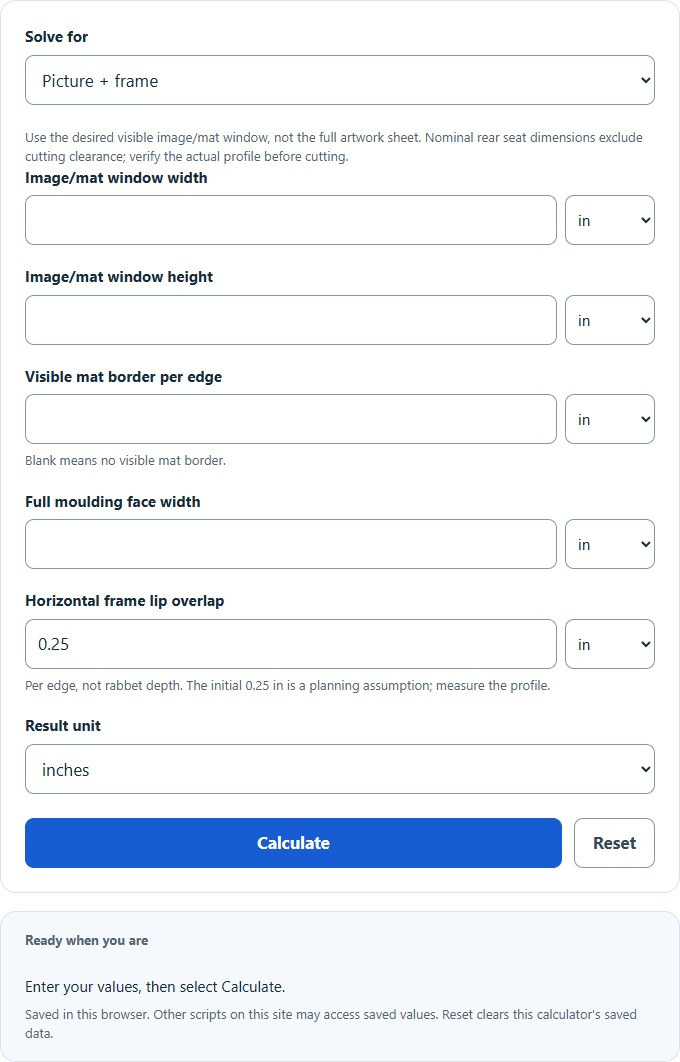
Calculate picture frame moulding length from picture size, mat width, or outer frame dimensions, and get a 45° cut list in chosen units.
- Every Day Life And Education Calculators
- Picture Spacing Calculator
- Price Per Frame Calculator
- Pixels to Inches Calculator
- Label Size Calculator
- Window Area Calculator
- Framing Calculator
Picture Frame Perimeter Formula
The perimeter of a rectangular frame is twice the sum of its outside height and outside width. The calculator uses three formulas depending on which measurements you have.
Picture + frame mode:
Outer frame mode:
Existing frame mat mode (perimeter plus visible mat):
- P = total moulding length (outside perimeter)
- H = desired visible image/mat-window height, not the full artwork sheet
- W = desired visible image/mat-window width, not the full artwork sheet
- m = visible mat width on each side
- f = moulding face width
- Ho = outside frame height
- Wo = outside frame width
- mat_tb = visible mat margin on top and bottom
- mat_lr = visible mat margin on left and right
Assumptions: a rectangular frame with 45-degree miters, uniform full moulding face width, and equal mat borders on opposing sides. Inputs H and W describe the desired visible image/mat window. The front sight opening is the window plus twice the visible mat border; the outside is the sight opening plus twice the full face width. Horizontal lip overlap per edge adds to the sight opening to estimate the nominal rear seat for the mat, cover and backing. It is not rabbet depth. This zero-clearance geometry is not an exact glass/backing cut size: measure the actual seat and follow the material and supplier fitting allowance. The 1.10 × P stock figure is only an illustration, not a guarantee that 10% covers kerf, trim, defects or stock layout.
Use Picture + frame to design around a desired visible image opening and mat border. A real artwork sheet must extend beyond a mat window to be retained; that artwork-to-mat overlap is separate and is not calculated here. With no mat, the frame lip covers the artwork edge. Use Outer frame for the perimeter and long-point cut list from known outside dimensions. Use Existing frame mat for visible left/right and top/bottom borders around a chosen image window, plus nominal rear seat dimensions.
Reference Tables
Example visible opening sizes, outside dimensions and geometric moulding totals with a 1-inch face frame and no visible mat border. The 10% stock illustration is rounded to the nearest 0.1 ft; it is not a purchase cut plan:
| Picture size (in) | Outer frame (in) | Moulding length (in) | 10% stock illustration (ft) |
|---|---|---|---|
| 4 × 6 | 6 × 8 | 28 | 2.6 |
| 5 × 7 | 7 × 9 | 32 | 2.9 |
| 8 × 10 | 10 × 12 | 44 | 4.0 |
| 11 × 14 | 13 × 16 | 58 | 5.3 |
| 16 × 20 | 18 × 22 | 80 | 7.3 |
| 18 × 24 | 20 × 26 | 92 | 8.4 |
| 24 × 36 | 26 × 38 | 128 | 11.7 |
Illustrative visible mat borders by desired image-window size. These are style examples, not minimum technical requirements:
| Picture size | Narrow example | Middle example | Wide example |
|---|---|---|---|
| Up to 5 × 7 | 1.5 in | 2 in | 2.5 in |
| 8 × 10 to 11 × 14 | 2 in | 2.5 in | 3 in |
| 16 × 20 to 18 × 24 | 2.5 in | 3 in | 4 in |
| 24 × 36 and larger | 3 in | 4 in | 5 in |
Example and Common Questions
Worked example. You want an 11 × 14 visible image opening, a 2-inch visible mat border on every side, and chose a moulding with a 1.25-inch face. Outer height = 14 + 2(2) + 2(1.25) = 20.5 in. Outer width = 11 + 2(2) + 2(1.25) = 17.5 in. Perimeter = 2 × (20.5 + 17.5) = 76 in. Buy at least 76 × 1.10 ≈ 83.6 in, or about 7 ft of moulding.
Why add 10 percent for waste? The 10% figure is a planning illustration, not a validated universal waste factor. Actual needs depend on blade kerf, trim, defects, profile, available stick lengths and the cutting arrangement. Plan those cuts before ordering stock.
Should I measure the picture or the frame? For a new design, choose the desired visible image window and mat borders. For an existing frame, measure the full outside size and face width to estimate the sight opening. Before ordering cover or backing, measure the actual rear seat directly and obtain the required fitting clearance; the materials may need different allowances.
What is the rabbet? The rabbet is the rear recess that holds the cover, mat, artwork and backing. Its horizontal lip overlap reduces the front sight opening; its depth controls the stack thickness. Profiles differ. Enter the measured horizontal overlap, and verify depth and fitting clearances separately.
How do the 45-degree cuts work? Each piece of moulding is cut with 45-degree miters at both ends. The long point to long point measurement on the outside of each piece equals the outer height or outer width of the finished frame. You need two pieces at the outer height and two pieces at the outer width.
Does this work for square frames? Yes. Enter the same value for height and width. The perimeter is simply 4 × side length.
Measurement references: American Frame measuring guide, framing glossary, and FrameTek fitting instructions. These distinguish visible windows, nominal frame seats and material-specific cutting allowances.