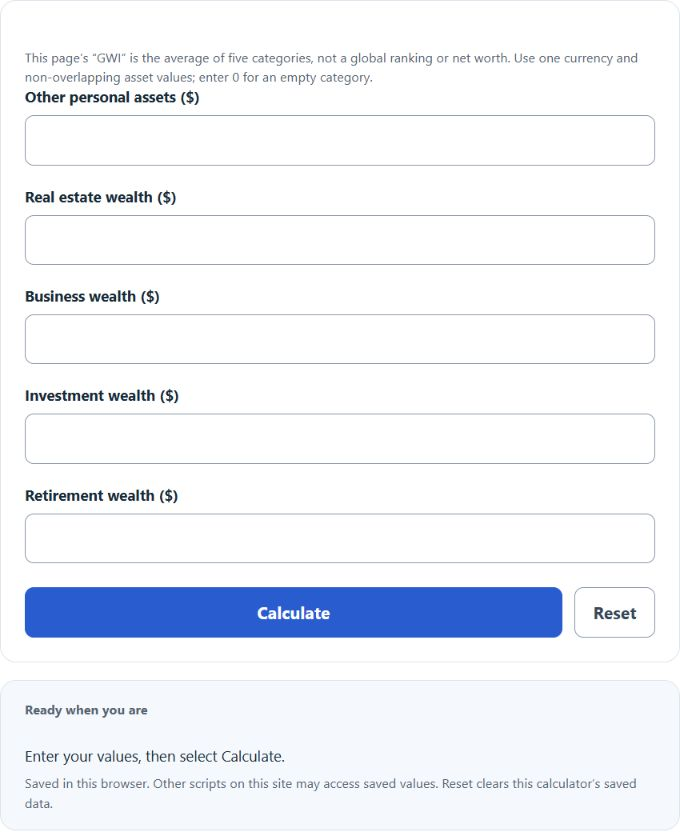
Calculate your Global Wealth Index by averaging other personal assets, real estate, business, investment, and retirement wealth values.
Related Calculators
- Human Capital Index Calculator
- Money Supply Calculator
- Total Equity Calculator
- Excess Reserves Calculator
- All Business Calculators
Global Wealth Index Formula
The “Global Wealth Index” (GWI) used on this page is a site-defined arithmetic average of five wealth categories, not a validated global ranking or percentile. It tells you the average value per category, not your total wealth and not your debt-adjusted net worth.
- A = other personal assets
- B = real estate wealth
- C = business wealth
- D = investment wealth
- E = retirement wealth
If you want to see the full amount being averaged, first calculate the total tracked wealth:
Then divide by 5:
How to Calculate the Global Wealth Index
- Estimate the value of your other personal assets that are not already included elsewhere.
- Determine the value of your real estate wealth.
- Estimate your business wealth, if any.
- Total your investment wealth held outside retirement accounts.
- Total your retirement wealth.
- Add all five amounts together.
- Divide the sum by 5 to get the Global Wealth Index.
For a clean result, use the same currency for every input and keep categories non-overlapping so the same asset is not counted twice.
How to Interpret the Result
- Higher GWI means a higher average amount across the five categories.
- Equal weighting matters: each category affects the result the same way, even if one category is much more important to your actual financial position.
- Zero-value categories reduce the average, because the formula always divides by 5.
- GWI summarizes the total: dividing the same total by five always gives the same average. It does not measure the balance or diversification of categories and does not replace net worth.
Example Calculation
| Category | Amount |
|---|---|
| Other Personal Assets | $80,000 |
| Real Estate Wealth | $320,000 |
| Business Wealth | $150,000 |
| Investment Wealth | $210,000 |
| Retirement Wealth | $140,000 |
Total tracked wealth:
Global Wealth Index:
In this case, the average value across the five categories is $180,000.
What to Include in Each Category
- Other personal assets: cash, vehicles, collectibles, jewelry, precious metals, art, and other personal holdings not already counted in another category.
- Real estate wealth: homes, rental properties, land, or your ownership stake in real property.
- Business wealth: the estimated value of a business you fully or partially own.
- Investment wealth: stocks, bonds, mutual funds, ETFs, brokerage balances, and similar non-retirement investments.
- Retirement wealth: 401(k)s, IRAs, pensions with an account value, and other retirement-focused assets.
Common Input Mistakes
- Double-counting assets, such as listing the same brokerage holdings in both investment and retirement categories.
- Mixing currencies, which makes the average meaningless.
- Using inconsistent valuation methods, such as gross property value in one category and equity value in another.
- Forgetting liabilities: this calculator does not subtract debts unless you reduce the category values before entering them.
- Comparing GWI to income: GWI is an asset-based average, not an earnings measure.
GWI vs. Total Wealth vs. Net Worth
These three numbers answer different questions:
- Global Wealth Index: What is the average amount across my five categories?
- Total tracked wealth: How much do these five categories add up to?
- Net worth: What do I own after subtracting liabilities?
Here, NW is net worth, T is total tracked wealth, and L is total liabilities. To calculate net worth, subtract liabilities from consistently valued assets. GWI summarizes the category total but cannot measure the balance of those categories.
When This Calculator Is Most Useful
- Reviewing your personal balance sheet at regular intervals
- Tracking how your wealth mix changes over time
- Comparing category growth year over year
- Creating a simple summary number for personal planning
- Reviewing the separate category values for concentration; the average alone cannot reveal it
Frequently Asked Questions
- Is the Global Wealth Index the same as net worth?
- No. Net worth subtracts liabilities. GWI is only the average of the five entered wealth categories.
- Can I enter zero for a category I do not have?
- Yes. If you do not own assets in one category, enter 0. Keep in mind that zero still affects the average because every category is weighted equally.
- Should I use market value or equity?
- Use a method consistently. If you want a debt-aware view, equity is often more meaningful because liabilities are not automatically removed by the formula.
- Do all inputs need to use dollars?
- No. Any currency works as long as all five fields use the same one.
- What does a rising GWI over time mean?
- It means the total of the five entered category values is increasing. It does not establish greater diversification; growth may be concentrated in one category.