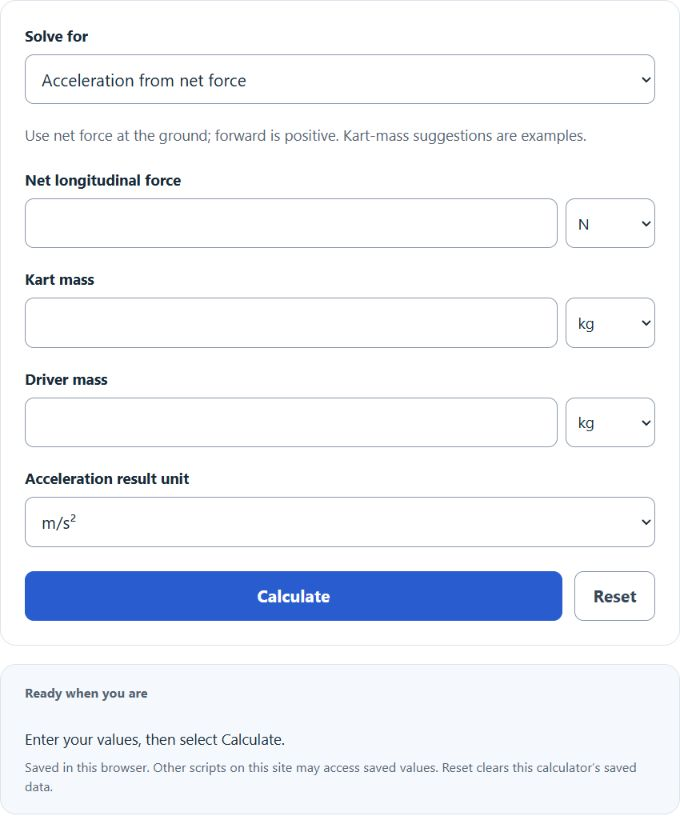
Calculate go-kart acceleration from net longitudinal force, kart and driver mass, or use idealized traction and torque models. Grip, tire and efficiency presets are illustrative assumptions; actual performance also depends on driven-wheel load, resistance and drivetrain behavior.
- All Automotive Calculators
- All Acceleration Calculators
- Motorcycle Acceleration Calculator
- Truck Acceleration Calculator
Go-Kart Acceleration Formula
The following equation is used to calculate the Go Kart Acceleration.
- Where A is the Go Kart Acceleration (m/s^2)
- Fgk is the net longitudinal force acting on the kart and driver (N), after opposing forces such as drag and rolling resistance.
- mgk is the mass of the go-kart (kg)
- md is the mass of the driver (kg)
To calculate go-kart acceleration, divide net longitudinal force by the combined kart and driver mass. The traction mode uses the ideal flat-ground upper bound a = μg, assuming all normal load is available at driven tires. Torque mode uses engine torque × rear/drive teeth × efficiency, divided by tire radius and total mass; it excludes wheelspin, resistance and rotational inertia.
What are the units for Go-Kart Acceleration?
The most common units for Go Kart Acceleration are m/s^2.
How to Calculate Go-Kart Acceleration?
Example Problem:
The following example problem outlines the steps and information needed to calculate the Go Kart Acceleration.
First, determine the net longitudinal force. In this example, the net force is 1000 N.
Next, determine the mass of the go-kart. For this problem, the mass of the go-kart is measured to be 150 (kg).
Next, determine the mass of the driver. In this case, the mass of the driver is found to be 80 (kg).
Finally, calculate the Go Kart Acceleration using the formula above:
A = Fgk / (mgk + md)
Inserting the values from above and solving the equation with the imputed values gives:
A = 1000 / (150 + 80) ≈ 4.3478 m/s², rounded to four decimal places.
FAQ
What factors can affect the acceleration of a go-kart?
The acceleration of a go-kart can be affected by several factors including the power of the engine, the total weight of the go-kart and driver, the condition of the track, tire grip, and aerodynamic drag. Modifications to the engine to increase power, reducing the weight of the go-kart, and optimizing tire and aerodynamic performance can all contribute to improved acceleration.
How does the weight of the driver influence go-kart performance?
For the same net force, a heavier driver increases total mass and reduces acceleration. Driver weight also affects load distribution and rolling resistance, but mass alone does not determine top speed; gearing, available power, drag and other resistance matter.
Can the type of engine in a go-kart affect its acceleration?
Yes, the type of engine in a go-kart can greatly affect its acceleration. Engines with higher power output and torque can provide greater force, leading to quicker acceleration. Electric engines, for example, can deliver instant torque, offering potentially faster acceleration compared to traditional internal combustion engines. The choice of engine will depend on the specific requirements of the go-kart, including the type of racing or riding it is designed for.