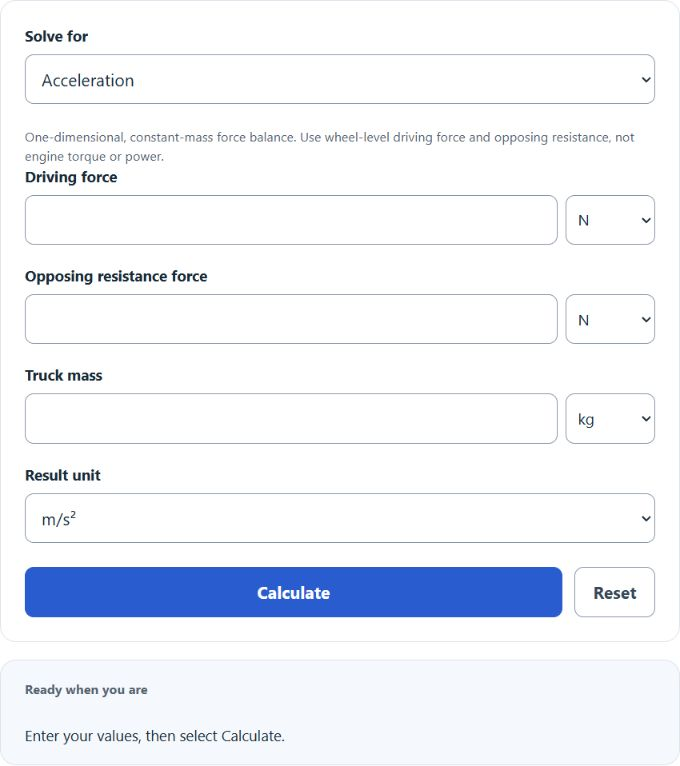
Choose acceleration, driving force, resistance or mass to solve for, then enter the three displayed quantities and select a result unit.
- All Automotive Calculators
- All Acceleration Calculators
- Piston Acceleration Calculator
- Motorcycle Acceleration Calculator
- Go Kart Acceleration Calculator
Truck Acceleration Formula
The truck acceleration calculator uses Newton’s second law. The net force on the truck is the engine force minus the drag force, and acceleration is net force divided by mass.
- a = acceleration of the truck
- F_e = force generated by the engine
- F_d = force of drag
- m = mass of the truck
When Acceleration is selected, the calculator uses:
When Driving force is selected, the calculator rearranges the formula to:
When Opposing resistance force is selected, the calculator uses:
When Truck mass is selected, the calculator uses:
The calculator converts all inputs to base SI units before solving: newtons for force, kilograms for mass, and meters per second squared for acceleration. It then converts the result back to the unit you selected.
Illustrative Truck Mass and Acceleration Inputs
These ranges are illustrative inputs, not verified typical masses or performance limits. Actual mass and acceleration require vehicle-specific data, load, wheel-level driving force and all opposing forces.
| Truck Type | Illustrative mass range | Notes |
|---|---|---|
| Pickup truck | 1,800 to 3,200 kg | Varies by cab, bed, drivetrain, and payload. |
| Box truck | 4,000 to 12,000 kg | Mass changes significantly with cargo. |
| Loaded semi truck | 25,000 to 36,000 kg | A fully loaded tractor-trailer can be much slower to accelerate. |
| Acceleration | Equivalent | General Interpretation |
|---|---|---|
| 0.5 m/s² | 1.64 ft/s² | Forward velocity changes by 0.5 m/s each second if acceleration stays constant. |
| 1.5 m/s² | 4.92 ft/s² | Forward velocity changes by 1.5 m/s each second if acceleration stays constant. |
| 3.0 m/s² | 9.84 ft/s² | Forward velocity changes by 3 m/s each second if acceleration stays constant. |
Example Problems
Example 1: Calculate truck acceleration
You have an engine force of 40,000 N, a drag force of 5,000 N, and a truck mass of 10,000 kg.
The truck acceleration is 3.5 m/s².
Example 2: Calculate required engine force
You want a 12,000 kg truck to accelerate at 2.0 m/s² while drag force is 6,000 N.
The required engine force is 30,000 N.
FAQ
What does drag force mean in this calculator?
Drag force is the opposing force acting against the truck’s motion. In a simple model, this can represent air resistance or any resistance force you want to subtract from the engine force. The calculator treats drag as a force that reduces the net forward force.
Why would the acceleration result be negative?
Acceleration becomes negative when the drag force is greater than the engine force. In the formula, that makes F_e – F_d negative. A negative result is acceleration opposite the chosen forward direction. It means slowing only while the truck is moving forward.
What units should you use?
You can use N or lbf for force, kg or lb for mass, and m/s² or ft/s² for acceleration. The calculator converts the values internally before solving. For the most direct physics calculation, use newtons, kilograms, and meters per second squared.