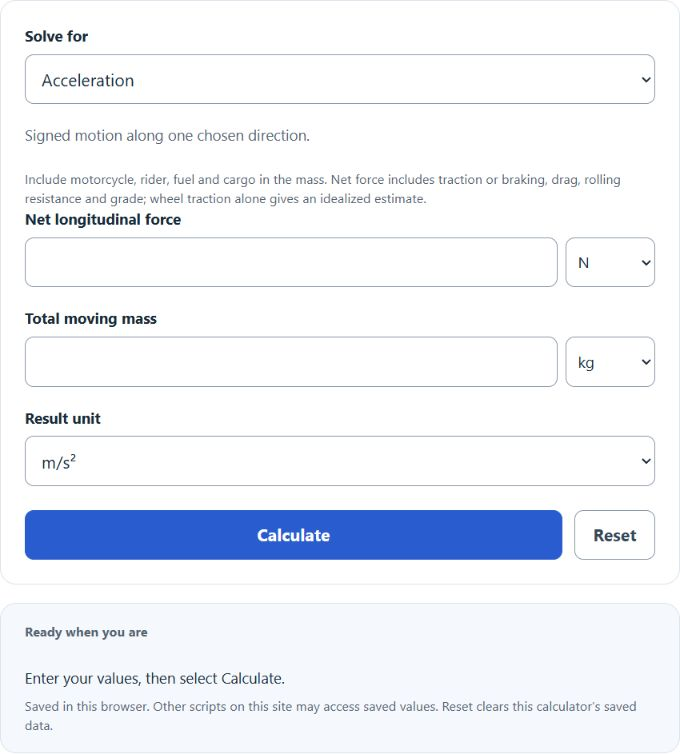
Calculate motorcycle acceleration, force, or mass from any two values, with unit conversions between N, lbf, kg, lb, m/s², and ft/s².
- All Automotive Calculators
- All Acceleration Calculators
- Truck Acceleration Calculator
- Piston Acceleration Calculator
Motorcycle Acceleration Formula
The motorcycle acceleration calculator uses Newton’s second law of motion. Choose acceleration, net force or total moving mass and enter the two known values.
- F = net longitudinal external force, in newtons (N)
- m = total moving mass of motorcycle, rider, fuel and cargo, in kilograms (kg)
- a = motorcycle acceleration, in meters per second squared (m/s²)
The calculator converts your selected units to base units before calculating. Force is converted to newtons, mass is converted to kilograms, and acceleration is converted to meters per second squared. After the calculation, the result is converted back to the unit you selected.
- To calculate force: enter mass and acceleration. The calculator uses F = m × a.
- To calculate mass: enter force and acceleration. The calculator uses m = F ÷ a.
- To calculate acceleration: enter force and mass. The calculator uses a = F ÷ m.
Common Motorcycle Acceleration Reference Values
Use these values as rough reference points. Actual acceleration depends on rider weight, traction, gearing, engine output, aerodynamics, road grade, and drivetrain losses.
| Acceleration | Equivalent in ft/s² | Approximate meaning |
|---|---|---|
| 1 m/s² | 3.28 ft/s² | Gentle acceleration |
| 2 m/s² | 6.56 ft/s² | Moderate street acceleration |
| 4 m/s² | 13.12 ft/s² | Strong acceleration |
| 6 m/s² | 19.69 ft/s² | Very hard acceleration with good traction |
| 9.81 m/s² | 32.17 ft/s² | 1 g of acceleration |
Unit Conversion Values Used
| Quantity | Conversion |
|---|---|
| Force | 1 lbf = 4.4482216152605 N |
| Mass | 1 lb = 0.45359237 kg |
| Acceleration | 1 ft/s² = 0.3048 m/s² |
Example Calculations
Example 1: Calculate motorcycle acceleration
You have a total moving mass of 250 kg and net longitudinal force of 1,000 N.
The motorcycle acceleration is 4 m/s².
Example 2: Calculate wheel force
You have a total moving mass of 600 lb and an acceleration of 10 ft/s².
First convert to base units:
Then calculate force:
The required wheel force is about 829.53 N, or about 186.49 lbf.
FAQs
Does motorcycle mass include the rider?
For a realistic acceleration estimate, use the total moving mass. That means the motorcycle, rider, fuel, luggage, and any added equipment. If you use only the motorcycle’s listed curb weight, the calculated acceleration will be higher than what you would usually get on the road.
Is wheel force the same as engine force?
No. The calculator uses net external force along the motion direction. Wheel traction is only one contribution; subtract resistance and account for road grade. Wheel force depends on engine torque, gear ratio, final drive ratio, drivetrain losses, and tire radius. If you only know engine torque, you need additional drivetrain information before using this calculator accurately.
Why does the result differ from real-world acceleration?
The formula uses net external force and total moving mass. If wheel traction alone is supplied, the result ignores air resistance, rolling resistance and grade. Tire slip, gear changes and drivetrain losses also affect the available traction. At higher speeds, aerodynamic drag becomes much more important, so actual acceleration may be lower than the calculated value.