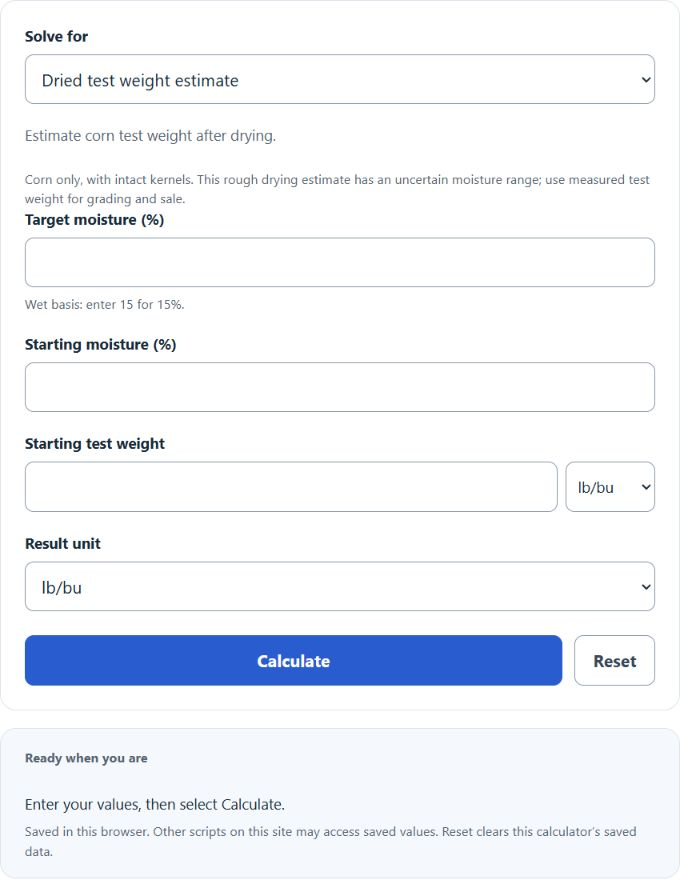
Estimate corn test weight after drying, or solve a model inverse. Choose the result you need and enter the known values in lb/bu or kg/bu. This rough estimate assumes intact corn kernels; use measured test weight for grading and sale.
- All Construction Calculators
- All Weight Calculators
- Grain Bin Capacity Calculator
- Moisture Content Calculator
- Drying Rate Calculator
Grain Test Weight Formula
This calculator uses the rough corn drying estimate reported by Purdue Extension. It assumes intact kernels. Its applicable moisture range is uncertain, and kernel damage, packing and drying conditions affect actual test weight. It does not standardize different grain types or replace a measured grade.
Choose lb/bu or kg/bu for each test-weight input and the result. The calculator converts mass units using 1 lb = 0.45359237 kg exactly; the same standard volumetric bushel is used throughout.
| Variable | Meaning | Typical Input |
|---|---|---|
| GTW | Estimated corn test weight after drying | lb/bu or kg/bu |
| TW | Test weight measured at the wet moisture content | lb/bu or kg/bu |
| W | Wet moisture content | % |
| D | Dry or target moisture content | % |
What the Calculator Does
Test weight measures mass per standard bushel volume. Corn kernels may shrink and pack more closely as they dry, increasing test weight. This calculator estimates that increase under the stated model; a water-only mass-shrink calculation is a different quantity. The algebraic moisture inverses describe the model and do not measure actual moisture.
How to Calculate Grain Test Weight
- Select the result to estimate, usually dried test weight, then enter the target moisture content as a percentage.
- Enter the wet moisture content as a percentage.
- Enter the test weight at wet moisture content.
- Select Calculate to view the estimate and its limitations.
For the calculation to be meaningful, moisture values should be entered as percentages such as 15 for 15% and 25 for 25%, not as decimals like 0.15 or 0.25.
Example
If the wet test weight is 50 lb/bu, the wet moisture content is 25%, and the target dry moisture content is 15%, then:
The model estimates 56.67 lb/bu for corn after drying. This is not a guaranteed measured test weight.
Why Moisture Adjustment Matters
- Model comparison: estimate the effect of drying intact corn under the stated assumption.
- Drying discussion: use the estimate alongside measured moisture, grain condition and test weight.
- Quality review: use actual measurements for grading, sale and final quality decisions.
- Operational estimates: the moisture-only model cannot account for kernel damage or drying temperature.
Practical Notes
- Keep units consistent from start to finish.
- Use accurate moisture readings; small moisture errors can change the result.
- This calculator is best used for estimation and comparison, not as a substitute for formal grading procedures.
- If D = W, the adjusted test weight equals the original test weight.
Common Input Mistakes
- Entering moisture as a decimal instead of a percentage.
- Mixing lb/bu and kg/bu in the same problem.
- Swapping the wet and dry moisture values.
- Using test weight values that were not measured on the same grain lot.
Frequently Asked Questions
Is grain test weight the same as moisture content?
No. Moisture content measures water in the grain, while test weight measures how much a standard volume of grain weighs.
Will the calculator convert between lb/bu and kg/bu?
Yes. Select lb/bu or kg/bu for each applicable input and result.
Can this be used for different grain types?
No. This rough estimate is for corn with intact kernels; no general moisture-only prediction for other grains is supplied.
Do I need all four values?
No. Select the solve mode and enter the three required values. A moisture inverse is only the value implied by the approximate model.