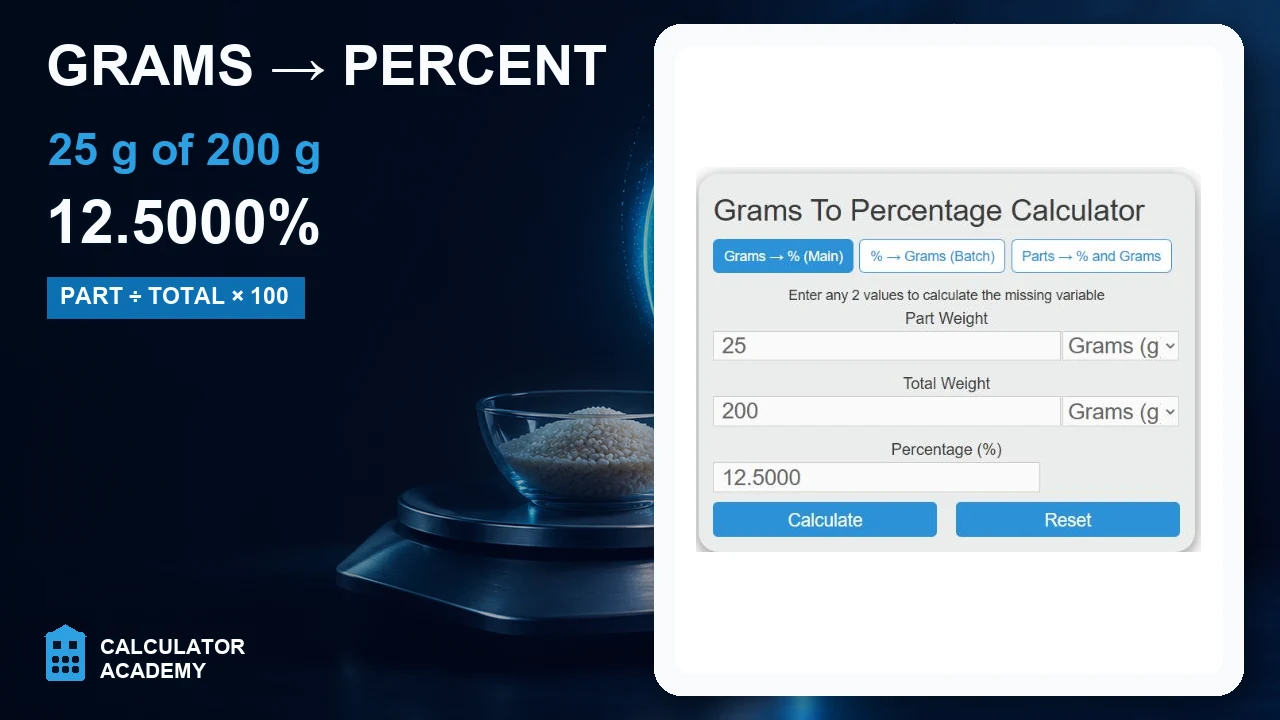
Calculate a part’s percentage from part and total weight, find ingredient and remainder grams from a batch percent, or convert mix ratios.
| Grams to Percentage | Percentage to Grams |
|---|---|
| 1 g of 1 kg = 0.1% | 0.25% of 1 kg = 2.5 g |
| 2 g of 1 kg = 0.2% | 0.33% of 1 kg = 3.3 g |
| 3 g of 1 kg = 0.3% | 0.5% of 1 kg = 5 g |
| 5 g of 1 kg = 0.5% | 0.75% of 1 kg = 7.5 g |
| 7 g of 1 kg = 0.7% | 1% of 1 kg = 10 g |
| 10 g of 1 kg = 1% | 1.5% of 1 kg = 15 g |
| 12 g of 1 kg = 1.2% | 2% of 1 kg = 20 g |
| 15 g of 1 kg = 1.5% | 3% of 1 kg = 30 g |
| 20 g of 1 kg = 2% | 4% of 1 kg = 40 g |
| 50 g of 1 kg = 5% | 12% of 1 kg = 120 g |
| Formulas: % = (part / total) x 100 and part = (% / 100) x total. Table assumes total weight = 1 kg. | |
| Grams to Percentage | Percentage to Grams |
|---|---|
| 1 g of 1 lb = 0.220% | 0.5% of 1 lb = 2.268 g |
| 2 g of 1 lb = 0.441% | 1% of 1 lb = 4.536 g |
| 3 g of 1 lb = 0.661% | 2% of 1 lb = 9.072 g |
| 5 g of 1 lb = 1.102% | 2.5% of 1 lb = 11.340 g |
| 7 g of 1 lb = 1.543% | 5% of 1 lb = 22.680 g |
| 10 g of 1 lb = 2.205% | 7.5% of 1 lb = 34.019 g |
| 14 g of 1 lb = 3.086% | 10% of 1 lb = 45.359 g |
| 20 g of 1 lb = 4.409% | 12% of 1 lb = 54.431 g |
| 28 g of 1 lb = 6.173% | 15% of 1 lb = 68.039 g |
| 50 g of 1 lb = 11.023% | 20% of 1 lb = 90.718 g |
| Formulas: % = (part / total) x 100 and part = (% / 100) x total. Table assumes total weight = 1 lb (453.592 g). | |
Grams to Percentage Formula
The core formula for converting grams to a percentage is:
Where P is the percentage, PW is the part weight in grams, and TW is the total weight in grams. To reverse the conversion and find grams from a known percentage: PW = (P / 100) * TW.
Where This Conversion Is Used
Grams-to-percentage conversion appears across several fields, each with its own conventions. The same math produces different labels depending on the industry.
Chemistry: Weight/Weight Percent (w/w%)
In chemistry, expressing grams as a percentage of a solution's total mass is called weight/weight percent (w/w%). The denominator is always the total solution mass (solute + solvent), not just the solvent. Dissolving 30 g of NaOH in 70 g of water produces a 30% w/w NaOH solution (30 / 100 = 0.30). Commercial reagents like concentrated hydrochloric acid (37% w/w) and sulfuric acid (96% w/w) are labeled this way. The w/w% system is preferred over volume-based concentrations when a solution will be used across a range of temperatures, because mass does not change with temperature the way volume does.
Baking: Baker's Percentage
Professional bakers express every ingredient as a percentage of the flour weight, not the total dough weight. Flour is always set to 100%. In a bread formula with 1000 g flour, 650 g water, 20 g salt, and 10 g yeast, the baker's percentages are 65% water, 2% salt, 1% yeast. These percentages add up to more than 100% because each is relative to flour alone. This system makes scaling recipes trivial: pick any flour weight, multiply by each ingredient's percentage, and the ratios stay perfect regardless of batch size.
Nutrition Labels
U.S. food labels list nutrient amounts in grams alongside a Percent Daily Value (%DV). The %DV shows what fraction of a daily recommended intake one serving provides, based on a 2,000-calorie diet. For fat, the Daily Value is 78 g, so a food with 15.6 g of fat per serving shows 20% DV (15.6 / 78 = 0.20). A %DV of 5% or less is considered low; 20% or more is high. Protein, trans fat, and total sugars do not carry a %DV on most labels.
Metallurgy and Alloys
Metal alloys are specified by the mass percentage of each element. 18-karat gold is 75% gold by weight (18/24), with the remaining 25% split among copper, silver, or zinc. Stainless steel grade 304 contains 18% chromium and 8% nickel by mass. These percentages directly determine corrosion resistance and tensile strength, making precise gram-to-percentage conversion during smelting and quality testing essential.
Pharmacy and Compounding
Compounding pharmacists use w/w% for creams, ointments, and topical preparations. A 2% hydrocortisone cream contains 2 g of hydrocortisone per 100 g of total product. The remaining 98 g is the base. Because dosing accuracy depends on precise mass fractions, compounders weigh ingredients on analytical balances and express every component as grams per total grams.
Percentage vs. PPM vs. PPB
Percentage works well for concentrations above roughly 0.01%, but smaller quantities are easier to express in parts per million (ppm) or parts per billion (ppb). All three are dimensionless ratios of part mass to total mass, scaled differently: 1% = 10,000 ppm = 10,000,000 ppb. In practical terms, 1 ppm equals 1 mg per kg and 1 ppb equals 1 microgram per kg. Drinking water contaminant limits are almost always given in ppm or ppb because the percentages would be inconveniently small. If your gram-to-percentage result falls below 0.001%, converting to ppm (multiply by 10,000) makes the number more readable.
Common Mistakes
Using solvent weight instead of solution weight. A frequent error in chemistry is dividing the solute mass by the solvent mass alone. The denominator must be the total: solute + solvent. Adding 5 g of salt to 95 g of water gives 5/100 = 5%, not 5/95 = 5.26%.
Mixing mass and volume. Grams measure mass. Milliliters measure volume. They are only equivalent for water at roughly 4 degrees Celsius (density 1.00 g/mL). For oils, syrups, alcohol, or any liquid with a density other than 1, you must use the actual mass in grams, not the volume reading.
Forgetting unit conversions. Both weights must be in the same unit before dividing. If the part is in milligrams and the total in grams, divide milligrams by 1,000 first. The calculator above handles this automatically when you select different units.
Worked Examples
Example 1: Solution concentration. You dissolve 12 g of citric acid into 388 g of water. Total solution mass = 12 + 388 = 400 g. Percentage = (12 / 400) * 100 = 3%.
Example 2: Baker's percentage. A dough uses 800 g of flour and 16 g of salt. Salt percentage = (16 / 800) * 100 = 2%. The denominator is flour only, per baking convention.
Example 3: Alloy composition. A 500 g bronze casting contains 440 g copper and 60 g tin. Copper = (440 / 500) * 100 = 88%. Tin = (60 / 500) * 100 = 12%.
Example 4: Reverse calculation. You need a 5% saline solution totaling 250 g. Salt required = (5 / 100) * 250 = 12.5 g. Water = 250 - 12.5 = 237.5 g.