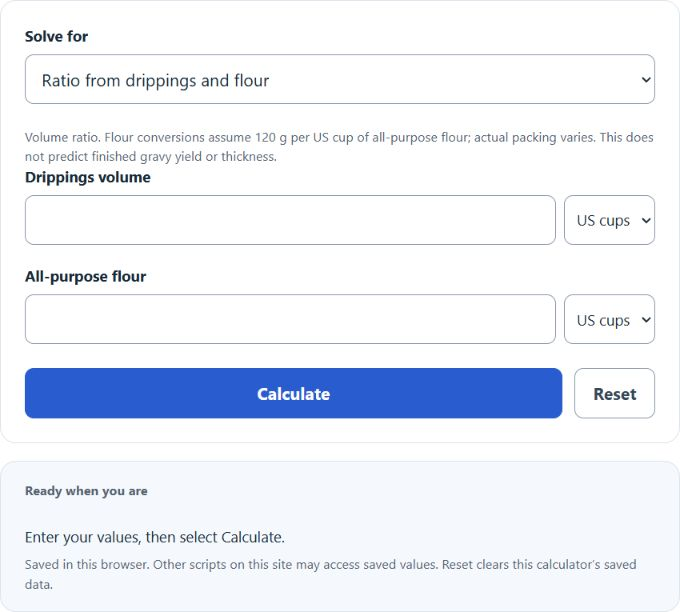
Calculate the gravy ratio from drippings and flour, or find the missing amount in cups, ml, or grams for your recipe with unit conversions.
Related Calculators
- Turkey Yield Calculator
- 18 Minutes Per Pound Calculator
- Pork Loin Cooking Time Calculator
- Potatoes Per Person Calculator
- All Food and Cooking Calculators
Gravy Ratio Formula
The gravy ratio compares the volume of drippings to the volume of flour: parts of drippings for every 1 part flour. It is a recipe-scaling ratio, not a prediction of finished gravy strength or thickness.
If you know the ratio and one ingredient, you can solve for the other.
- R = gravy ratio (drippings : flour)
- D = drippings volume in US cups
- F = flour volume in US cups
This ratio is most useful for building a roux-style gravy base. It does not represent the entire finished gravy yield after stock, milk, water, or seasoning is added.
How to Interpret the Ratio
The texture descriptions below are qualitative only: fat/water content, flour and added liquid affect the outcome. The calculator does not recommend a recipe ratio.
| Ratio Range | Meaning | Typical Effect |
|---|---|---|
| Below 1 | More flour than drippings | Heavier thickening power and a paste-like base |
| Around 1 | Similar amounts of drippings and flour | Balanced starting point for many pan gravies |
| Above 1 | More drippings than flour | Looser base that may need reduction or more flour for a thicker result |
How to Use the Calculator
- Enter the amount of drippings.
- Enter the amount of flour, or enter the desired ratio.
- Select the quantity to solve for, enter the two shown inputs and select Calculate.
- Use the result to adjust the gravy base before adding additional liquid.
The calculator uses US customary cups (236.5882365 mL), not 240 or 250 mL cups. Flour mass conversion assumes approximately 120 g per cup of all-purpose flour; packing, flour type and measuring technique can change that value.
Examples
Example 1: finding the ratio
If you have 0.5 cups of drippings and 0.25 cups of flour:
The gravy base ratio is 2, meaning 2 parts drippings for every 1 part flour.
Example 2: finding drippings from a known ratio
If the target ratio is 1.5 and you are using 0.6667 cups of flour:
You would need about 1 cup of drippings.
Example 3: finding flour from a known ratio
If you have 0.75 cups of drippings and want a ratio of 1.25:
You would need 0.6 cups of flour.
Why This Ratio Matters
- Texture: The ratio affects whether the base starts loose, balanced, or very thick.
- Mouthfeel: Too much flour can make gravy feel heavy or chalky; too little can leave it thin.
- Flavor concentration: More drippings usually means more roasted flavor and fat carried into the gravy.
- Control: Knowing the ratio helps you scale recipes up or down without guessing.
Practical Cooking Notes
- If the drippings are low in fat and mostly roasting liquid, you may need to add butter or oil before whisking in flour.
- Cook the flour briefly in the fat to remove the raw flour taste before adding stock or milk.
- Add liquid gradually while whisking so the roux stays smooth.
- If the finished gravy is too thick, thin it with warm stock a little at a time.
- If the finished gravy is too thin, simmer to reduce it or increase the flour relative to the drippings in the base.
Common Mistakes
- Using unmatched measurements: Mixing inconsistent units can make the ratio harder to interpret.
- Adding all liquid at once: This often causes lumps.
- Skipping the roux stage: Flour added directly to hot liquid is more likely to clump.
- Ignoring final liquid volume: A good base ratio still needs the right amount of stock or milk to reach the desired consistency.
Quick Reference
Use this calculator when you want to:
- check whether your drippings-to-flour mix is balanced,
- scale gravy for a larger meal,
- solve for missing drippings or flour, or
- standardize your gravy method from one cooking session to the next.