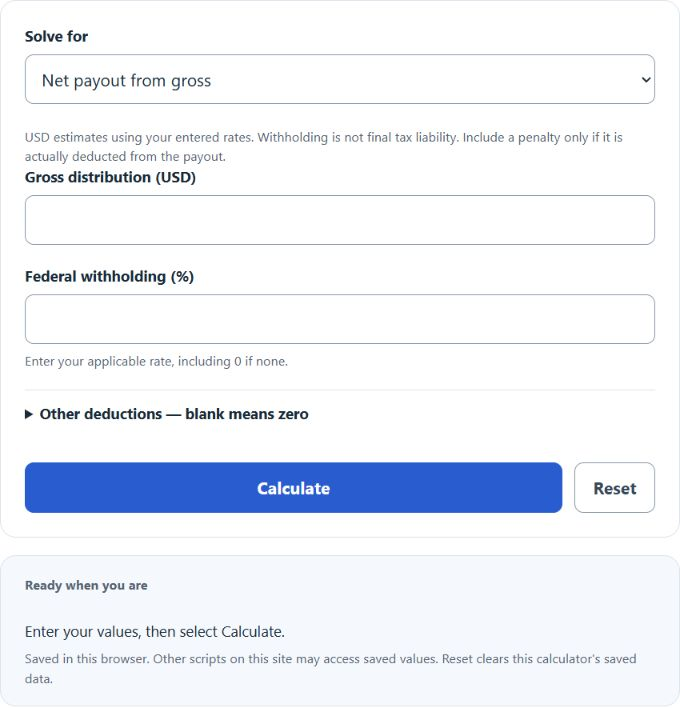
Calculate net proceeds from a gross distribution or gross up a desired net payout after federal and state withholding, penalties, and fixed fees.
Gross Distribution Formula
Choose net payout, gross for a desired net payout, or gross from actual statement amounts.
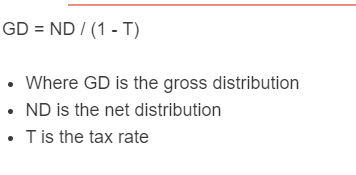
Gross up net:
From statement:
Net from gross:
- Gross = total distribution before any tax or fees
- Net = amount you actually receive
- Rate = combined federal, state and other amounts actually withheld as a decimal (20% = 0.20), applied to the full gross
- Tax Withheld = dollar amount of tax taken out
- Other Deductions = plan fees, loan offsets, or other amounts withheld
The rate modes include fixed fees separately. Combined percentage deductions must be below 100%. Use actual statement amounts when reconstructing gross from a deposit. All dollar amounts are USD; rate-mode answers are estimates rounded to cents, and payer rounding may differ. A tax penalty owed later is not automatically a deduction from the payout.
Common Withholding Rates and Effective Net
Federal withholding depends on payment type and elections. The calculator does not choose a rate or determine your tax liability. See IRS Form W-4R for nonperiodic payments and eligible rollovers, and Form W-4P for periodic pensions and annuities.
| Distribution Type | Federal withholding context |
|---|---|
| Eligible rollover (paid to you) | 20% mandatory |
| Direct rollover (trustee to trustee) | 0% |
| Periodic pension or annuity | Depends on Form W-4P elections and tables |
| Nonperiodic payment, not eligible for rollover | 10% default; elections may apply |
| Other circumstances, including nonresident payments | Consult your payer and applicable IRS rules |
| Your actual withholding election | Enter the applicable rate, not a universal default |
This table shows the gross amount needed to produce a $1,000 net check at common rates.
| Withholding Rate | Gross for $1,000 Net | Tax Withheld |
|---|---|---|
| 10% | $1,111.11 | $111.11 |
| 20% | $1,250.00 | $250.00 |
| 22% | $1,282.05 | $282.05 |
| 24% | $1,315.79 | $315.79 |
| 30% | $1,428.57 | $428.57 |
| 37% | $1,587.30 | $587.30 |
Example and FAQ
Example. You need $5,000 in your bank account from an IRA withdrawal. Your withholding election is 20%. The required gross distribution is 5,000 / (1 – 0.20) = $6,250. The custodian withholds $1,250 in tax and sends you $5,000.
Why is gross higher than net plus the rate applied to net? Tax is calculated on the gross amount, not the net. Adding 20% to a $5,000 net only gives $6,000, which would withhold $1,200 and leave $4,800. You have to divide by (1 – rate) to land on the right gross figure.
Does this account for state tax? Yes, enter the state percentage separately. For 20% federal plus 5% state applied to the full gross, the calculator uses a combined 25% rate. Do not also include the same amount in other deductions.
Does withholding equal what you actually owe? No. Withholding is a prepayment. Your final tax liability is settled when you file your return, and you may owe more or get a refund.