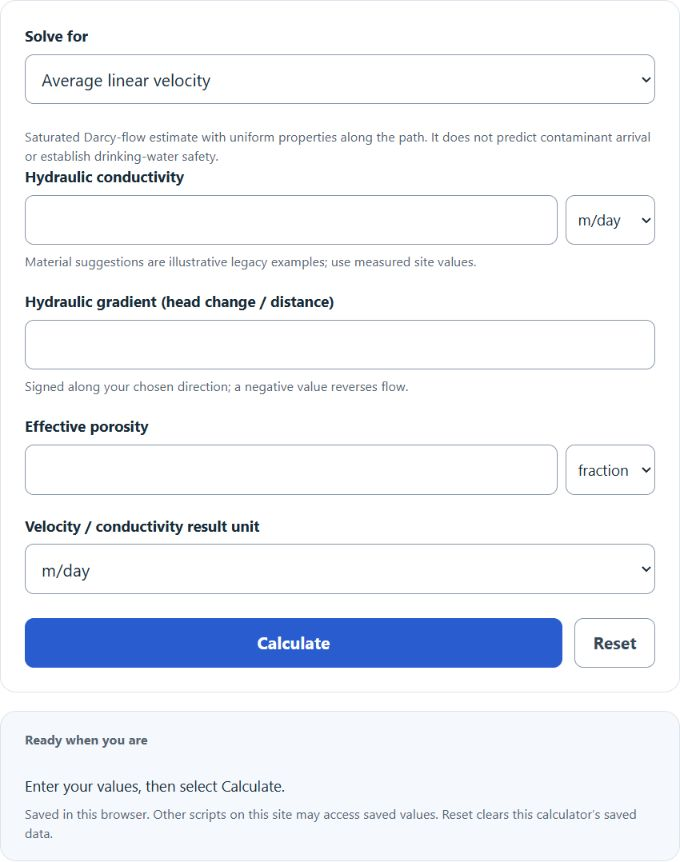
Select the quantity to solve, Darcy flux, or travel time. Enter hydraulic conductivity, signed hydraulic gradient, and effective porosity as required; material suggestions are illustrative examples and should be replaced by site measurements.
Groundwater Velocity Formula
The following equation is used to calculate the Groundwater Velocity.
- Where Vgw is the groundwater (average linear/seepage) velocity
- K is the horizontal hydraulic conductivity
- i is the horizontal hydraulic gradient
- n is the effective porosity
To calculate the groundwater velocity, multiply the horizontal hydraulic conductivity by the horizontal hydraulic gradient, then divide by the effective porosity.
What is Groundwater Velocity?
Definition:
Groundwater velocity (often called average linear velocity or seepage velocity) is the average speed at which groundwater moves through the pore spaces of an aquifer. It depends on the hydraulic conductivity, the hydraulic gradient, and the effective porosity.
How to Calculate Groundwater Velocity?
Example Problem:
The following example outlines the steps and information needed to calculate the Groundwater Velocity.
First, determine the horizontal hydraulic conductivity. In this example, the horizontal hydraulic conductivity is found to be 5 m/day.
Next, determine the horizontal hydraulic gradient. For this problem, the horizontal hydraulic gradient is found to be 0.03 (unitless).
Next, determine the effective porosity. In this case, the effective porosity is measured to be 0.20 (20%).
Finally, calculate the Groundwater Velocity using the formula above:
Vgw = (K*i)/n
Vgw = (5*0.03)/0.20
Vgw = 0.75 m/day