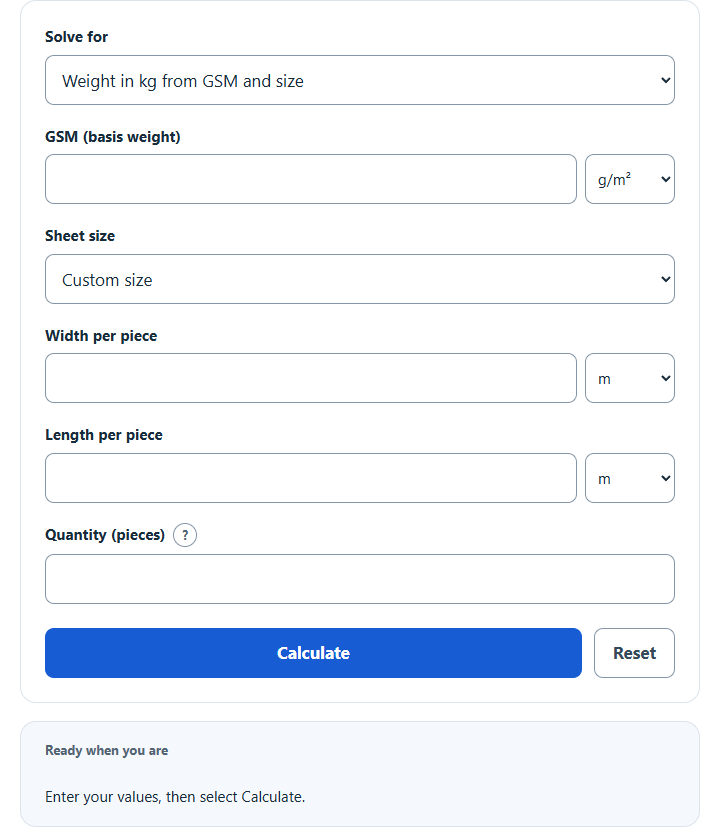
Convert GSM to kg: enter grams per square meter, the sheet or piece size and quantity to get total weight in kg, lb and grams, or work back to GSM.
Calculator Functions
| Function | What it does | What it requires |
|---|---|---|
| Weight in kg from GSM and size | Converts GSM to total weight for sheets, pieces or a roll of a known size | Requires the GSM, the width and length of one piece and the number of pieces |
| GSM from weight and size | Finds the GSM of a material from a weighed stack, piece or roll | Requires the total weight, the width and length of one piece and the number of pieces |
| Width | Finds the width of one piece from its weight | Requires the total weight, the GSM, the length of one piece and the number of pieces |
| Length | Finds the length of one piece or roll from its weight | Requires the total weight, the GSM, the width of one piece and the number of pieces |
| Number of pieces | Finds how many equal pieces make up a weight | Requires the total weight, the GSM and the width and length of one piece |
GSM can be entered in g/m² or in oz/yd², where 1 oz/yd² is 33.906 g/m² [2]. The sheet size list fills in A4, A3, US Letter or 1 m × 1 m, and a custom size takes meters, centimeters, millimeters or inches. Weight can be in kg, lb or g. A blank quantity counts as one piece. The weight result is also shown in pounds and grams, with the total area in square meters.
GSM to kg Formulas
N ÷ 1000
| kg | Total weight (kilograms) |
| GSM | Grams per square meter of the paper, fabric or film, also called grammage [1] |
| W | Width of one piece (meters) |
| L | Length of one piece (meters) |
| N | Number of equal pieces |
GSM is a weight for each square meter, so it has no single kg value: the answer depends on how much area there is. One square meter of 80 gsm paper weighs 0.08 kg, and 1 kg of it covers 12.5 m². A material reaches 1 kg per square meter only at 1,000 gsm. W × L × N is the total area in square meters, and dividing by 1,000 turns grams into kilograms.
Weight in kg from GSM and size
A ream of 500 sheets of 80 gsm A4 is 80 × 0.210 × 0.297 × 500 ÷ 1000 = 2.495 kg. A single piece of 150 gsm fabric 1.2 m wide and 2.5 m long is 150 × 1.2 × 2.5 ÷ 1000 = 0.45 kg. The table gives the weight of a 500-sheet ream for common paper weights.
| Paper weight | 500 sheets of A4 | 500 sheets of US Letter |
|---|---|---|
| 60 gsm | 1.871 kg | 1.810 kg |
| 70 gsm | 2.183 kg | 2.111 kg |
| 75 gsm | 2.339 kg | 2.262 kg |
| 80 gsm | 2.495 kg | 2.413 kg |
| 90 gsm | 2.807 kg | 2.715 kg |
| 100 gsm | 3.118 kg | 3.016 kg |
| 120 gsm | 3.742 kg | 3.619 kg |
| 150 gsm | 4.678 kg | 4.524 kg |
| 200 gsm | 6.237 kg | 6.032 kg |
| 300 gsm | 9.355 kg | 9.048 kg |
GSM from weight and size
(W × L × N)
A ream of 500 A4 sheets that weighs 2.5 kg works out to 2,500 g ÷ 31.185 m² = 80.2 gsm. Weighing a stack rather than one sheet gives a steadier figure, because a single sheet is only a few grams.
Width
(GSM × L × N)
A 50 m roll of 300 gsm material that weighs 12 kg is 12,000 ÷ (300 × 50) = 0.8 m wide.
Length
(GSM × W × N)
This gives the length on a roll, or the meters in each kilogram. A 20 kg roll of 200 gsm fabric 1.5 m wide holds 20,000 ÷ (200 × 1.5) = 66.67 m, which is 3.33 m for every kilogram.
Number of pieces
(GSM × W × L)
5 kg of 80 gsm A4 is 5,000 ÷ (80 × 0.06237) = 1,002 sheets. The result can include a part piece, so round down for whole sheets on hand and up when ordering.
Limits of This Estimate
- The formula treats the material as the same weight all over and every piece as the same size. Real paper and fabric vary around their stated GSM, which is why grammage is measured by a set test method [1].
- Packaging, roll cores, moisture taken up from the air, coatings added later and cutting waste are not included.
- GSM does not give thickness or density on its own. Density in kg/m³ is the GSM divided by the thickness in millimeters, so a thickness is needed as well.
- A paper “weight” in pounds, such as 20 lb bond, is the weight of a ream at that grade’s own basis size. It is not the same as oz/yd² and has to be converted to GSM before using it here.
Sources
- ISO 536:2019, Paper and board: Determination of grammage: grammage as the measured property and its standard test method
- NIST, Guide to the SI (Special Publication 811), Appendix B.8: ounce per square yard, pound and inch factors