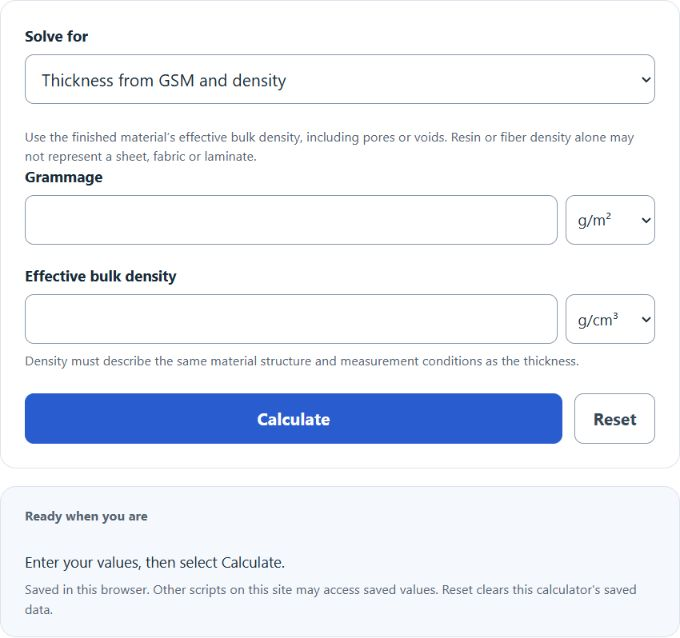
Calculate material thickness in mils, microns, millimeters, or inches from GSM and density, or solve for GSM or density using any two known values.
GSM to Mil Formula
The core formula for converting grams per square meter to thickness in mils is:
T is thickness in mils, G is grammage in g/m² and D is effective bulk density in g/cm³. First convert G to g/cm² by dividing by 10,000, then divide by density to obtain centimeters. Multiply by 1,000/2.54 to obtain mils. The combined factor is 1/25.4 ≈ 0.03937008, not 0.00155.
An equivalent form used in metric contexts expresses thickness in microns: T(um) = GSM / density, where density is in g/cm3. To then convert microns to mils, divide by 25.4, since one mil equals 25.4 microns.
Why GSM Does Not Equal Thickness
GSM is a measure of mass per unit area, not a direct measurement of how thick a material is. Two materials can share the same GSM yet have very different thicknesses because their internal structures and densities differ. A sheet of tissue paper at 30 GSM may be several times thicker than a 30 GSM aluminum foil because tissue paper is loosely packed with air pockets between its cellulose fibers, while aluminum is a dense, solid metal. This is why density is the critical third variable in the conversion. Without knowing the density of the specific material, converting GSM to mils produces meaningless numbers.
Manufacturing processes also affect density within the same material category. A calendered (compressed) paper sheet is denser and thinner than an uncalendered sheet of the same GSM. Coated papers have different densities than uncoated papers at identical weights. Even within plastic films, the blow ratio, cooling rate, and additive package all influence the final density and therefore the relationship between GSM and thickness.
Material Density Reference Table
The table below explains which density is needed for different structures. Generic resin or fiber density is not a reliable substitute for the finished sheet’s apparent bulk density, especially for porous or compressible materials.
| Structure | Density needed | Key limitation |
|---|---|---|
| Uniform solid film | Finished-film mass per occupied volume | Confirm the actual grade and composition |
| Paper or porous nonwoven | Apparent bulk density including voids | Use matching thickness measurement conditions |
| Woven or knitted fabric | Effective density of the whole fabric structure | Fiber density excludes the spaces between fibers and yarns |
| Laminate | Measured composite bulk density, or each layer’s GSM and density | Sum layer thicknesses; do not average densities arbitrarily |
GSM to Mils Conversion Table: LDPE Film
The following calculation examples assume a uniform film density of 0.92 g/cm³. This is an illustrative input, not a universal LDPE specification or a product-use recommendation. Verify finished-film density and measured thickness for the actual product.
| GSM (g/m2) | Thickness (mil) | Thickness (um) | Assumption |
|---|---|---|---|
| 5 | 0.214 | 5.4 | Density 0.92 g/cm³ |
| 10 | 0.428 | 10.9 | Density 0.92 g/cm³ |
| 15 | 0.642 | 16.3 | Density 0.92 g/cm³ |
| 20 | 0.856 | 21.7 | Density 0.92 g/cm³ |
| 25 | 1.070 | 27.2 | Density 0.92 g/cm³ |
| 30 | 1.284 | 32.6 | Density 0.92 g/cm³ |
| 40 | 1.712 | 43.5 | Density 0.92 g/cm³ |
| 50 | 2.140 | 54.3 | Density 0.92 g/cm³ |
| 60 | 2.568 | 65.2 | Density 0.92 g/cm³ |
| 80 | 3.423 | 87.0 | Density 0.92 g/cm³ |
| 100 | 4.279 | 108.7 | Density 0.92 g/cm³ |
| 120 | 5.135 | 130.4 | Density 0.92 g/cm³ |
| 150 | 6.419 | 163.0 | Density 0.92 g/cm³ |
| 200 | 8.559 | 217.4 | Density 0.92 g/cm³ |
| Formulas: thickness (um) = GSM / 0.92; thickness (mil) = GSM / (0.92 x 25.4). 1 mil = 25.4 um = 0.001 inches. | |||
GSM to Mils Across Different Materials
The same GSM gives different modeled thicknesses at different effective densities. The following hypothetical density scenarios demonstrate the mathematical relationship; they are not reference densities for named products.
| Scenario | Density (g/cm3) | Thickness (mil) | Thickness (um) |
|---|---|---|---|
| Illustrative 1 | 0.25 | 7.874 | 200.0 |
| Illustrative 2 | 0.20 | 9.843 | 250.0 |
| Illustrative 3 | 0.70 | 2.812 | 71.4 |
| Illustrative 4 | 0.75 | 2.625 | 66.7 |
| Illustrative 5 | 0.90 | 2.187 | 55.6 |
| Illustrative 6 | 0.92 | 2.140 | 54.3 |
| Illustrative 7 | 0.96 | 2.051 | 52.1 |
| Illustrative 8 | 1.10 | 1.790 | 45.5 |
| Illustrative 9 | 1.13 | 1.742 | 44.2 |
| Illustrative 10 | 1.39 | 1.416 | 36.0 |
| Illustrative 11 | 2.70 | 0.729 | 18.5 |
| All values at 50 GSM. Thickness (um) = 50 / density. Thickness (mil) = thickness (um) / 25.4. | |||
At 50 g/m², density assumptions of 0.25 and 2.70 g/cm³ give modeled thicknesses in a ratio of 10.8 to 1. This is a sensitivity comparison, not a validated comparison of particular nonwoven and foil products.
Industry Applications for GSM to Mil Conversion
For a uniform film specified at 30 g/m² and an effective density of 0.92 g/cm³, the model gives about 1.284 mil. This estimate alone does not prove measured thickness, labeling compliance or suitability for an application.
The printing and paper industry uses this conversion when sourcing paper internationally. A 120 GSM uncoated bond paper at a density of 0.75 g/cm3 yields a caliper of about 6.3 mils. Paper caliper directly affects bulk, stiffness, and the perception of quality, so printers need to verify that a GSM specification translates to the expected physical feel in the hand.
For a hypothetical material at 200 g/m² and effective bulk density 1.30 g/cm³, the model gives about 6.06 mil. Applying a solid polyester fiber density to a porous woven fabric would omit its void volume and can underestimate caliper.
For agricultural films, vapor barriers and liners, check the applicable product specification and project requirements directly. A GSM-derived estimate does not establish measured thickness, performance or building-code compliance.
Key Unit Conversion Factors
The following reference values are used throughout GSM to mil calculations and are helpful for cross-checking results or performing manual conversions.
| From | To | Multiply By (rounded where shown) |
|---|---|---|
| 1 mil | microns (um) | 25.4 |
| 1 mil | millimeters (mm) | 0.0254 |
| 1 mil | inches | 0.001 |
| 1 micron (um) | mils | 0.03937 |
| 1 mm | mils | 39.37 |
| 1 g/m2 | kg/m2 | 0.001 |
| 1 g/m2 | oz/yd2 (osy) | 0.02949 |
| 1 lb/ream (500 sheets, 25×38 in) | g/m2 | 1.480 |
| 1 g/cm3 | kg/m3 | 1000 |
| 1 g/cm3 | lb/ft3 | 62.43 |
Measuring GSM and Density in Practice
Measure mass over a known representative area using an appropriate procedure. A verified 100 cm² sample has GSM equal to its mass in grams multiplied by 100. Sampling and conditioning requirements depend on the material and test method; this arithmetic tool does not implement a full laboratory protocol.
Use density that represents the occupied volume of the finished structure. Resin data and tests that measure the solid phase alone may not represent a porous sheet’s apparent density. ISO 534 distinguishes apparent sheet and bulk density for paper using measured thickness; for compressible textiles, specify the thickness test pressure.
Compare the estimate with thickness measured using the relevant product method and stated conditions. Paper thickness and apparent density are addressed by ISO 534; textile thickness methods such as ASTM D1777 specify measurement conditions because pressure affects apparent thickness.
Common Errors in GSM to Mil Conversion
Using an unsuitable density changes the result inversely. For example, a 100 g/m² calculation using 0.91 instead of 0.93 g/cm³ gives a thickness about 2.2% higher. These are illustrative density inputs; use values appropriate to the actual grade, structure and test conditions.
Another common error is confusing GSM with basis weight in pounds per ream. The U.S. paper industry defines basis weight using different standard sheet sizes for different paper grades (bond uses 17×22 inches, cover uses 20×26 inches, text uses 25×38 inches). A 60 lb bond paper is not the same GSM as a 60 lb text paper. Always convert basis weight to GSM first using the correct ream size factor before applying the thickness formula.
Coatings and laminates change both grammage and structure. For separate uniform layers with known densities, calculate each layer’s thickness as its GSM divided by its density, then sum the thicknesses. For a 50 g/m² film plus a 5 g/m² coating, total grammage is 55 g/m², but an arbitrary arithmetic blend of the two densities is not a valid shortcut.