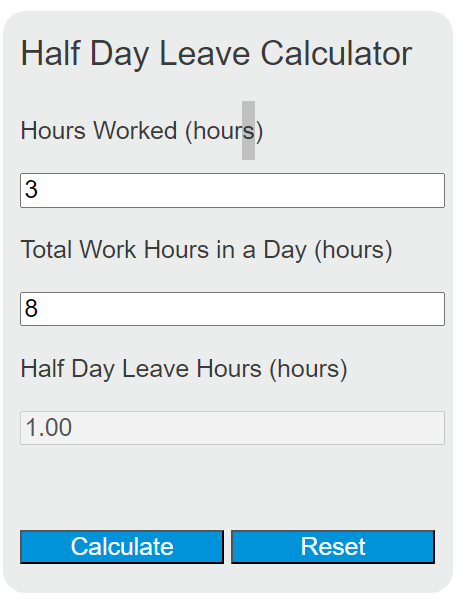
Calculate your half-day leave clock-out time from shift start and length, or half-day pay or deduction from salary and workdays.
Related Calculators
- Break Time Calculator
- Notice Period Calculator
- Year Of Experience Calculator
- Age In Days Calculator
- All Everyday Life and Education Calculators
Half Day Leave Formula
A half day leave is usually calculated as one-half of the employee’s normal scheduled workday. This calculator helps you quickly determine the half-day leave amount in hours and compare it with the number of hours already worked.
Variable meanings:
- HDL = half day leave hours
- TWH = total work hours in the day
- HW = hours worked so far, if you want to compare actual time worked with the half-day threshold
How to Calculate Half Day Leave
- Identify the total number of work hours in the employee’s regular day or shift.
- Divide that value by 2.
- The result is the number of hours that represents a half day leave.
- If needed, compare the result with hours already worked to see whether the employee has met, exceeded, or fallen short of a half day.
If you want to measure how far the hours worked are from the half-day point, you can use the following relationship:
Where R is the remaining time needed to reach the half-day threshold. If the result is negative, the employee has already worked more than half of the day.
Common Half-Day Leave Values
| Full Workday | Half Day Leave | Equivalent Time |
|---|---|---|
| 6 hours | 3 hours | 3 hours 0 minutes |
| 7 hours | 3.5 hours | 3 hours 30 minutes |
| 7.5 hours | 3.75 hours | 3 hours 45 minutes |
| 8 hours | 4 hours | 4 hours 0 minutes |
| 9 hours | 4.5 hours | 4 hours 30 minutes |
| 10 hours | 5 hours | 5 hours 0 minutes |
| 12 hours | 6 hours | 6 hours 0 minutes |
Example
If an employee’s normal workday is 8 hours, the half-day leave value is:
If that employee has already worked 3 hours, the remaining time needed to reach half of the day is:
In that case, the employee is 1 hour short of completing half of the workday.
When to Use This Calculator
- Checking whether a leave request counts as a half day
- Comparing hours worked against a half-day attendance requirement
- Planning partial-day leave for appointments, travel, or personal obligations
- Handling non-standard schedules such as 7.5-hour, 9-hour, 10-hour, or 12-hour shifts
- Estimating leave deductions when balances are tracked in hours instead of full days
Important Policy Considerations
The math is simple, but leave policy is not always identical across employers. Before relying on the result for payroll or attendance purposes, make sure the input reflects how your organization defines a workday.
- Paid vs. unpaid breaks: Some companies base leave on paid hours only, while others reference total scheduled shift time.
- Fixed half-day blocks: Certain workplaces treat “half day” as a morning or afternoon block rather than an exact hourly split.
- Part-time schedules: Use the employee’s actual scheduled daily hours, not a default 8-hour day.
- Shift-based roles: For rotating or extended shifts, calculate from that specific day’s scheduled hours.
- Rounding rules: Employers may round to the nearest 15 minutes, 30 minutes, or payroll increment.
Half Day Leave FAQs
Is a half day leave always 4 hours?
No. A half day is only 4 hours when the full workday is 8 hours. If the workday is 7.5 hours, a half day is 3.75 hours. If the workday is 10 hours, a half day is 5 hours.
Can I use this for part-time employees?
Yes. Enter the part-time employee’s actual scheduled hours for that day. The calculator will return half of that schedule.
Should lunch or meal breaks be included?
That depends on company policy. If meal breaks are unpaid and excluded from the official workday total, do not include them in the input.
What if the employee has already worked more than half the day?
If hours worked exceed the half-day threshold, the employee has already completed more than half of the scheduled workday. In that case, the remaining value from the comparison becomes negative.
Why use hours instead of fractions of a day?
Using hours is often more precise, especially for flexible schedules, compressed workweeks, and payroll systems that track leave in hourly increments.