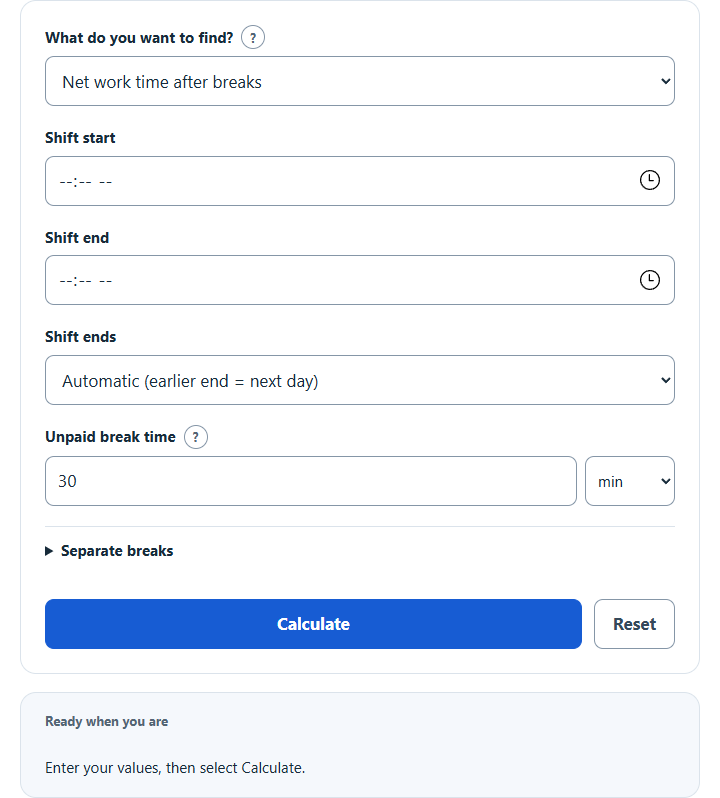
Calculate break time: your net work hours after unpaid breaks, the time to return from a break, or total break time, with overnight shifts handled.
Related Calculators
- Internship Hours Calculator
- 45 Minutes From Now Calculator
- Minutes Per Room Calculator
- Presentation Time Calculator
- All Everyday Life and Education Calculators
Calculator Functions
| Function | What it does | What it requires |
|---|---|---|
| Net work time after breaks | Finds the time worked in a shift once unpaid breaks are taken out, in hours and minutes and in decimal hours | Requires the shift start time, the shift end time and the unpaid break time, with room for a second and third unpaid break |
| Return time from a break | Finds the clock time a break ends | Requires the time the break starts and the break length |
| Total break time | Finds the combined length of several equal breaks | Requires the number of breaks and the length of each break |
Break lengths go in as minutes or hours, and clock times use the time picker. Unpaid break time starts at 30 minutes, and 0 means no unpaid break. The Shift ends setting handles overnight shifts: Automatic treats an end time earlier than the start time as the next day, and Same day or Next day (overnight) sets it directly.
Break Time Formulas
| W | Net work time (minutes) |
| E | Shift end time |
| S | Shift start time |
| B | Unpaid break time, all breaks added together (minutes) |
Only unpaid breaks are subtracted. Under U.S. federal wage rules, rest periods of about 5 to 20 minutes count as hours worked, while a meal period, ordinarily 30 minutes or more with no duties, is not work time [1]. A paid 15-minute rest break therefore stays in the shift, and an unpaid 30-minute lunch comes out.
Net work time after breaks
The shift length is the time from shift start to shift end, and up to three unpaid breaks are added together, rounded to the whole minute and subtracted. A shift from 7:50 AM to 4:20 PM lasts 8 hr 30 min, so a 30-minute unpaid break leaves 8 hr 0 min of work. For an overnight shift, 24 hours are added to the end time: 10:00 PM to 6:00 AM is an 8-hour shift. Breaks as long as the shift, and matching start and end times on the same day, are rejected.
Decimal hours are rounded to two places. A net time of 7 hr 45 min is 465 minutes, or 7.75 decimal hours.
Return time from a break
Length
The break length is added to the time the break starts. A 30-minute break that starts at 1:42 PM ends at 2:12 PM, and a 35-minute break from 12:40 PM ends at 1:15 PM. The answer is rounded to the nearest minute, and a break that runs past midnight is marked as the next day. The break has to be shorter than 24 hours.
Total break time
n is the number of breaks and d is the length of each one. Three 15-minute breaks add up to 45 minutes, which the result also shows as 0.75 decimal hours. Breaks of different lengths can be added in the unpaid break fields of Net work time after breaks.
Limits of This Estimate
- The result is clock arithmetic. It does not decide which breaks are paid or how many breaks a shift must include, which depend on the employer’s policy and state law.
- Times have no date or time zone, so a shift that crosses a daylight saving change is off by the hour that was added or dropped.
- A timesheet that rounds clock punches can show a slightly different total.
Sources
- U.S. Code of Federal Regulations, Title 29, Sections 785.18 and 785.19: short rest periods counted as hours worked, and meal periods that are not work time