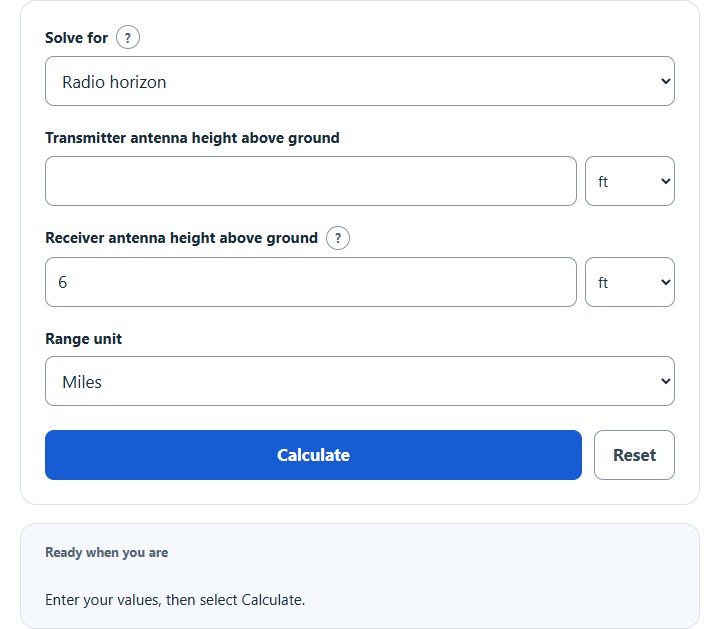
Estimate ham radio range in miles or km from your antenna heights, or work out a link-budget distance, Fresnel zone or repeater range for VHF/UHF.
Calculator Functions
| Function | What it does | What it requires |
|---|---|---|
| Radio horizon | Finds the line-of-sight range between two antennas over smooth ground | Requires the transmitter and receiver antenna heights above ground |
| Free-space link budget | Finds the distance at which the received signal falls to the receiver sensitivity plus a fade margin | Requires frequency in MHz, transmitter power and receiver sensitivity in dBm |
| First Fresnel zone | Finds the radius of the first Fresnel zone at an obstruction on the path | Requires frequency in MHz and the distances from the obstruction to each station |
| User-to-repeater horizon | Finds the line-of-sight range between a station and a repeater | Requires the station antenna height and the repeater antenna height |
Heights are entered in feet or meters, up to 10,000 m, and ranges are shown in miles and kilometers. The receiver and station heights start at 6 ft, a typical handheld or mobile antenna. The link budget also takes antenna gains, coax and other losses, an environment loss of 0 to 20 dB that starts at 10 dB, and a fade margin that is 10 dB when left blank. Transmitter power can be in watts or dBm.
Ham Radio Range Formulas
| R | Radio horizon range (km) |
| h1 | Height of the first antenna above ground (m) |
| h2 | Height of the second antenna above ground (m) |
The formula treats the Earth as a smooth sphere with 4/3 of its real radius, which allows for the normal bending of radio waves in the atmosphere [1]. The published form of the relation gives nautical miles, 2.23 × (√h1 + √h2) with heights in meters [1], and 2.23 nautical miles is 4.13 km. With heights in feet and range in miles the coefficient is 1.41.
Radio horizon
A transmitter antenna at 50 ft (15.24 m) and a receiver antenna at 30 ft (9.144 m) give 4.12 × (√15.24 + √9.144) = 28.54 km, or 17.74 miles.
Free-space link budget
20 log d [2]
L is the free-space path loss in dB, f is the frequency in MHz and d is the distance in km [2]. The allowed loss is transmitter power in dBm, plus both antenna gains, minus the losses, the receiver sensitivity and the fade margin, and the formula is solved for d. At 146 MHz, 5 W (36.99 dBm), a sensitivity of −120 dBm and the starting 10 dB environment loss and 10 dB fade margin, the allowed loss is 136.99 dB and the distance is about 718 miles (1,155 km). That is far beyond the radio horizon, which is why the horizon and the terrain, not the link budget, usually set the range on VHF and UHF.
First Fresnel zone
(d1 + d2)) [3]
λ is the wavelength in meters, 299.792458 ÷ f with f in MHz, and d1 and d2 are the distances in meters from the obstruction to each station. At 146 MHz with an obstruction 5 km from each end, λ is 2.0534 m and r is 71.65 m. A path behaves like free space when at least 60% of that radius is clear [3], here 42.99 m, and the result lists this clearance.
User-to-repeater horizon
This is the radio horizon formula with the station height and the repeater height. A 6 ft (1.83 m) handheld antenna and a repeater antenna at 100 ft (30.48 m) give 4.12 × (√1.8288 + √30.48) = 28.32 km, or 17.60 miles.
Limits of This Estimate
- The horizon functions assume smooth ground and a normal atmosphere. Hills, buildings and trees shorten the range, and unusual weather can lengthen or shorten it.
- The link budget assumes free space. Its environment loss settings are round allowances, not measurements, and the result ignores the radio horizon.
- These functions describe VHF and UHF line-of-sight paths. HF signals (3 to 30 MHz) can travel far beyond the horizon by refraction in the ionosphere, and the usable frequencies change with the time of day, the season and the solar cycle. Lower frequencies are absorbed more in daytime, and the skip zone around a transmitter grows at night and at solar minimum [4]. None of the functions predicts HF range.
Sources
- Alliance for Telecommunications Industry Solutions, ATIS Telecom Glossary, radio horizon range (RHR): radio horizon relation and the 4/3 effective Earth radius
- International Telecommunication Union, Recommendation ITU-R P.525-5, Calculation of free-space attenuation, Equation 6: free-space path loss with frequency in MHz and distance in km
- International Telecommunication Union, Recommendation ITU-R P.530-14, Propagation data and prediction methods required for the design of terrestrial line-of-sight systems: first Fresnel zone radius and the 60% clearance rule
- Australian Bureau of Meteorology, Space Weather Services, Introduction to HF Radio Propagation: HF sky wave behavior, daytime absorption and skip zones