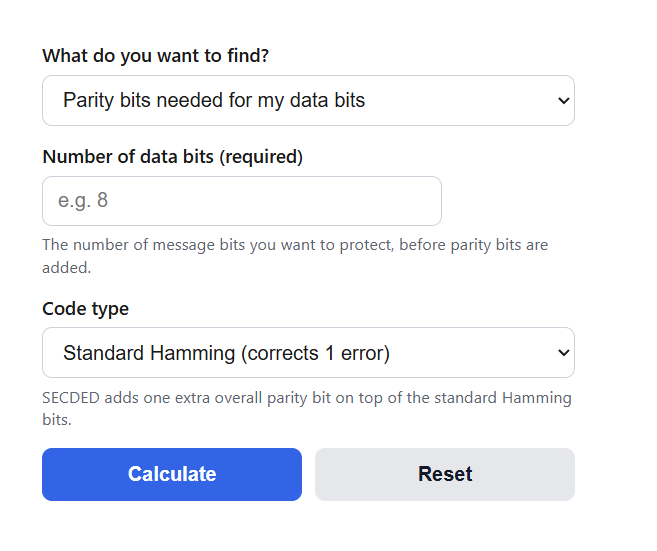
Calculate how many parity bits a Hamming code needs for your data bits, find their positions, and encode a binary message with even or odd parity.
Hamming Code Parity Bits Formula
The number of parity bits r needed to protect m data bits in a Hamming code is the smallest r that satisfies this inequality:
2^r >= m + r + 1
Working backwards, a fixed budget of r parity bits can protect at most this many data bits:
m_max = 2^r - r - 1
Variables:
- r is the number of parity (check) bits added to the message
- m is the number of data bits in the original message
- n = m + r is the total length of the encoded codeword
The inequality works because the r parity bits together form an r-bit syndrome, which can represent 2^r different states. Those states must cover an error in any of the n = m + r bit positions plus one extra state for “no error,” which is where the + 1 comes from. The calculator’s default mode applies the first formula: enter your data bits and it returns the smallest r that works, the total codeword length, the parity bit positions (always the powers of two: 1, 2, 4, 8, and so on), and the code rate.
The second mode inverts the problem with the m_max formula: enter how many parity bits you can afford and it returns the largest message they can protect. The third mode encodes an actual binary string: it counts your data bits, computes r, places the parity bits at the power-of-two positions, and calculates each parity value using even or odd parity so you get the finished codeword. Choosing SECDED (extended Hamming) in the first two modes adds one extra overall parity bit, which is the variant used in ECC memory.
Parity Bits Required for Common Data Sizes
This table applies the formula to the data widths you are most likely to meet in coursework and in hardware. Rows marked “perfect” are perfect Hamming codes, where every possible syndrome value is used and the parity bits protect the largest message they can.
| Data bits (m) | Parity bits (r) | Total (n) | Code | Code rate |
|---|---|---|---|---|
| 1 | 2 | 3 | (3, 1) perfect | 33.3% |
| 4 | 3 | 7 | (7, 4) perfect | 57.1% |
| 8 | 4 | 12 | (12, 8) | 66.7% |
| 11 | 4 | 15 | (15, 11) perfect | 73.3% |
| 16 | 5 | 21 | (21, 16) | 76.2% |
| 26 | 5 | 31 | (31, 26) perfect | 83.9% |
| 32 | 6 | 38 | (38, 32) | 84.2% |
| 57 | 6 | 63 | (63, 57) perfect | 90.5% |
| 64 | 7 | 71 | (71, 64) | 90.1% |
| 120 | 7 | 127 | (127, 120) perfect | 94.5% |
| 128 | 8 | 136 | (136, 128) | 94.1% |
| 247 | 8 | 255 | (255, 247) perfect | 96.9% |
Notice the trend: parity overhead shrinks fast as messages grow. Protecting 4 bits costs 3 parity bits (75% extra), while protecting 247 bits costs only 8 (about 3% extra). The second table shows the SECDED variant, which adds one more check bit and is the standard scheme in error-correcting memory. The (72, 64) row is exactly why ECC server RAM is 72 bits wide for every 64 bits of data.
| Data bits (m) | SECDED check bits | Total (n) | Overhead | Typical use |
|---|---|---|---|---|
| 8 | 5 | 13 | 62.5% | Small registers, teaching examples |
| 16 | 6 | 22 | 37.5% | Embedded memories, caches |
| 32 | 7 | 39 | 21.9% | Microcontroller flash and SRAM ECC |
| 64 | 8 | 72 | 12.5% | ECC server RAM (72-bit DIMMs) |
| 128 | 9 | 137 | 7.0% | Wide memory buses, HBM links |
Example Problems
Example 1: How many parity bits does one byte need?
You want to protect m = 8 data bits. Test values of r in the inequality 2^r >= m + r + 1. For r = 3: 2^3 = 8, but 8 + 3 + 1 = 12, and 8 is less than 12, so 3 parity bits are not enough. For r = 4: 2^4 = 16, and 8 + 4 + 1 = 13. Since 16 is at least 13, r = 4 works. The codeword is n = 8 + 4 = 12 bits long, a (12, 8) code, with parity bits at positions 1, 2, 4, and 8. Enter 8 in the calculator’s default mode to confirm.
Example 2: Encode the data 1011 with even parity.
Here m = 4, so r = 3 (2^3 = 8 equals 4 + 3 + 1) and n = 7, the classic (7, 4) code. Lay out positions 1 through 7 with parity bits at 1, 2, and 4 and data bits 1, 0, 1, 1 at positions 3, 5, 6, 7. Parity bit 1 checks positions 3, 5, 7 (values 1, 0, 1, sum 2), so p1 = 0 for even parity. Parity bit 2 checks positions 3, 6, 7 (values 1, 1, 1, sum 3), so p2 = 1. Parity bit 4 checks positions 5, 6, 7 (values 0, 1, 1, sum 2), so p4 = 0. Reading positions 1 through 7 gives the codeword 0110011. The encode mode of the calculator reproduces this result and the full coverage table.
Hamming Code Parity Bits FAQ
Why does the formula add 1 to m + r?
The r parity bits are re-checked at the receiver to form an r-bit syndrome with 2^r possible values. A single-bit error can land in any of the n = m + r positions, and each of those needs its own syndrome value so the decoder knows which bit to flip. That accounts for n values, but the decoder also needs one more value, the all-zero syndrome, to say “no error occurred.” So 2^r must cover m + r + 1 states in total.
Why are parity bits placed at positions 1, 2, 4, 8, and so on?
Each position number, written in binary, tells you exactly which parity bits check it: position 6 is 110 in binary, so it is checked by the parity bits at positions 2 and 4. Placing parity bits at the powers of two means each parity bit owns exactly one bit of the position index, and the syndrome produced by the checks spells out the error position directly in binary. Nothing about the math forbids other placements, but this arrangement makes decoding a simple read-off.
How many errors can the parity bits detect and correct?
A standard Hamming code has a minimum distance of 3, which lets it correct any single-bit error or, alternatively, detect (but not locate) up to two errors. It cannot do both at once: a double error looks like a correctable single error at a wrong position. Adding one extra overall parity bit produces the extended Hamming (SECDED) code with distance 4, which corrects any single error while reliably flagging double errors, which is why ECC memory uses SECDED rather than the plain code.