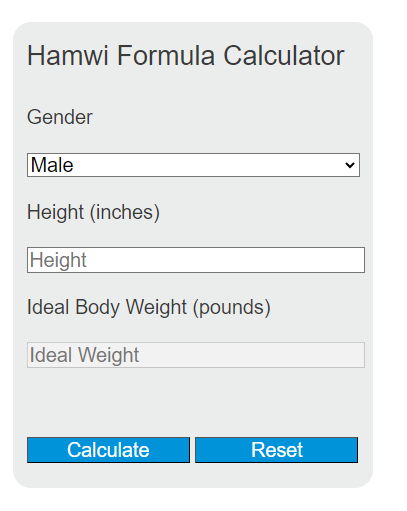
Calculate Hamwi ideal body weight from height and sex—or solve for height—with metric and imperial units, frame-size adjustment, and optional weight comparison.
Note: This calculator provides an educational estimate (Hamwi IBW reference) and isn’t medical advice. Don’t use it as a “goal weight” or to diagnose health status. Not intended for children/teens, pregnancy/postpartum, or people with a history of eating disorders. Don’t use IBW for medication dosing unless a clinician specifically instructs you.
- All Health and Medical Calculators
- Adjusted Body Weight & Ideal Body Weight Calculator
- Ideal Waist Size Calculator
Hamwi Formula
The Hamwi method estimates an adult ideal body weight (IBW) from height using sex-based reference values. It is best used as a quick reference point for comparison, nutrition planning, and general screening. It does not directly measure body fat, muscle mass, or overall health status.
Hamwi ideal body weight formula
Male reference
Female reference
Here, H is height in inches. Because the reference point is 60 inches, the formula adds weight above 5 feet and subtracts weight below 5 feet automatically.
Hamwi formula in kilograms
Male reference
Female reference
Height conversion formulas
If your height is entered in centimeters or meters, convert it to inches before applying the Hamwi equation.
How to calculate ideal body weight
- Select the sex reference used by the calculator.
- Enter height in inches, centimeters, or meters.
- Convert height to inches if needed.
- Apply the correct Hamwi equation.
- Read the result in pounds or kilograms.
IBW range around the estimate
Some calculators also show a comparison band around the Hamwi estimate. A common presentation is 10% below to 10% above the calculated IBW.
Hamwi reference table
| Height | Male IBW | Female IBW |
|---|---|---|
| 5 ft 0 in | 106 lb (48.1 kg) | 100 lb (45.4 kg) |
| 5 ft 2 in | 118 lb (53.5 kg) | 110 lb (49.9 kg) |
| 5 ft 4 in | 130 lb (59.0 kg) | 120 lb (54.4 kg) |
| 5 ft 6 in | 142 lb (64.4 kg) | 130 lb (59.0 kg) |
| 5 ft 8 in | 154 lb (69.9 kg) | 140 lb (63.5 kg) |
| 5 ft 10 in | 166 lb (75.3 kg) | 150 lb (68.0 kg) |
| 6 ft 0 in | 178 lb (80.7 kg) | 160 lb (72.6 kg) |
Example calculations
Male, 70 inches tall
Female, 64 inches tall
How to interpret your result
- Use it as a reference, not a diagnosis. A result above or below Hamwi IBW does not by itself determine whether someone is healthy or unhealthy.
- Body composition matters. Two people can have the same height and weight but very different levels of muscle mass and body fat.
- Frame size and build can shift practical expectations. A simple Hamwi calculator does not fully account for skeletal frame, athletic build, edema, or unusual body proportions.
- It is most appropriate for adults. It is not designed for children or teenagers, and it should be interpreted cautiously in pregnancy and other special situations.
- Clinical context matters. In healthcare settings, IBW may be used alongside other measures rather than by itself.
When the Hamwi formula is useful
- Getting a fast height-based weight reference
- Comparing different ideal body weight methods
- Building a general nutrition or wellness estimate
- Reviewing an adult height-to-weight benchmark in pounds or kilograms
Hamwi formula FAQ
- Is the Hamwi formula the same as BMI?
- No. Hamwi gives a reference body weight based on height, while BMI compares a person’s current weight to height. They answer different questions.
- What happens if height is below 5 feet?
- The same equation still works. Because 60 inches is subtracted inside the formula, heights below 5 feet reduce the final IBW estimate.
- Why might my actual healthy weight differ from the Hamwi result?
- The formula does not capture body-fat distribution, muscle mass, frame size, training status, age-related changes, or medical conditions that can affect body weight.
- Should Hamwi IBW be treated as a target weight?
- It is better viewed as a reference value. Personal goals and clinical decisions should consider broader health factors, not only a single formula result.
- Can I use Hamwi IBW for medication dosing?
- Only if a clinician or protocol specifically tells you to do so. Medication dosing rules depend on the drug and the clinical setting.