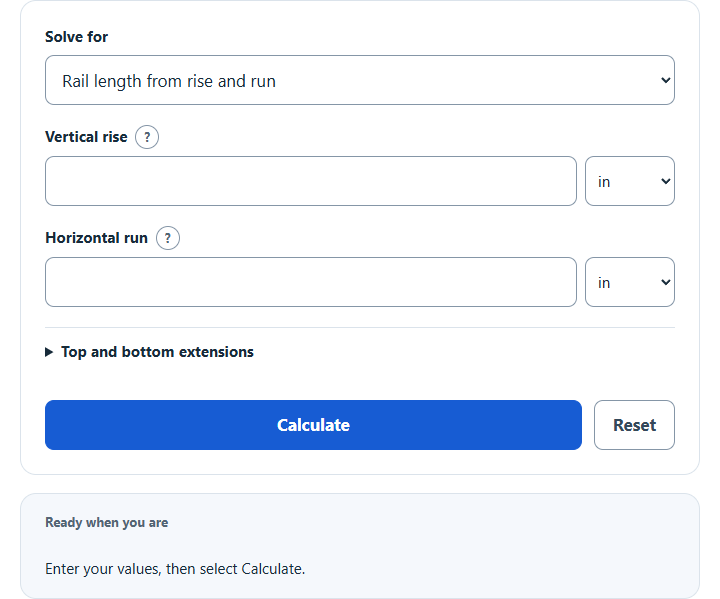
Calculate stair handrail length and angle from the rise and run, with optional top and bottom extensions, in feet and inches or metric units.
Related Calculators
- Deck Post Spacing Calculator
- Baseboard Trim Calculator
- Waste Factor Calculator
- Pipe Slope Calculator
- All Construction Calculators
Calculator Functions
| Function | What it does | What it requires |
|---|---|---|
| Rail length from rise and run | Finds the sloped rail length and adds any top and bottom extensions | Requires the vertical rise and the horizontal run |
| Horizontal run from sloped length | Finds the horizontal run under a rail of known sloped length | Requires the straight sloped length, excluding extensions, and the vertical rise |
| Vertical rise from sloped length | Finds the vertical rise under a rail of known sloped length | Requires the straight sloped length, excluding extensions, and the horizontal run |
Lengths can be entered in inches, feet, centimeters, meters or millimeters. Every function has optional top and bottom extensions, measured along the rail and counted as zero if left blank. Each result lists the straight sloped segment, the total with extensions, the handrail angle from horizontal, and the total in feet and inches and in meters.
Handrail Length Formulas
| L | Straight sloped length of the rail |
| rise | Height from the bottom rail point to the top rail point |
| run | Level distance between the same two points |
The rise, the run and the rail form a right triangle, so the rail is its diagonal [1]. The handrail angle from horizontal is arctan(rise ÷ run).
Rail length from rise and run
A 72 in rise over a 120 in run gives a sloped length of 139.94 in at an angle of 31°. Adding a 12 in top extension and an 11 in bottom extension gives a total of 162.94 in, or 13 ft 6.9 in.
Horizontal run from sloped length
A 150 in sloped length with a 90 in rise has a 120 in run. The rise must be shorter than the sloped length.
Vertical rise from sloped length
A 150 in sloped length with a 120 in run has a 90 in rise.
Handrail extensions
Under the ADA Standards, a stair handrail extends horizontally for at least 12 in beyond the top riser nosing. At the bottom it continues at the slope of the stair for a horizontal distance of at least one tread depth beyond the last riser nosing [2]. The calculator adds extensions as lengths along the rail, so a sloped bottom extension is longer than its horizontal distance: an 11 in tread depth at 31° is 11 ÷ cos 31° = 12.8 in of rail. The same standards put the top of the gripping surface 34 to 38 in above the stair nosings [2].
Limits of This Estimate
- No allowance is included for returns, fittings, joints, landings, trimming or waste.
- The rise and run must be measured between the same two rail end points. A riser count times a tread depth is not always the actual horizontal span.
- Length alone does not show that a handrail is supported well enough or meets a building code. The extension and height figures are from the ADA Standards [2], and other codes can differ.
Sources
- Clark University, Euclid’s Elements, Book I, Proposition 47: the sloped length as the diagonal of the right triangle formed by rise and run
- U.S. Access Board, ADA Accessibility Standards, Section 505 Handrails: handrail height and the top and bottom extensions at stairs