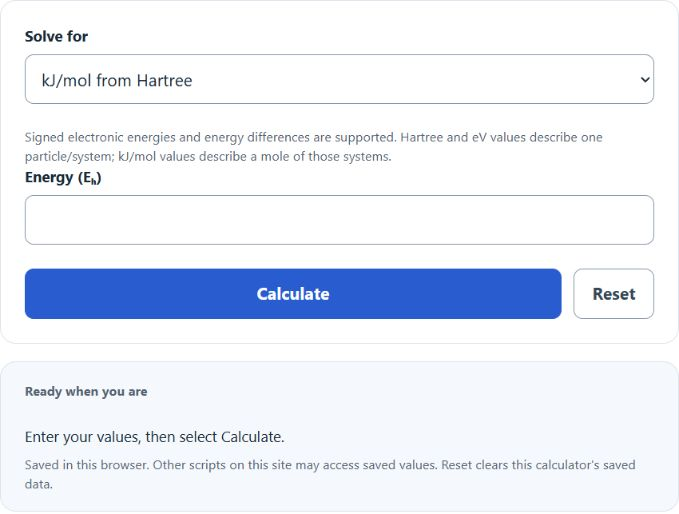
Convert Hartree to kJ/mol or kJ/mol to Hartree using the 2022 CODATA energy constant, with results in kcal/mol, J/mol, electron volts, and joules.
Related Calculators
- Moles To kJ Calculator
- Enthalpy To Temperature Calculator
- Eyring Equation Calculator
- Bond Length Calculator
- All Chemistry Calculators
Hartree to kJ/mol Formula
The following formula converts energy from Hartree to kJ/mol:
Variables:
- EkJ/mol = energy in kilojoules per mole
- EHartree = energy in Hartree
- 2625.5 = rounded conversion factor (2022 CODATA central-value calculation: approximately2625.4996394792 kJ/mol)
To convert kJ/mol back to Hartree, divide by the same conversion factor. Using2625.5 instead of the 2022 central-value factor introduces approximately0.0000137% relative error. Choose rounding to suit the required precision; the calculator retains the unrounded factor.
| Hartree (Eₕ) | kJ/mol | Context |
|---|---|---|
| 0.0001 | 0.263 | Below chemical accuracy |
| 0.0015936 (approx.) | 4.184 (approx.) | Chemical accuracy threshold (1 kcal/mol) |
| 0.01 | 26.3 | Small activation barrier |
| 0.05 | 131.3 | Moderate activation energy |
| 0.10 | 262.6 | Strong activation barrier |
| 0.16 | 420.1 | Approx. C–H bond dissociation energy |
| 0.174 | 456.8 | H–H bond dissociation energy |
| 0.50 | 1312.8 | Half a Hartree |
| 1.00 | 2625.5 | 1 Hartree (base value) |
| 5.00 | 13127.5 | |
| 10.00 | 26255.0 | |
| Constant: 1 Hartree = 2625.5 kJ/mol. BDE values are approximate. | ||
What is a Hartree?
The Hartree (symbol:Eh) is the atomic unit of energy. Its 2022 CODATA value is4.3597447222060(48)×10−18 J. The parentheses indicate standard uncertainty in the final digits. It equals2hcR∞ and the Coulomb energy scale for elementary charges separated by one Bohr radius. Twice the actual hydrogen ionization energy is only an approximation, owing to finite nuclear mass and other corrections.
Douglas Hartree (1897–1958), a British mathematician and physicist, introduced the atomic unit system to eliminate physical constants from Schrödinger’s equation by setting me = e = ℏ = 1. In atomic units, the Hartree is the natural energy scale the same way the meter is the natural length scale in SI. Many molecular quantum-chemistry programs report electronic energies in Hartree. Always check the output units: VASP, for example, reports relevant total-energy output in eV.
Why the Conversion Factor is 2625.5
The factor comes from multiplying the per-molecule joule value by Avogadro’s number, then dividing by 1000:
4.3597447 × 10−18 J × 6.02214076 × 1023 mol−1 ÷ 1000 = 2625.4996 kJ/mol
The factor is derived from Avogadro’s constant and the SI value of the Hartree. Rounding it to2625.5 produces approximately0.0000137% relative error; whether that matters depends on the requested precision.
Quantum Chemistry Energy Unit Reference
The table below shows rounded equivalents for 1 Hartree in all energy units commonly encountered in computational chemistry output files and published results:
| Unit | Value | Used In |
|---|---|---|
| kJ/mol | 2625.4996 | Thermochemistry, IUPAC standard |
| kcal/mol | 627.5095 | US computational chemistry literature |
| eV | 27.2114 | Solid-state physics, band gaps, ionization energies |
| cm−1 (wavenumbers) | 219,474.6 | Vibrational spectroscopy, IR/Raman |
| K (kBT) | 315,775 | Statistical thermodynamics, Boltzmann populations |
| J (per molecule) | 4.35974 × 10⁻¹⁸ | SI base; rarely used directly in QC |
Chemical Accuracy in Hartree
“Chemical accuracy” is the benchmark of 1 kcal/mol (4.184 kJ/mol = 0.001594 Eh). Meeting this error target on an appropriate benchmark does not by itself establish reliability for a different system or reaction. Because quantum chemistry codes report energies to 6+ decimal places in Hartree, small numerical differences carry large physical consequences: 0.003 Eh = 7.9 kJ/mol, enough to change a reaction from exothermic to endothermic.
| Method | MAE (kcal/mol) | MAE (Eₕ) | Chemical Accuracy? |
|---|---|---|---|
| CCSD(T)/CBS | ~0.1 | ~0.000159 | Yes |
| MP2/large basis | 1–5 | 0.0016–0.0080 | Borderline |
| DFT hybrid (B3LYP) | 3–5 | 0.0048–0.0080 | Often not |
| DFT modern (ωB97M-V) | 0.5–1.5 | 0.0008–0.0024 | Near threshold |
| Hartree–Fock (HF) | 10–50 | 0.016–0.080 | No |
| Illustrative magnitudes, not universal performance guarantees: MAE depends on the benchmark, system and calculation protocol. MAE = mean absolute error; CBS = complete basis set extrapolation. | |||