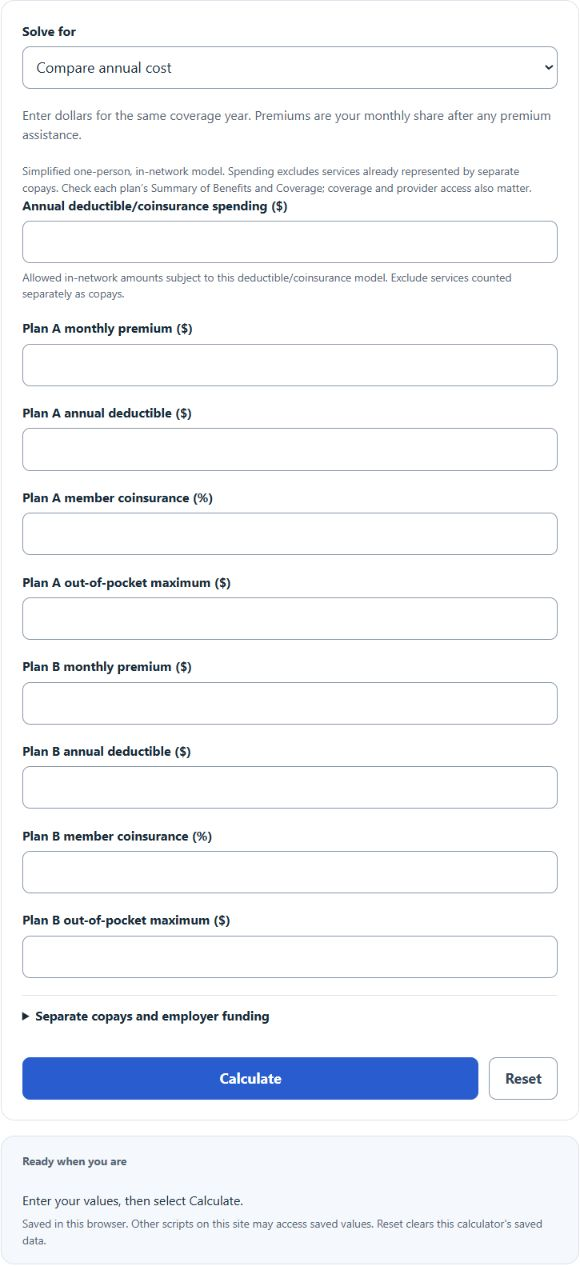
Compare two simplified annual health-plan cost models using premiums, deductible, member coinsurance, separate copays, out-of-pocket maximum and an employer funding offset. This estimate does not choose coverage for you.
Health Insurance Plan Comparison Formula
A simplified net annual plan cost adds your premiums to covered in-network cost sharing and subtracts the employer funding offset you choose to value:
Annual Cost = 12 * Monthly Premium + Cost Sharing - Employer Contribution
The modeled spending includes only allowed amounts subject to the deductible and coinsurance. Exclude services already represented by the separate copay estimate to avoid double-counting. That separate cost sharing is assumed to count toward the same out-of-pocket maximum:
Cost Sharing = min(OOP Max, min(Spending, Deductible) + Coinsurance * max(0, Spending - Deductible) + Copays)
Variables:
- Monthly Premium is the employee or household premium contribution
- Spending is annual in-network allowed spending subject to this deductible/coinsurance model, excluding services represented by separate copays
- Deductible is the amount paid before modeled coinsurance begins
- Coinsurance is the member percentage after the deductible
- Copays is a separate, fixed annual estimate of covered in-network cost sharing that counts toward this maximum; blank means $0
- OOP Max is the annual in-network out-of-pocket maximum
- Employer Contribution is the eligible employer funding offset you choose to value; blank means $0. Your own HSA deposits are not a cost discount. HRA reimbursements depend on actual eligible expenses
The break-even calculation checks every deductible/cap boundary and the segments between them, including the final unbounded segment. It reports all isolated equality points and continuous equality intervals, or establishes that one modeled cost remains lower.
Health Plan Cost Comparison Example
Plan A has a $450 monthly premium, $2,000 deductible, 20% member coinsurance, $7,000 out-of-pocket maximum, $500 in separate annual copays, and a $1,000 employer funding offset. Plan B has a $650 premium, $1,000 deductible, 10% member coinsurance, a $4,500 maximum, $350 in separate copays and no funding offset. Spending below excludes services represented by those copays; $0 spending therefore does not mean no care.
| Allowed spending | Plan A net annual cost | Plan B net annual cost | Lower cost |
|---|---|---|---|
| $0 | $4,900 | $8,150 | Plan A |
| $5,000 | $7,500 | $9,550 | Plan A |
| $15,000 | $9,500 | $10,550 | Plan A |
| $40,000 | $11,400 | $12,300 | Plan A |
Example Problems
Example 1: Compare plans at expected spending.
Using the example plans, you expect $12,000 of allowed spending subject to the deductible/coinsurance model, excluding services represented by the separate copays.
Plan A’s modeled cost sharing is $4,500 and its net annual cost is $8,900. Plan B’s modeled cost sharing is $2,450 and its annual cost is $10,250, so Plan A is lower by about $1,350.
Example 2: Evaluate a high-spending year.
At sufficiently high spending, each plan eventually reaches its out-of-pocket maximum.
If each maximum is reachable under the entered coinsurance rules, the modeled high-spending net amount is annual premiums plus that maximum minus the chosen funding offset: $11,400 for Plan A and $12,300 for Plan B. This is not an overall spending limit because noncovered and out-of-network care are excluded.
Frequently Asked Questions
Should I enter billed charges or allowed amounts?
Enter insurer-negotiated allowed amounts for the in-network services subject to this deductible/coinsurance model. Exclude services represented by the separate copay estimate. Provider billed charges are not the same as allowed amounts.
Does the out-of-pocket maximum include premiums?
No. Premiums normally do not count toward the plan’s out-of-pocket maximum, which is why the calculator adds annual premiums separately.
What does this simplified model leave out?
It does not fully model family/embedded deductibles, service-specific benefits, prescription tiers, noncovered care, out-of-network limits, taxes or premium-assistance eligibility. Copays stay fixed in break-even mode. An employer funding offset is a comparison assumption, not a reimbursement or refund calculation; HSA funds generally cannot pay premiums, and HRA funds follow eligible-expense restrictions. Review the plan’s Summary of Benefits and Coverage, network and covered services. See HealthCare.gov on total plan costs and HSA restrictions.