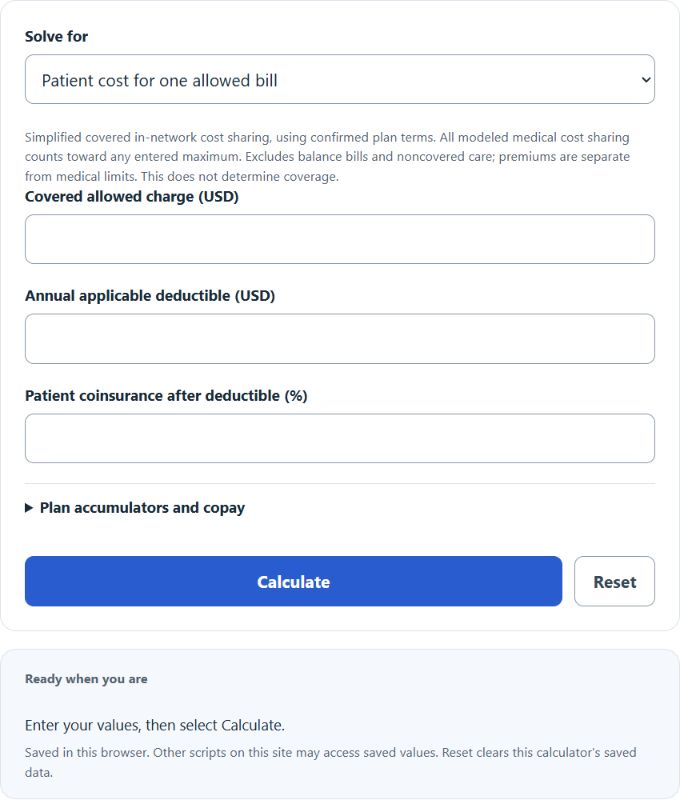
Calculate what you owe out of pocket for one medical bill or a full year using your deductible, coinsurance, copay and out-of-pocket maximum.
Out-of-Pocket Cost Formula
The calculator supports one allowed bill, projected annual cost, a reverse medical budget, and adding known deductible/coinsurance amounts. The simple formula below describes the known-components task with no copay or cap. The other tasks apply the entered deductible, coinsurance percentage and any confirmed remaining medical limit. Use plan terms that match the disclosed model, not an assumed universal copay sequence.
- OPC = estimated out-of-pocket cost for the covered service
- D = deductible paid for that service
- CI = coinsurance amount paid in dollars
What this calculator includes
| Cost component | How to treat it |
|---|---|
| Deductible applied to the service | Included directly in the calculator |
| Coinsurance amount in dollars | Included directly in the calculator |
| Copay | Included as an optional distinct known component; the one-bill task explicitly models copay before deductible. |
| Non-covered services | Not reflected in the estimate |
| Balance billing or out-of-network charges | Usually not reflected in the estimate |
| Out-of-pocket maximum limits | Enter an optional confirmed maximum and prior covered spending; blank is no cap modeled, while entered 0 means reached. |
How to calculate out-of-pocket cost
- Identify the dollar amount of the service that will be applied to your deductible.
- Identify the coinsurance amount you will owe for the remaining allowed charge.
- Choose the known-components task and enter both dollar amounts.
- Add a distinct copay or confirmed medical cap in optional settings if applicable. Noncovered charges and balance bills remain excluded.
In the known-components task, enter 0 for a contribution that does not apply. In the other tasks, enter the annual deductible and its already-credited amount; enter the patient coinsurance percentage, including 0 when the plan pays the rest.
If you only know the coinsurance rate
The one-bill, annual and budget tasks accept the patient coinsurance percentage directly. For the known-components task, convert that rate to a dollar amount first if the amount is not already known. For a no-copay service:
Where r is the coinsurance rate written as a decimal and R is the remaining allowed amount after deductible.
Using the allowed amount is important because insurance cost-sharing is commonly based on the insurer's allowed charge, not the provider's original billed amount.
Examples
Example 1
A covered service applies $400 to your deductible and you owe $120 in coinsurance.
Your estimated out-of-pocket cost for that service is $520.
Example 2
Your deductible contribution is $250. After that amount is applied, the remaining allowed charge is $1,000 and your plan requires 20% coinsurance.
Your estimated out-of-pocket cost is $450.
Common situations
| Situation | What to enter or adjust |
|---|---|
| Deductible already met | Known-components task: enter 0 for deductible contribution. Other tasks: enter annual deductible and equal already-credited amount. |
| No coinsurance on the service | Enter 0 for known coinsurance dollars or for the patient percentage, as appropriate to the selected task. |
| Only a coinsurance percentage is known | Use a rate-based task directly, or convert the percentage for the known-components task. |
| Service also has a copay | Use the optional copay only when its disclosed treatment matches the plan; do not double-count it. |
| You are close to your out-of-pocket maximum | Enter the confirmed maximum and already-paid covered cost sharing so the selected cap is applied. |
Deductible, coinsurance, and copay differences
- Deductible is the amount you pay before the plan starts sharing more of the cost.
- Coinsurance is your share of the allowed charge after deductible rules are applied.
- Copay is a fixed charge for a visit, prescription, or service and is not the same as coinsurance.
When this estimate is most useful
- Comparing the likely patient cost of one procedure under different plans
- Estimating the cost of imaging, lab work, specialist visits, or outpatient treatment
- Checking whether a bill seems consistent with your deductible and coinsurance structure
- Planning healthcare spending before a scheduled covered service
Important note
This estimate is intentionally simplified. Actual member responsibility depends on network status, authorization, exclusions, allowed rates, copays and plan limits. All modeled medical cost sharing counts toward any selected maximum; premiums do not. The annual task uses remaining charges and adds prior covered spending plus 12 monthly premiums once. The reverse task assumes no copays: a budget covering the remaining cap, or exactly meeting the remaining deductible at 0% coinsurance, has no finite charge ceiling in this equation, not unlimited insurance coverage. Coinsurance is rounded once to cents, half up; per-claim rounding can differ. Confirm plan terms and covered in-network status.