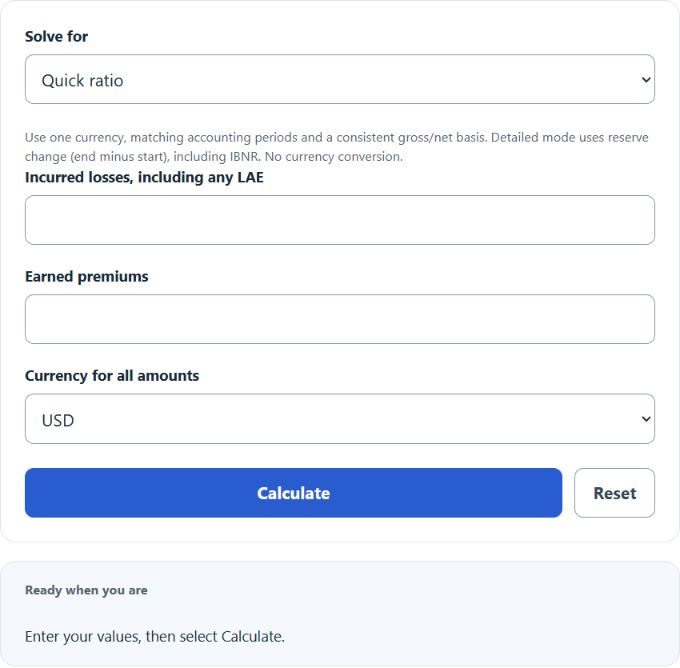
Calculate insurance loss ratio from incurred losses and earned premiums, and find the premium needed for a target loss ratio before expenses.
Related Calculators
- Annual Loss Expectancy Calculator
- Cost Per Claim Calculator
- Unearned Premium Calculator
- Annual Insurance Premium Calculator
- Actual Cash Value Calculator
- Total Loss Calculator
- All Business Calculators
Insurance Loss Ratio Formula
The calculator uses one of three formulas depending on the mode you select.
Quick ratio
Detailed ratio
Combined ratio (earned-premium basis, when expense ratio is provided)
Target premium
- Incurred Losses: claims paid during the period plus the change in case and IBNR reserves, plus incurred LAE when included in the chosen ratio basis.
- Claims Paid: claim payments during the matching accounting period.
- Reserves: in Detailed ratio, the ending unpaid loss reserve (including IBNR) minus the beginning reserve; releases can be negative.
- LAE: loss adjustment expenses, incurred costs of investigating and settling claims; do not include amounts already counted in reserves.
- Earned Premiums: portion of written premium attributable to coverage already provided.
- Expense Ratio: other underwriting expenses divided by the same earned-premium basis, excluding LAE already counted in the numerator.
- Target Loss Ratio: the loss ratio the insurer wants to achieve, entered as a percent or decimal.
Both numerator and denominator must cover the same accounting period. Use earned premiums, not written premiums, so the income matches the exposure that produced the losses. The calculator does not adjust for reinsurance, so enter net or gross figures consistently.
The Quick ratio tab gives you the headline loss ratio from a single losses figure. The Detailed ratio mode breaks losses into period paid claims, reserve change and incurred LAE so you can see incurred losses build up, and it adds a combined ratio when you supply an expense ratio. The Target premium tab inverts the formula to tell you what premium volume you need to hit a chosen loss ratio, and it compares that to your current premium if you enter one.
Reference Tables
The ranges below are illustrative scenarios, not verified current industry averages or universal healthy targets. Appropriate ratios vary by line of business, jurisdiction and accounting basis. Statutory health medical loss ratios include quality-improvement costs and adjustments and are not calculated by this widget.
| Loss Ratio | Interpretation |
|---|---|
| Below 40% | Losses are well below premium before expenses; this alone does not establish adequate pricing or profitability. |
| 40% to 60% | Illustrative band; profitability depends on all included expenses and the accounting basis. |
| 60% to 80% | Profitability depends on whether the complete combined ratio is below 100%. |
| 80% to 100% | Less than 20 percentage points remain for other expenses before the combined ratio reaches 100%. |
| Above 100% | Underwriting loss. Losses alone exceed earned premiums. |
| Line of Business | Illustrative P&C Range / Separate Health Standard |
|---|---|
| Personal auto | 65% to 75% |
| Homeowners | 55% to 75% (highly catastrophe sensitive) |
| Commercial property | 50% to 70% |
| Workers compensation | 60% to 75% |
| General liability | 55% to 70% |
| Health (ACA minimum) | Generally 80% individual and small group / 85% large group, using separate statutory health MLR rules |
Worked Examples and FAQ
Example 1: Quick ratio. A carrier earned $5,000,000 in premiums and incurred $3,200,000 in losses. Loss ratio = 3,200,000 / 5,000,000 × 100 = 64%. Underwriting margin before other expenses is $1,800,000.
Example 2: Detailed ratio with combined ratio. Period claims paid $1,800,000, reserve increase $700,000, separately incurred LAE $250,000, earned premiums $4,000,000, expense ratio 28%. Incurred losses = $2,750,000. Loss ratio = 68.75%. Combined ratio = 68.75% + 28% = 96.75%, leaving about 3.25 percentage points after the included costs on a common earned-premium basis.
Example 3: Target premium. You expect $6,000,000 of incurred losses next year and want a 60% loss ratio. Required premium = 6,000,000 / 0.60 = $10,000,000. If current earned premium is $9,000,000, the premium gap is about 11.1% of current premium, assuming unchanged losses, exposures and business mix; this is not an automatic rate recommendation.
Is a lower loss ratio always better? No. A very low loss ratio can signal overpricing, which invites competitors to underbid and regulators to push back. The goal is a stable ratio that covers expected losses, expenses, and a reasonable profit margin.
What is the difference between loss ratio and combined ratio? Loss ratio covers the chosen incurred-loss basis, including LAE when supplied. Combined ratio adds other underwriting expenses without double-counting LAE; its profitability interpretation requires matching denominator and accounting conventions.
Should I use paid or incurred losses? Use incurred losses for performance analysis. Paid losses alone omit unpaid claims. For calendar-period data, incurred losses use paid claims plus the change in unpaid liabilities; for cumulative cohort data, match cumulative payments, reserves and premium to that cohort.
Why use earned premium instead of written premium? Written premium includes coverage that has not yet been provided. Earned premium matches the period in which losses actually occurred, giving a fair ratio.
Does the calculator handle reinsurance? It treats whatever you enter as the basis. If you want a net loss ratio, enter losses net of recoveries and premiums net of ceded premium. For a gross ratio, enter gross figures.