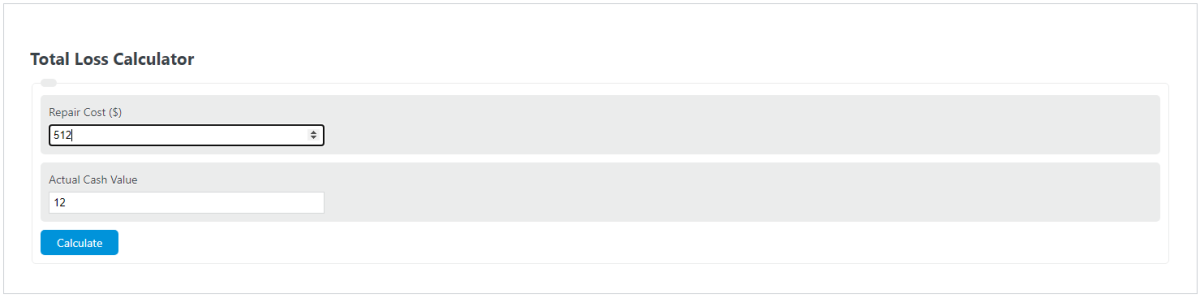
Calculate whether a vehicle may be a total loss using repair cost, actual cash value, salvage value, or a percentage threshold, and estimate the payout.
- All Automotive Calculators
- Actual Cash Value Calculator
- Accident Depreciation Calculator
- Depreciation Calculator Per Year
- Salvage Value Calculator
- Residual Value Calculator
Total Loss Formula
The core calculation compares repair cost to actual cash value as a percentage:
- TL% is the total loss percentage (%)
- RC is the repair cost ($)
- ACV is the actual cash value ($)
Most states declare a vehicle a total loss when TL% exceeds a specific threshold, ranging from 60% to 100% depending on the state. States that use the Total Loss Formula (TLF) instead apply a different rule: when repair cost plus salvage value is greater than or equal to the ACV, the vehicle is totaled regardless of the damage percentage alone.
What Is a Total Loss?
A total loss is a legal and insurance designation applied when a vehicle’s damage makes repair economically impractical relative to its pre-accident market value. The term does not require the vehicle to be destroyed or unsafe. A vehicle in apparently drivable condition can be declared a total loss if the cost to restore it to pre-accident condition crosses the state’s defined threshold.
The insurer, not the owner, makes the total loss determination. Only after inspecting the vehicle and obtaining a repair estimate does the adjuster compare repair cost against the independently calculated ACV. Owners who believe their vehicle was incorrectly valued or incorrectly declared a total loss have the right to dispute both the ACV and the total loss determination.
How Insurance Companies Determine ACV
Actual cash value is not calculated internally by the insurance adjuster. Instead, insurers rely on one of three dominant third-party valuation platforms: CCC One, Mitchell WorkCenter, or Audatex. These systems analyze millions of recent vehicle transactions and generate a localized market value based on comparable sales within the prior 30 to 60 days in your geographic area.
The valuation begins with a base price for the specific year, make, model, and trim, then applies a series of adjustments. Mileage relative to expected average (approximately 12,000 to 15,000 miles per year), documented condition, factory options, aftermarket upgrades, color, and regional supply-and-demand all influence the final figure. Each adjustment is documented in the valuation report, which policyholders are entitled to receive upon request.
ACV is not the same as retail price, trade-in value, or loan payoff balance. It reflects what the vehicle would have sold for, as-is, in the open market on the day before the loss. A vehicle with a $14,000 loan balance and a $10,000 ACV will generate a $10,000 settlement (minus deductible), leaving the owner responsible for the $4,000 gap unless gap insurance is in force.
Two Methods States Use to Declare a Total Loss
Percentage Threshold (TLT) is the more common approach. A vehicle is declared a total loss when repair costs reach a fixed percentage of ACV. Thresholds vary widely: Oklahoma sets the lowest threshold in the country at 60%, meaning moderate damage to older vehicles frequently triggers a total loss. Nevada uses 65%. Most states cluster around 70% to 75%. Florida, Missouri, and Oregon use 80%. Colorado and Texas require 100%, meaning an insurer in those states is not obligated to declare a total loss until repair costs meet or exceed the vehicle’s full ACV.
Total Loss Formula (TLF) states skip the percentage entirely. Instead, the test is whether repair cost plus salvage value is greater than or equal to the ACV. Because salvage value is added to the equation, even a moderately damaged vehicle can pass the total loss threshold if salvage value is high (common for newer vehicles or popular models with strong parts demand). California, Georgia, Illinois, Ohio, Pennsylvania, Washington, and approximately 20 other states use this method.
The practical difference matters. Under TLF, a vehicle worth $8,000 with $5,000 in repair costs and a $3,500 salvage value would be totaled ($5,000 + $3,500 = $8,500, which exceeds $8,000 ACV), even though the damage-to-value ratio is only 62.5%. Under a 75% threshold state, that same vehicle would be repaired.
State Total Loss Thresholds Reference
The table below shows the method and threshold applied in each U.S. state and the District of Columbia.
| State | Method | Threshold |
|---|---|---|
| Alabama | Percentage | 75% |
| Alaska | Total Loss Formula | RC + Salvage ≥ ACV |
| Arizona | Total Loss Formula | RC + Salvage ≥ ACV |
| Arkansas | Percentage | 70% |
| California | Total Loss Formula | RC + Salvage ≥ ACV |
| Colorado | Percentage | 100% |
| Connecticut | Total Loss Formula | RC + Salvage ≥ ACV |
| Delaware | Total Loss Formula | RC + Salvage ≥ ACV |
| Florida | Percentage | 80% |
| Georgia | Total Loss Formula | RC + Salvage ≥ ACV |
| Hawaii | Total Loss Formula | RC + Salvage ≥ ACV |
| Idaho | Total Loss Formula | RC + Salvage ≥ ACV |
| Illinois | Total Loss Formula | RC + Salvage ≥ ACV |
| Indiana | Percentage | 70% |
| Iowa | Percentage | 70% |
| Kansas | Percentage | 75% |
| Kentucky | Percentage | 75% |
| Louisiana | Percentage | 75% |
| Maine | Total Loss Formula | RC + Salvage ≥ ACV |
| Maryland | Percentage | 75% |
| Massachusetts | Total Loss Formula | RC + Salvage ≥ ACV |
| Michigan | Percentage | 75% |
| Minnesota | Percentage | 70% |
| Mississippi | Total Loss Formula | RC + Salvage ≥ ACV |
| Missouri | Percentage | 80% |
| Montana | Total Loss Formula | RC + Salvage ≥ ACV |
| Nebraska | Percentage | 75% |
| Nevada | Percentage | 65% |
| New Hampshire | Percentage | 75% |
| New Jersey | Total Loss Formula | RC + Salvage ≥ ACV |
| New Mexico | Total Loss Formula | RC + Salvage ≥ ACV |
| New York | Percentage | 75% |
| North Carolina | Percentage | 75% |
| North Dakota | Percentage | 75% |
| Ohio | Total Loss Formula | RC + Salvage ≥ ACV |
| Oklahoma | Percentage | 60% |
| Oregon | Percentage | 80% |
| Pennsylvania | Total Loss Formula | RC + Salvage ≥ ACV |
| Rhode Island | Total Loss Formula | RC + Salvage ≥ ACV |
| South Carolina | Percentage | 75% |
| South Dakota | Total Loss Formula | RC + Salvage ≥ ACV |
| Tennessee | Percentage | 75% |
| Texas | Percentage | 100% |
| Utah | Total Loss Formula | RC + Salvage ≥ ACV |
| Vermont | Total Loss Formula | RC + Salvage ≥ ACV |
| Virginia | Percentage | 75% |
| Washington | Total Loss Formula | RC + Salvage ≥ ACV |
| West Virginia | Percentage | 75% |
| Wisconsin | Percentage | 70% |
| Wyoming | Percentage | 75% |
| District of Columbia | Percentage | 75% |
Total Loss Frequency: How Common Are Totaled Vehicles?
According to CCC Intelligent Solutions, 22.6% of all auto insurance losses through early 2025 were declared total losses, up from 22.1% in 2024. That rate hit a record high in 2024 and has continued rising. Roughly 1 in 4 vehicles involved in a reported claim is now declared a total loss, a figure that would have been unimaginable in prior decades.
Two structural forces drive this trend. First, over 70% of total loss valuations in 2024 involved vehicles 7 years old or older, and the average age of the U.S. vehicle fleet reached a record 12.6 years. Depreciation on older vehicles outpaces rising repair costs, meaning even moderate damage regularly crosses the total loss threshold. Second, modern vehicles equipped with advanced driver assistance systems (ADAS) carry radar, lidar, and camera sensors embedded in bumpers, windshields, and mirrors. A low-speed collision causing minimal body damage can still require sensor recalibration and replacement costing $1,500 to $3,000 or more, pushing repair estimates above the threshold on vehicles that appear only lightly damaged.
What Happens After a Total Loss Declaration
Once an insurer declares a total loss, the claim follows a defined sequence. The adjuster provides a written valuation report showing the ACV calculation and a settlement offer equal to ACV minus your deductible. Policyholders have the right to review the report, identify errors in the comparable vehicles selected, and formally dispute the ACV. Providing documentation of pre-accident condition, recent maintenance, and dealer-installed or factory options supports a higher valuation counter-argument.
If you financed or leased the vehicle, the settlement payout goes first to the lienholder. If you owe more than the ACV, you are responsible for the difference unless you carry gap insurance, which is specifically designed to cover the shortfall between ACV and the remaining loan or lease balance. Gap insurance is commonly included in dealer financing arrangements and can also be purchased as a standalone policy or added as a rider to a standard auto policy.
If you want to keep the vehicle after a total loss settlement, most states allow this. The insurer deducts the salvage value from the payout, and the title is rebranded as a salvage title. The owner can then pursue repairs and apply for a rebuilt title, though the inspection and re-registration process varies by state.
Salvage Title and Rebuilt Title: Value Impact
A vehicle declared a total loss receives a salvage title, which permanently flags the vehicle in DMV records nationwide. Salvage title vehicles are typically worth 20% to 60% of their clean title market value, depending on the type and severity of damage. Flood and fire damage carry the steepest discounts, with values as low as 10% to 30% of a comparable clean title vehicle. Collision-damaged vehicles with good structural integrity hold more value on the salvage market because parts remain serviceable.
After full repairs and a passing state safety inspection, the owner can apply for a rebuilt title. Even with a rebuilt title, most valuation guides and lenders apply a 20% to 40% deduction compared to a clean title vehicle of the same year, make, model, and mileage. Standard auto insurance policies typically restrict coverage on rebuilt title vehicles to liability only. Some insurers will not write comprehensive or collision coverage at all, which also limits financing options since lenders generally require full coverage as a condition of a loan.
Disputing a Total Loss Settlement
The insurer’s first settlement offer is a starting point. Policyholders can challenge the ACV by requesting the full valuation report and identifying errors in the comparable vehicles used. Common grounds for dispute include comps with higher mileage, lower trim levels, worse condition ratings, or sales from markets with materially different pricing than your local area. Bringing your own documented comparables from current local dealer listings and recent private party sales strengthens a counter-argument considerably.
If direct negotiation does not resolve the dispute, most policies include an appraisal clause. Both parties hire independent appraisers, and a neutral umpire resolves any remaining difference. Total loss public adjusters and attorneys who specialize in insurance claims are also options for high-value disputes. Most states require insurers to respond to disputes within a defined timeframe and to provide written explanations for claim delays exceeding 30 days.