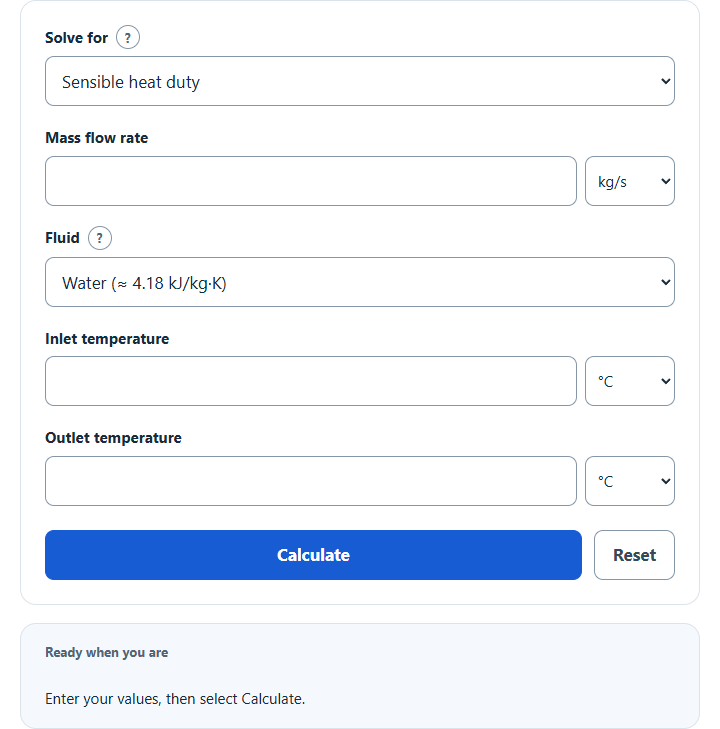
Calculate heat exchanger duty (Q = m·Cp·ΔT) from flow rate and inlet and outlet temperatures with typical Cp for water, glycol or air, or latent duty.
- All Physics Calculators
- All Heat Calculators
- Electric Motor Heat Loss Calculator
- Heat Exchanger Effectiveness Calculator
Heat Exchanger Duty Formula
For a single-phase stream, sensible duty is Q̇ = ṁ × Cp × |Tout − Tin| with constant Cp. For phase change, the separate latent-duty equation below applies to the mass flow actually undergoing the transition.
Variables:
- HED is the Heat Exchanger Duty (kW)
- M is the fluid mass flow rate through the exchanger (kg/s)
- LH is the latent heat (kJ/kg)
For phase-change duty, multiply the phase-changing mass flow by the applicable latent heat. This excludes sensible heating before or after the transition. Use the separate sensible, outlet-temperature or mass-flow modes for single-phase energy balances.
How to Calculate Heat Exchanger Duty?
The following steps describe Phase-change duty mode. Select the relevant solve mode rather than leaving an arbitrary input blank.
- First, determine the fluid mass flow rate through the exchanger (kg/s).
- Next, determine the latent heat (kJ/kg).
- Next, gather the formula from above = HED = M * LH.
- Finally, calculate the Heat Exchanger Duty.
- After inserting the variables and calculating the result, check your answer with the calculator above.
Example Problem :
Use the following variables as an example problem to test your knowledge.
fluid mass flow rate through the exchanger (kg/s) = 75
latent heat (kJ/kg) = 100
HED = M * LH = 75 × 100 = 7,500 kW