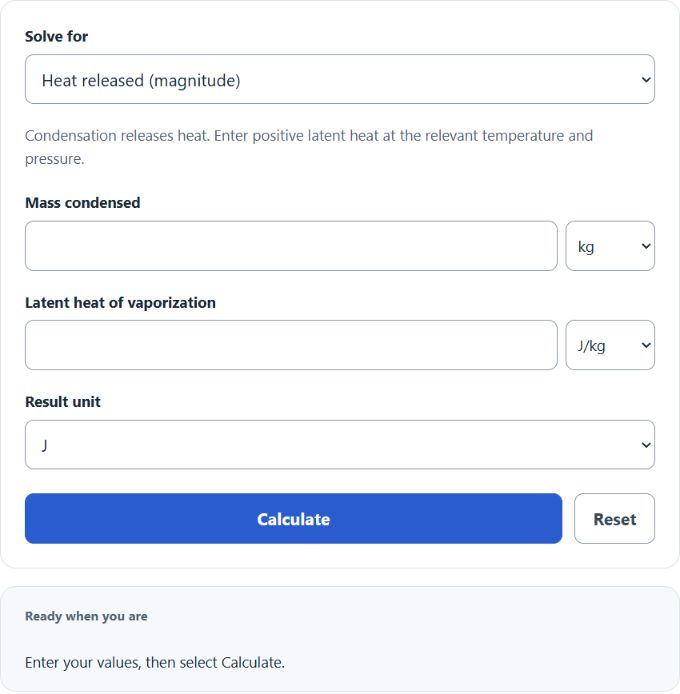
Calculate heat of condensation, mass, or latent heat of vaporization from two known values with J, kJ, MJ, kg, g, and lb units using the Q = mL formula.
Heat of Condensation Formula
The following formula gives the positive magnitude of heat released by condensation for a given mass and latent heat of vaporization at the same temperature and pressure.
Variables:
- Q is the positive magnitude of heat released by condensation (joules)
- m is the mass (kilograms)
- L is the latent heat of vaporization (joules per kilogram)
To calculate the heat of condensation, multiply the mass by the latent heat of vaporization.
What is Heat of Condensation?
The heat of condensation is the amount of heat released when a substance changes from a gas to a liquid at a constant temperature. This process is the reverse of vaporization, where heat is absorbed to convert a liquid into a gas. At the same temperature and pressure, the specific enthalpy change of condensation is equal in magnitude and opposite in sign to that of vaporization. Here, Q = mL reports the positive amount of heat released; the substance’s enthalpy change is −mL. This concept is crucial in various applications, including meteorology, HVAC systems, and industrial processes where phase changes are involved.
How to Calculate Heat of Condensation?
The following steps outline how to calculate the Heat of Condensation.
- First, determine the mass of the substance (m).
- Next, determine the latent heat of vaporization (L).
- Finally, calculate the heat of condensation using the formula Q = m * L.
- After inserting the values and calculating the result, check your answer with the calculator above.
Example Problem :
Use the following variables as an example problem to test your knowledge.
Mass (m) = 2 kg
Latent Heat of Vaporization (L) ≈ 2256 kJ/kg for water at 100 °C and approximately 1 atm. With 2 kg, the released heat is approximately 4512 kJ (4.512 MJ).