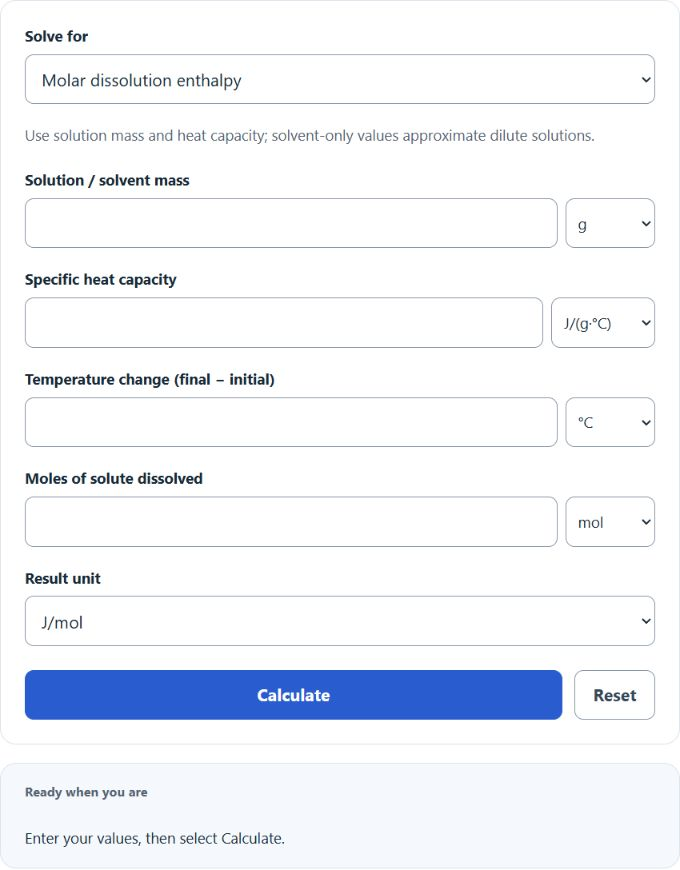
Calculate heat of dissolution, solvent mass, specific heat, temperature change, or moles of solute using the other four entered values.
Related Calculators
- Enthalpy To Temperature Calculator
- Moles To Kj Calculator
- J to kJ/mol Calculator
- Molar Conductivity Calculator
- All Chemistry Calculators
Heat Of Dissolution Formula
Molar dissolution enthalpy is calculated from the heat gained or lost by the solution, divided by moles of solute. The heat of dissolving has the opposite sign to the measured solution heat. Using solvent mass and specific heat approximates a dilute solution; concentrated solutions need the actual solution properties.
- ΔHdiss = heat of dissolution, usually in J/mol or kJ/mol
- m = mass of solution (or solvent mass as a dilute-solution approximation)
- c = specific heat of the solution (or solvent specific heat as an approximation)
- ΔT = change in temperature of the solution or solvent
- n = moles of solute dissolved
Choose the quantity to solve for and enter the four known values. The calculator uses the main formula above or its rearrangement:
The calculator converts entries to base units before solving: J/mol for heat of dissolution, grams for mass, J/g°C for specific heat, °C for temperature change, and mol for amount of solute. A positive temperature change gives a negative heat of dissolution, which means the dissolving process released heat. A negative temperature change gives a positive heat of dissolution, which means the dissolving process absorbed heat.
Common Solvent Specific Heat Values
Use the correct specific heat for the solvent when it is known. For dilute aqueous solutions, water is often used as an approximation.
| Solvent | Specific Heat | Notes |
|---|---|---|
| Water | 4.184 J/g°C | Common value for aqueous calorimetry problems |
| Ethanol | 2.44 J/g°C | Lower heat capacity than water |
| Methanol | 2.53 J/g°C | Typical liquid value near room temperature |
| Acetone | 2.15 J/g°C | Use only if acetone is the solvent |
Interpreting Heat Of Dissolution Results
| Result Sign | Temperature Change | Meaning |
|---|---|---|
| Negative ΔHdiss | Temperature increases | Exothermic dissolution, heat is released |
| Positive ΔHdiss | Temperature decreases | Endothermic dissolution, heat is absorbed |
| Near zero | Very small change | Small heat effect or limited measurement precision |
Example Problems
Example 1: Calculate heat of dissolution
You dissolve 0.050 mol of solute in 100 g of water. The specific heat is 4.184 J/g°C, and the temperature increases by 6.0°C.
The heat of dissolution is:
ΔHdiss = -50,208 J/mol = -50.208 kJ/mol
Example 2: Calculate moles of solute
A dissolution has ΔHdiss = 25,000 J/mol. The solvent mass is 150 g, the specific heat is 4.184 J/g°C, and the temperature change is -2.0°C.
The amount of solute is:
n = 0.050208 mol
FAQ
Why is there a negative sign in the heat of dissolution formula?
The negative sign accounts for heat flow direction. The solvent temperature change shows the heat gained or lost by the solvent. The dissolving process has the opposite heat change. If the solvent warms up, the dissolving process released heat, so ΔHdiss is negative. If the solvent cools down, the dissolving process absorbed heat, so ΔHdiss is positive.
Should temperature change be entered in Celsius or Kelvin?
For a temperature difference, 1°C and 1 K have the same size. A change of 5°C is the same as a change of 5 K. If you enter Fahrenheit, the calculator converts the temperature difference using 5/9.
Can this be used for any solvent?
Use the mass and specific heat of the solution at the measurement conditions. Solvent-only values are a dilute-solution approximation; 4.184 J/g°C is commonly used for dilute aqueous solutions. The model assumes constant pressure, negligible calorimeter heat capacity and no external heat exchange.