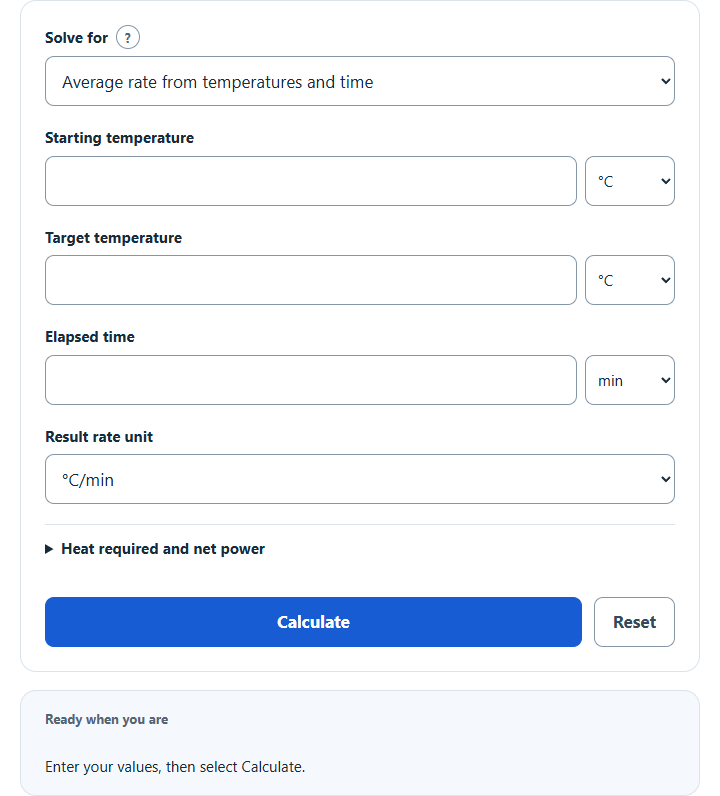
Calculate heating rate from start and end temperatures and elapsed time, or find the final temperature or time, plus optional heat required.
Heating Rate Formula
The examples below calculate average temperature change per unit time. This temperature rate is different from heat-transfer power in watts.
- Where HR is the Heating Rate (°F/min)
- dT is the total change in temperature (°F)
- t is the total time (min)
To calculate the average temperature rate, divide final minus initial temperature by a positive elapsed time. Equal temperatures give zero rate. Final-temperature and time predictions assume a constant signed rate; a zero rate cannot reach a different target. If the target equals the start and the rate is zero, elapsed time is not uniquely determined. Optional sensible heat uses Q = mass × specific heat × temperature change, with suitable average specific heat, uniform temperature and no phase change. Average net power is Q divided by elapsed time; it is not an electrical heater rating.
How to Calculate Heating Rate?
The following example problems outline how to calculate Heating Rate.
Example Problem #1:
- First, determine the total change in temperature (°F).
- The total change in temperature (°F) is given as 40; for example, use 32 °F initially and 72 °F finally. Select °F/min as the result rate unit.
- Next, determine the total time (min).
- The total time (min) is provided as 20.
- Finally, calculate the Heating Rate using the equation above:
HR = dT / t
The values provided above are inserted into the equation below and computed.
HR = 40 / 20 = 2 (°F/min)
Example Problem #2:
For this problem, the variables required are provided below:
total change in temperature (°F) = 60
total time (min) = 5
Test your knowledge using the equation and check your answer with the calculator.
HR = dT / t = ?