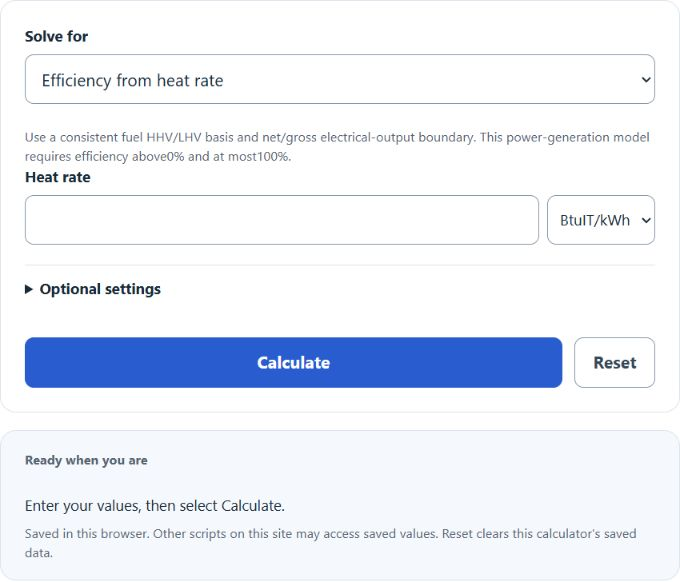
Calculate power-plant heat rate from efficiency or energy input and output, with Btu/kWh, kJ/kWh, rejected heat, sensitivity, and fuel-cost detail.
- All Efficiency Calculators
- Thermal Efficiency Calculator
- All Physics Calculators
- Condenser Efficiency Calculator
Heat Rate and Efficiency Formula
The following equations relate heat rate and (thermal) efficiency.
- Where HR is the heat rate (for example, kJ/kWh or Btu/kWh)
- Where η is the thermal efficiency (%)
- TEI is the thermal energy input
- EEO is the electrical energy output
To calculate heat rate, divide thermal input energy by electrical output (kJ/kWh or BtuIT/kWh). For efficiency, first convert both energies to the same unit, then divide electrical output by thermal input and multiply by100. Use a consistent HHV/LHV fuel basis and gross/net output boundary;1 kWh =3,600 kJ =3,412.141633 BtuIT.
What is Heat Rate (Efficiency)?
Definition:
Heat rate is a measure of how much thermal (fuel) energy a power plant must supply to produce one unit of electrical energy, commonly expressed as Btu/kWh (or kJ/kWh). A lower heat rate means the plant converts fuel to electricity more efficiently (higher thermal efficiency).
Heat rate is useful for comparing generating units, estimating fuel use, and estimating fuel cost and emissions (when combined with fuel heating value and emission factors). However, overall cost-effectiveness depends on many factors besides heat rate, including fuel price, capital cost, operating and maintenance costs, and capacity factor.
Heat rate and efficiency are inversely related. For example:
- Efficiency (%) ≈ (3412.142 / Heat Rate in Btu/kWh) × 100
- Efficiency (%) ≈ (3600 / Heat Rate in kJ/kWh) × 100
Heat rates depend on technology, load, fuel-energy convention and gross/net output. Compare only consistent boundaries and heating-value bases. The calculator provides an illustrative ±5% heat-rate sensitivity rather than a technology rating. Its non-electric share includes all other energy uses/losses and is not solely condenser heat; optional fuel-only cost excludes capital, operating and other generation costs.