Estimate shoulder width from your height, height from shoulder width, or your shoulder-to-height ratio, using average adult proportions for men and women.
- All Health and Medical Calculators
- Height To Arm Span Calculator
- Height To Head Circumference Calculator
- Height To Waist Circumference Calculator
- Height To Chest Circumference Calculator
- Height To Neck Length Calculator
- Waist to Height Ratio
Calculator Functions
| Function | What it does | What it requires |
|---|---|---|
| Shoulder width from height | Estimates the typical shoulder width for a given height | Requires the height and a body proportions setting |
| Height from shoulder width | Estimates the height at which a given shoulder width is typical | Requires the shoulder width and a body proportions setting |
| Shoulder-to-height ratio | Finds shoulder width as a percentage of height and compares it with the typical figure | Requires the height, the shoulder width and a body proportions setting |
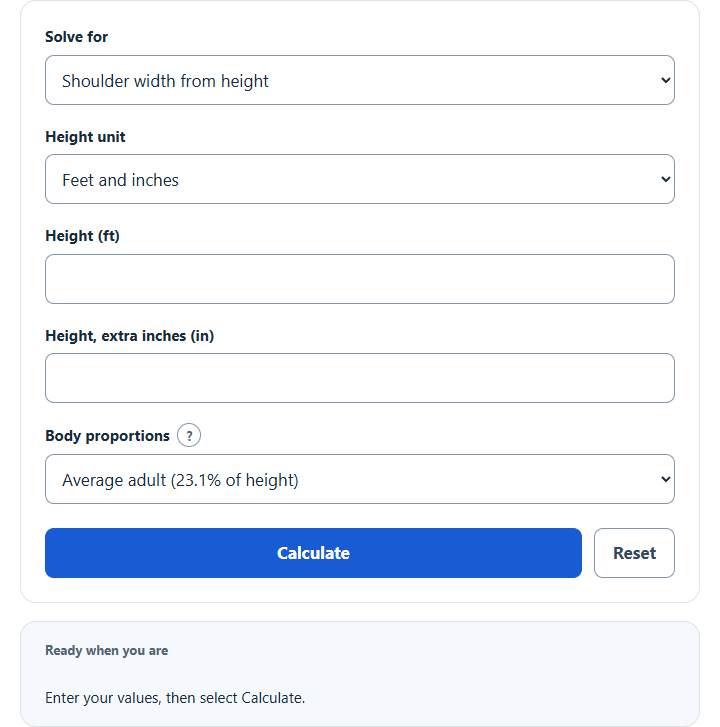
Height can be entered in feet and inches, inches, centimetres or metres, and shoulder width in inches or centimetres. The body proportions setting is Average adult (23.1% of height), Men (23.4%) or Women (22.7%). Shoulder width here is the biacromial width: the straight distance across the back between the bony tips of the shoulders. Every result also compares the width with the average for the selected group.
Height to Shoulder Width Formulas
| SW | Estimated biacromial shoulder width (same unit as height) |
| H | Height |
| r | Shoulder-to-height ratio: 0.231 for an average adult, 0.234 for men, 0.227 for women |
The ratios are average shoulder width divided by average height in a United States health survey of adults aged 20 and over, measured from 1988 to 1994. Men averaged 41.1 cm across the shoulders at a height of 175.6 cm, and women averaged 36.7 cm at 161.8 cm [1]. That gives 41.1 ÷ 175.6 = 0.234 for men and 36.7 ÷ 161.8 = 0.227 for women, and the midpoint figures of 38.9 cm and 168.7 cm give 0.231.
Shoulder width from height
The formula above applies directly. A man 5 ft 10 in tall (177.8 cm) has an estimated shoulder width of 177.8 × 0.234 = 41.6 cm, or 16.4 inches. The result also gives a width across the deltoid muscles, taken as 1 to 2 inches more than the bone-to-bone figure.
| Height | Average adult | Men | Women |
|---|---|---|---|
| 5 ft 0 in | 13.9 in (35.2 cm) | 14.0 in (35.7 cm) | 13.6 in (34.6 cm) |
| 5 ft 2 in | 14.3 in (36.4 cm) | 14.5 in (36.9 cm) | 14.1 in (35.7 cm) |
| 5 ft 4 in | 14.8 in (37.6 cm) | 15.0 in (38.0 cm) | 14.5 in (36.9 cm) |
| 5 ft 6 in | 15.2 in (38.7 cm) | 15.4 in (39.2 cm) | 15.0 in (38.1 cm) |
| 5 ft 8 in | 15.7 in (39.9 cm) | 15.9 in (40.4 cm) | 15.4 in (39.2 cm) |
| 5 ft 10 in | 16.2 in (41.1 cm) | 16.4 in (41.6 cm) | 15.9 in (40.4 cm) |
| 6 ft 0 in | 16.6 in (42.2 cm) | 16.8 in (42.8 cm) | 16.3 in (41.5 cm) |
| 6 ft 2 in | 17.1 in (43.4 cm) | 17.3 in (44.0 cm) | 16.8 in (42.7 cm) |
| 6 ft 4 in | 17.6 in (44.6 cm) | 17.8 in (45.2 cm) | 17.3 in (43.8 cm) |
Height from shoulder width
A man with 17 inch shoulders (43.18 cm) has an estimated height of 43.18 ÷ 0.234 = 184.5 cm, or 6 ft 0.6 in. A width measured across the deltoids needs 1 to 2 inches taken off first.
Shoulder-to-height ratio
Shoulders 45 cm wide on a height of 175 cm give 45 ÷ 175 × 100 = 25.7% of height. The result is called close to typical when it is within half a percentage point of the selected group’s ratio, and broader or narrower otherwise.
Limits of This Estimate
- The ratios come from average measurements, not from a formula fitted to individuals, and they assume shoulder width rises in step with height. These estimates are based on the best available data and estimations.
- People of the same height differ widely. In the survey, the middle 90% of men measured 37.3 to 45.0 cm across the shoulders and the middle 90% of women 33.4 to 40.3 cm [1].
- The averages describe United States adults aged 20 and over measured from 1988 to 1994. They do not cover children, and other populations and later years can differ.
- The estimate is a width across the shoulders. It is not shoulder height, the distance from the floor to the top of the shoulder, and it is not a clothing size.
Sources
- Centers for Disease Control and Prevention, National Center for Health Statistics, Anthropometric Reference Data for Children and Adults: U.S. Population, 1988–1994: average biacromial breadth, average height and percentiles for adults