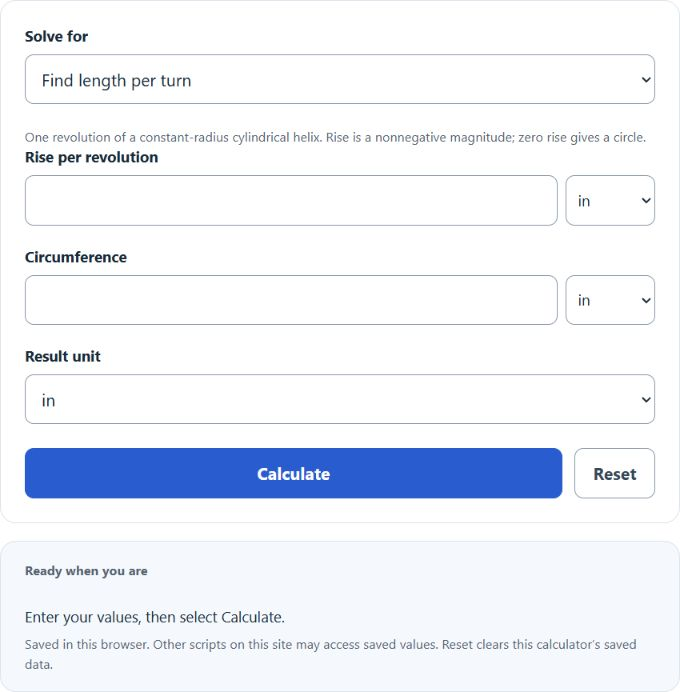
Calculate helix rise, circumference, or length from any two values using inches, feet, centimeters, or meters and get the missing result.
- All Length Calculators
- Helix Angle Calculator
- Spiral Length Calculator
- Coil Length Calculator
- Spiral Torsion Spring Calculator
- All Math and Numbers Calculators
Helix Length Formula
The helix length is the distance measured along one full turn of a cylindrical helix. If you unwrap one revolution of the helix from the cylinder, it forms a right triangle where the vertical leg is the rise in one revolution and the horizontal leg is the circumference. The helix length is the hypotenuse of that triangle.
- HXL = helix length for one revolution
- R = rise of the helix in one revolution
- C = circumference of the helix
This is an exact geometric relationship for a cylindrical helix with constant radius and constant rise per turn.
Rearranged Forms
Because the calculator can solve for any missing value when the other two are known, these rearranged equations are also useful:
To solve for rise, helix length must be at least the circumference; equality gives a circle with zero rise. To solve for a positive circumference, helix length must exceed the rise.
Equivalent Forms Using Radius or Diameter
If you know the cylinder radius or diameter instead of the circumference, convert first and then apply the helix length formula.
In many applications, the rise per revolution is also called the pitch. For a single-start helix, pitch and rise per revolution are the same. For multi-start threads, use the actual rise gained in one full revolution.
Total Length Over Multiple Revolutions
If the helix has the same geometry on every turn, multiply the one-turn helix length by the number of turns.
- Ltotal = total helix length
- N = number of revolutions
How to Calculate Helix Length
- Measure the rise of the helix in one complete revolution.
- Measure or calculate the circumference around the cylinder.
- Square both values.
- Add the squared values together.
- Take the square root of the result to get the helix length for one turn.
Keep all measurements in the same unit before calculating. If the rise is in inches and the circumference is in feet, convert one so both match first.
Examples
Example 1
A helix rises 4 ft in one revolution and has a circumference of 5 ft.
The helix length is 6.403 ft for one revolution.
Example 2
A helix length is 10 m for one turn, and the circumference is 8 m. Solve for the rise.
The rise of the helix in one revolution is 6 m.
Example 3
A cylinder has a diameter of 3 in, and the helix rises 2 in per revolution.
The helix length is about 9.635 in for one turn.
Practical Notes
- If the rise is zero, the helix length equals the circumference because the path becomes a circle.
- If the rise is positive, the helix length is always greater than the circumference.
- This formula assumes a constant-radius cylindrical helix. If the radius changes, calculate the path in smaller sections.
- If you know total axial rise over several turns, first find the rise per revolution before using the calculator.
Common Applications
- spring and coil design
- screw threads and lead calculations
- helical ramps and stair geometry
- cables, wires, or tubing wrapped around cylinders
- augers, conveyors, and spiral flighting
Use the calculator whenever you know any two of the three values—rise, circumference, or helix length—and need to solve for the third.