Calculate exact Archimedean spiral, rolled-material, or helical length from radii, diameters, thickness, pitch, turns, and angle.
- All Math and Numbers Calculators
- Arc Length Calculator
- Helix Angle Calculator
- Helix Length Calculator
- Coil Length Calculator
- Roll Length Calculator
- Spiral Torsion Spring Calculator
Spiral Length Formula
The spiral length calculator estimates the total path length of a spiral by treating it as N circular turns whose diameter increases uniformly from the inside diameter (ID) to the outside diameter (OD). This is a practical mean-diameter approximation commonly used for quick estimates of coiled material, rolled sheets, wound strip, tubing, rope, or wire.
In this model, the spiral length is found by multiplying the number of turns by the circumference based on the average diameter.
Variable Definitions
- SL = spiral length
- N = number of turns or rings
- OD = outside diameter
- ID = inside diameter
Keep OD and ID in the same units. The calculated spiral length will be returned in that same unit system.
Rearranged Forms
If you know any three values, you can solve for the fourth using these equivalent forms:
| Unknown | Formula |
|---|---|
| Spiral Length | SL ≈ π × N × (OD + ID) / (2) |
| Number of Turns | N ≈ (2 × SL) / (π × (OD + ID)) |
| Outside Diameter | OD ≈ (2 × SL) / (π × N) - ID |
| Inside Diameter | ID ≈ (2 × SL) / (π × N) - OD |
How to Use the Calculator
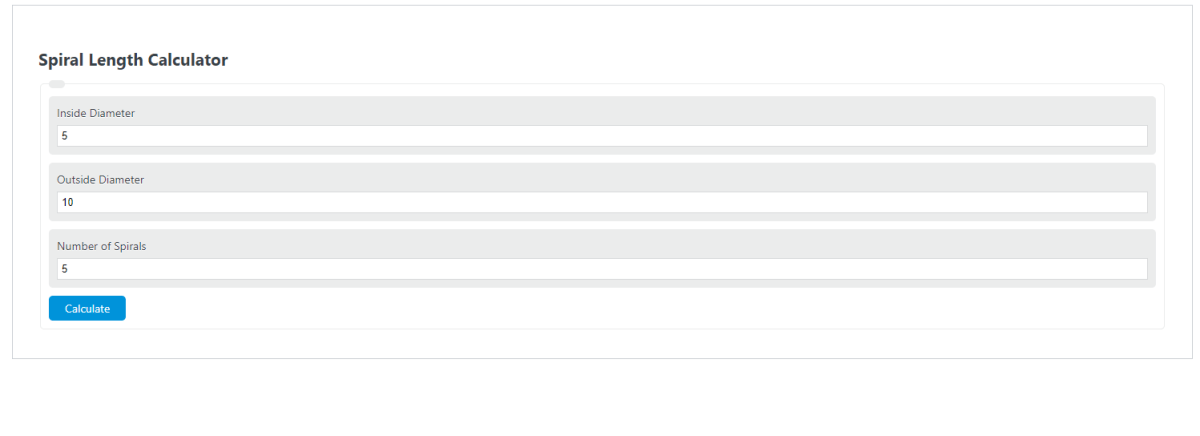
- Enter the inside diameter.
- Enter the outside diameter.
- Enter the number of turns, or instead provide the spiral length if that is the unknown you want to solve around.
- Make sure all diameter values use the same unit, such as inches, feet, centimeters, or meters.
- Calculate to find the missing value.
Examples
If a spiral has an inside diameter of 4 in, an outside diameter of 10 in, and 6 turns, the estimated spiral length is:
If the spiral length is 240 in, the inside diameter is 6 in, and the outside diameter is 18 in, then the estimated number of turns is:
When This Approximation Is Useful
- Estimating the length of rolled material before cutting or ordering stock
- Checking approximate coil length from known inner and outer diameters
- Planning layouts for wound products, packaging rolls, or compact spiral assemblies
- Quick engineering and fabrication estimates where a full spiral-curve calculation is unnecessary
Important Accuracy Notes
- This calculator uses a mean-diameter / circular-turn approximation, not the exact arc length of a continuously defined spiral curve.
- For true geometric spirals, such as an Archimedean spiral, the actual path is usually a little longer because the curve moves outward as it rotates.
- The estimate is most reliable when the spiral can reasonably be represented as a sequence of circular turns with steadily increasing diameter.
- Use positive values only, and make sure OD > ID.
- If you enter mixed units, the result will be incorrect unless the values are converted first.
Helpful Geometry Relationship
If the spiral is tightly wound from material with thickness t and negligible spacing between layers, the turn count can sometimes be estimated from the change in diameter:
This can be helpful when the number of turns is not directly known, but the material thickness and overall diameters are known.
Common Questions
Is spiral length the same as helix length?
This calculator is for a flat spiral estimate based on changing diameter. A helix length calculation is different because it also includes axial rise or pitch.
Why does the answer use the same units as the diameters?
Because the formula multiplies a unitless turn count by circumference based on diameter, the output remains in the same linear units as the input diameters.
Can I use this for wire, rope, strip, or rolled sheet material?
Yes, as long as a mean-diameter estimate is appropriate for the geometry you are modeling.