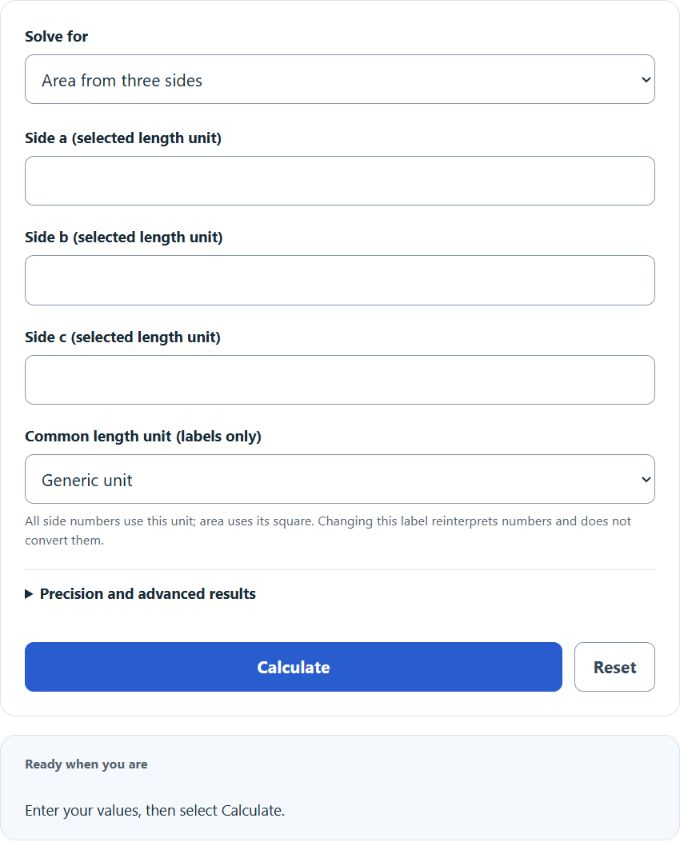
Calculate the area of any triangle from its three side lengths using Heron’s formula, or solve for a missing side when you know the area and two sides.
Heron’s Formula
Heron’s formula finds the area of a triangle from the lengths of its three sides, without needing the height or any angles. First find the semi-perimeter, then plug it into the area equation.
s = (a + b + c) / 2
- A = area of the triangle (square units)
- s = semi-perimeter, half of the triangle’s total perimeter
- a, b, c = the lengths of the three sides
Enter the three side lengths and the calculator computes the semi-perimeter, then the area. When you switch Solve for to missing side a, supply the area and sides b and c. There are generally two solutions, corresponding to acute and obtuse included angles between b and c; at the maximum area bc/2 they coincide in a right angle. Precision and advanced results controls set display rounding and optional angles, altitudes and radii; Calculation details contains the method. The common unit selector labels and reinterprets all side numbers without converting them; area uses the square of that unit. The three sides must satisfy the triangle inequality (each side shorter than the sum of the other two) or no real triangle exists.
Triangle Area for Common Side Sets
These values come straight from Heron’s formula and are useful for a quick sanity check against your own inputs.
| Sides a, b, c | Semi-perimeter s | Area A |
|---|---|---|
| 3, 4, 5 | 6 | 6 |
| 5, 5, 5 | 7.5 | 10.83 |
| 6, 8, 10 | 12 | 24 |
| 7, 8, 9 | 12 | 26.83 |
| 13, 14, 15 | 21 | 84 |
When the sides do not form a triangle
| Sides a, b, c | Result |
|---|---|
| 2, 2, 5 | Invalid: 2 + 2 is less than 5 |
| 1, 1, 2 | Degenerate: area is 0, sides lie on a line |
Example Problems
Example 1. A triangle has sides of 7, 8, and 9.
- Semi-perimeter: s = (7 + 8 + 9) / 2 = 12
- Area: A = √(12(12 – 7)(12 – 8)(12 – 9)) = √(12 * 5 * 4 * 3) = √(720)
- A = 26.83 square units
Example 2. A triangle has sides of 6, 8, and 10.
- Semi-perimeter: s = (6 + 8 + 10) / 2 = 12
- Area: A = √(12(12 – 6)(12 – 8)(12 – 10)) = √(12 * 6 * 4 * 2) = √(576)
- A = 24 square units (this is a right triangle, so you can confirm with 1/2 * 6 * 8 = 24)
FAQ
What do you need to use Heron’s formula?
You only need the lengths of all three sides. Unlike the base-times-height method, Heron’s formula does not require the height or any angle, which makes it useful when you know the sides but cannot measure the height directly.
What if the calculator says the triangle is invalid?
The three sides must satisfy the triangle inequality: each side must be shorter than the sum of the other two. If one side is equal to or longer than the other two added together, no nondegenerate triangle exists. Equality gives zero area on a line; a longer side makes a triangle impossible.
Can Heron’s formula find a missing side?
Yes. If you know the area and two of the sides, you can rearrange the area equation to solve for the third side. Select missing side a, enter the area and sides b and c, and review both possible lengths. An extra angle or side condition is generally needed to select one. The strict maximum area is bc/2. Extremely thin configurations whose branches cannot both be represented reliably are rejected.