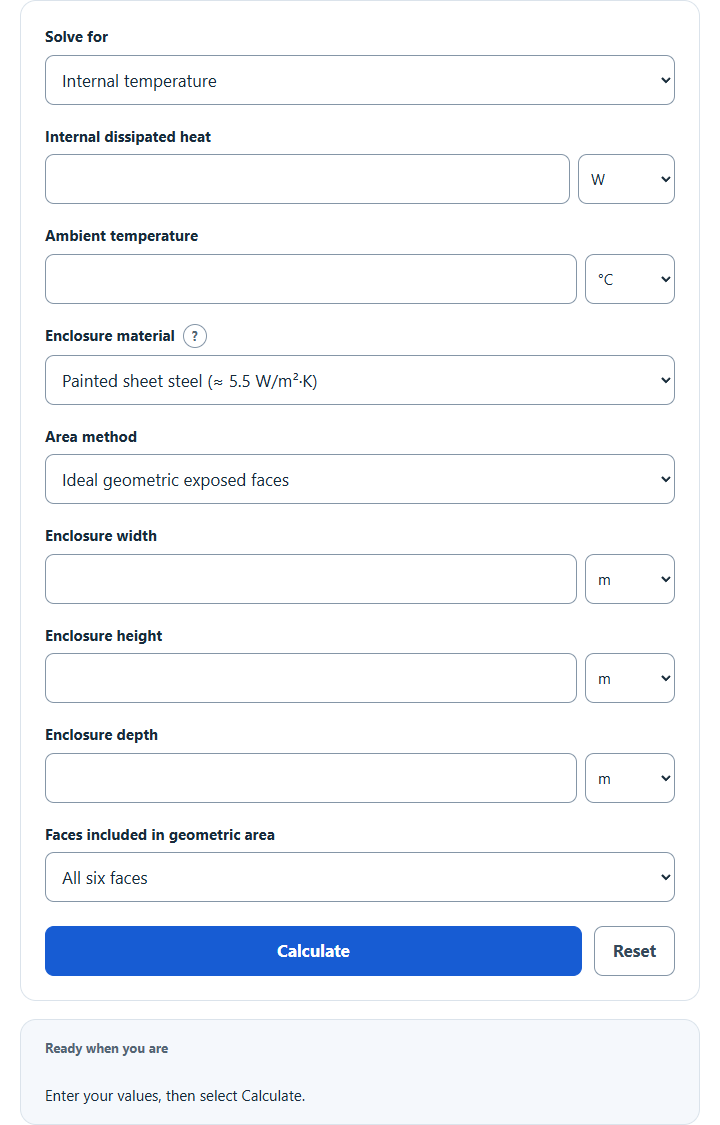
Estimate a Hoffman enclosure’s internal temperature or the cooling it needs from heat load, enclosure size, material and ambient temperature.
Related Calculators
- Heat Recovery Calculator
- LMT Calculator
- Chimney Draft Calculator
- Btu To Heat Water Calculator
- All Construction Calculators
Hoffman Enclosure Temperature Formula
This steady-state uniform-temperature estimate uses an installation-specific overall heat-transfer coefficient and effective area. It is not a certified HOFFMAN product selection; solar gain, latent loads, transients and local hot spots are excluded.
Variables:
- Te is the enclosure temperature
- To is the outside temperature
- P is the power dissipated in watts
- A is the effective thermal area in square meters; ideal exposed face geometry may differ from manufacturer installation-weighted area
- h is the overall effective heat-transfer coefficient in W/(m²·K), equivalent to W/(m²·°C). 1 W/(ft²·°F) = 19.37503875 W/(m²·K); 5.67826334 instead applies to BTUIT/(h·ft²·°F).
To calculate the enclosure temperature, add the outside temperature to the power dissipated divided by the product of the surface area and the heat transfer coefficient.
What is a Hoffman Enclosure?
A Hoffman enclosure is a type of protective casing used to house electrical or electronic equipment. These enclosures are designed to protect the equipment from environmental factors such as dust, water, and temperature fluctuations. Hoffman enclosures are commonly used in industrial and commercial applications to ensure the safety and longevity of sensitive equipment. They are made from various materials, including metal and plastic, and come in different sizes and configurations to suit specific needs.
How to Calculate Enclosure Temperature?
The following steps outline how to calculate the Enclosure Temperature.
- First, determine the outside temperature (To).
- Next, determine the power dissipated (P).
- Next, determine the surface area of the enclosure (A).
- Next, determine the heat transfer coefficient (h).
- Finally, calculate the Enclosure Temperature using the formula Te = To + (P / (A * h)).
- After inserting the values and calculating the result, check your answer with the calculator above.
Example Problem :
Use the following variables as an example problem to test your knowledge.
Outside Temperature (To) = 25°C
Power Dissipated (P) = 100 W
Surface Area (A) = 2 m²
Heat Transfer Coefficient (h) = 10 W/(m²·K). The example gives 25 + 100/(2 × 10) = 30°C. Cooling at a specified limit is max[P − hA(Tlimit − To), 0]; a limit below ambient adds surface heat gain.