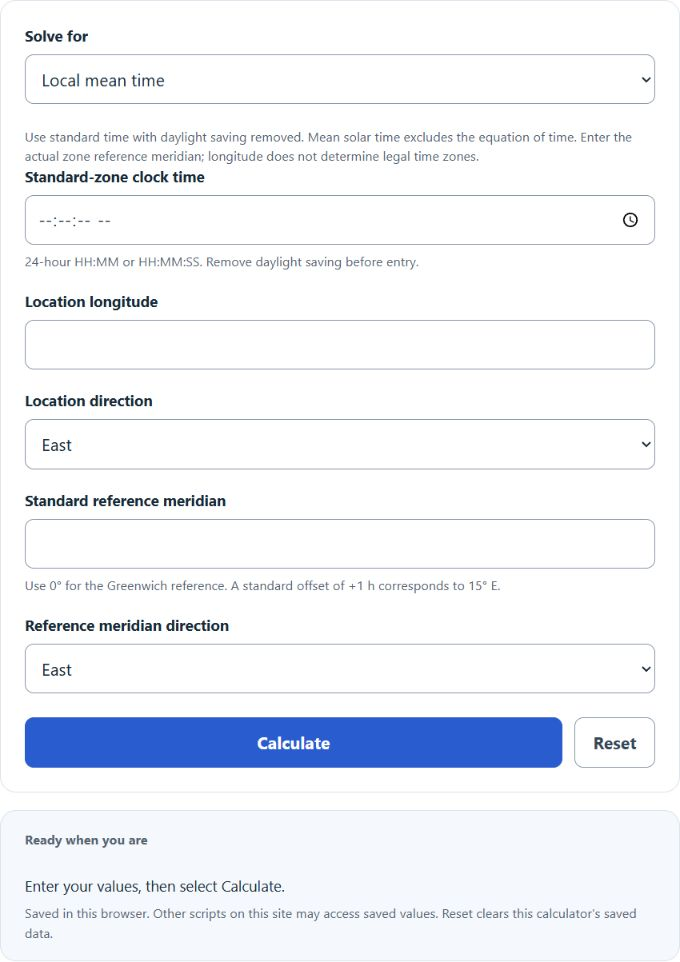
Calculate local mean time from standard time and longitude, reverse the conversion, or infer longitude from the four-minutes-per-degree offset.
- All Construction Calculators
- Mean Time Between Failures (MTBF) Calculator
- Lag Time Calculator
- Residence Time Calculator
- Clock Cycles Per Instruction Calculator
LMT Formula
The LMT calculator converts between standard-zone clock time and local mean solar time using the location and reference meridian. In signed east-positive degrees, LMT = standard time + 4 minutes × (location longitude − standard reference meridian). The Greenwich examples below use a reference meridian of 0°.
Where:
- LMT = local mean time at the location
- GMT = Greenwich Mean Time used as the reference time
- ΔT = time difference caused by longitude
Longitude to Time Conversion
Earth rotates 360 degrees in 24 hours, so every 15 degrees of longitude corresponds to 1 hour of time difference. East longitudes are ahead of Greenwich, and west longitudes are behind Greenwich.
This means you can convert longitude into a time offset before using the calculator:
- Positive offset for east longitude
- Negative offset for west longitude
- Enter longitude and the standard reference meridian; the calculator derives the correction rather than accepting a separate offset input
| Longitude | Offset from Greenwich |
|---|---|
| 15° E | +1 hour |
| 30° E | +2 hours |
| 45° W | -3 hours |
| 90° E | +6 hours |
| 120° W | -8 hours |
24-Hour Clock Adjustment
After adding the longitude offset, the result should be expressed on a 24-hour clock. If the result is above 24 hours, subtract 24 hours. If it is below 0 hours, add 24 hours until it falls within the normal daily range.
In plain terms:
- If your answer is 26:00, the local mean time is 02:00
- If your answer is -0:30, the local mean time is 23:30
How to Calculate LMT
- Determine the standard-zone clock time and its reference meridian. Remove daylight saving first.
- Enter the location longitude and direction, plus the standard reference meridian and direction.
- The calculator converts the signed longitude difference to time at four minutes per degree.
- Add the correction to standard time, or subtract it for the reverse conversion.
- Wrap the result into the 24-hour range if necessary.
For calculator use, the most common input mistake is the sign of the longitude. East is positive, west is negative.
Examples
Example 1: If the reference time at Greenwich is 07:00 and the location is 90° east, the longitude offset is 6 hours ahead of Greenwich.
The local mean time is 13:00.
Example 2: If the reference time at Greenwich is 02:30 and the location is 45° west, the longitude offset is 3 hours behind Greenwich.
The local mean time is 23:30 on the previous reference day after adjusting to the 24-hour clock.
Why Local Mean Time Is Useful
LMT is useful whenever time needs to be tied directly to longitude rather than to a modern legal time zone. It is commonly used in:
- astronomy and observational timing
- historical records and old navigation references
- solar position and daylight studies
- understanding how mean solar time differs from standard clock time
Important Notes
- LMT is not the same as civil clock time. Time zones, daylight saving time, and political boundaries can make local clock time different from longitude-based mean time.
- Use 24-hour clock inputs. Enter HH:MM or HH:MM:SS. Decimal-hour entry is not supported; 7.5 hours corresponds to 07:30.
- Check the sign of the offset. A west longitude entered as positive will shift the result in the wrong direction.
- Keep the time reference clear. Mean solar time excludes the equation of time. Greenwich mean solar time is represented by UT1; UTC is an approximation and no UT1−UTC correction is applied.
FAQ
What does LMT stand for?
LMT stands for Local Mean Time.
How do I get the longitude time difference?
Divide the longitude in degrees by 15 and assign a positive sign for east or a negative sign for west.
What if the result is negative?
Add 24 hours until the result falls within the standard 24-hour range.
Can I use minutes and seconds?
Use HH:MM or HH:MM:SS clock notation. Outputs round to the nearest second. Longitude inference uses the nearest signed clock difference within ±12 hours and returns longitude modulo 360°; clock inputs alone do not identify dates.