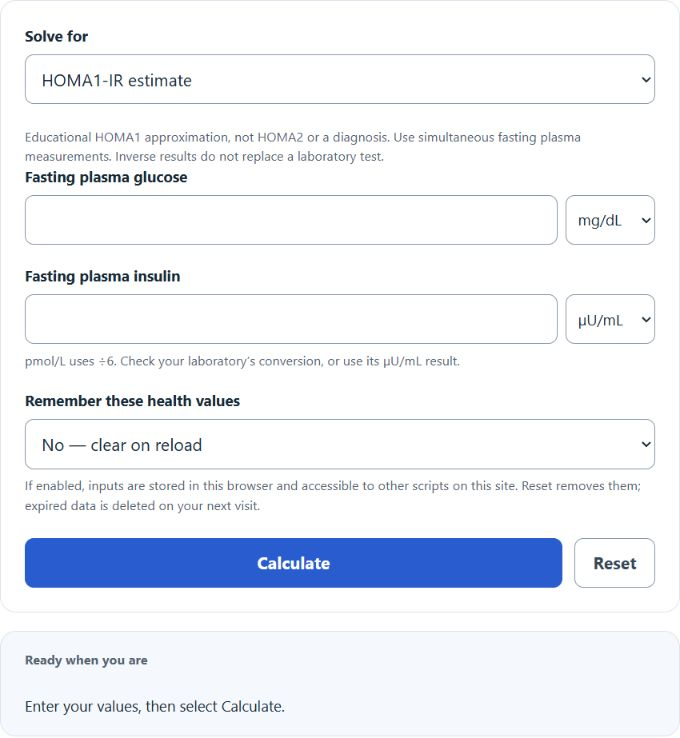
Choose a HOMA1-IR approximation or an algebraic glucose/insulin check. Enter two positive known values and select their units. Inverse results are not laboratory measurements.
- All Health and Medical Calculators
- Average Glucose To A1C Calculator
- Glucose Infusion Rate Calculator
- Glucose to Insulin Ratio Calculator
HOMA Index Formula
The HOMA Index on this page is the fasting insulin-resistance estimate commonly written as HOMA1-IR. This is the original simplified approximation, not the HOMA2 computer model. It combines fasting glucose and fasting insulin into one unitless value. In general, a higher result means more insulin is required to maintain fasting glucose, which usually suggests lower insulin sensitivity. This calculator focuses on insulin resistance rather than beta-cell function.
When fasting glucose is entered in mg/dL and fasting insulin is entered in μU/mL, the standard formula is:
| Symbol | Meaning | Typical Unit |
|---|---|---|
| HI | HOMA Index | Unitless |
| FG | Fasting glucose | mg/dL or mmol/L |
| FI | Fasting insulin | μU/mL or pmol/L |
Equivalent formulas by unit system
Because this calculator accepts more than one glucose and insulin unit, the denominator changes depending on the selected units. These forms are equivalent using this page’s stated conversion assumptions: glucose ×18 and insulin ÷6. Insulin assay conversions vary; some laboratories use 6.945 pmol/L per μU/mL. Confirm your laboratory’s factor or use its μU/mL result.
| Glucose Unit | Insulin Unit | Formula |
|---|---|---|
| mg/dL | μU/mL | HI = (FGmg / dL × FIμ U / mL) / (405) |
| mmol/L | μU/mL | HI = (FGmmol / L × FIμ U / mL) / (22.5) |
| mg/dL | pmol/L | HI = (FGmg / dL × FIpmol / L) / (2430) |
| mmol/L | pmol/L | HI = (FGmmol / L × FIpmol / L) / (135) |
Helpful unit conversions
If you want to verify the calculator manually, these conversions explain why the equation changes across unit systems.
How to calculate the HOMA Index
- Measure fasting glucose after an overnight fast.
- Measure fasting insulin from the same fasting state.
- Select the correct units for both values.
- Apply the matching equation, or enter the numbers into the calculator above.
- Use the result as an estimate of fasting insulin resistance, not as a stand-alone diagnosis.
Example
If fasting glucose is 100 mg/dL and fasting insulin is 10 μU/mL:
The estimated HOMA Index is 2.47.
Rearranged formulas
The equation can be rearranged for an algebraic consistency check. A computed glucose or insulin value does not replace a measured fasting laboratory result. In the standard unit set of mg/dL and μU/mL:
How to interpret the result
- Lower values generally reflect better fasting insulin sensitivity.
- Higher values generally suggest greater insulin resistance.
- The HOMA Index is population-dependent; there is no single universal cutoff that fits every lab, age group, or clinical setting.
- Results can vary with body composition, puberty, pregnancy, ethnicity, insulin assay method, and underlying metabolic disease.
- This metric is most useful when glucose and insulin are collected in a true fasting, steady-state condition.
Common reasons a result may be misleading
- Blood work was not taken after a proper fast.
- Glucose and insulin were entered in the wrong units.
- The sample was collected during acute illness, stress, or recent major exercise.
- Medications such as corticosteroids or glucose-lowering therapies are affecting fasting levels.
- The value is being interpreted by itself instead of alongside A1C, fasting glucose, lipid markers, body composition, and clinical history.
Why this calculator is useful
The HOMA Index provides a quick way to estimate fasting insulin resistance from routine lab data. HOMA modeling is used in research, but the simplified HOMA1 equation has assay and model limitations. It should not be used here as clinical screening or a treatment target. Since this calculator accepts multiple unit combinations and can solve for a missing variable, it is helpful for checking the stated approximate formula and manual calculations. Clinical interpretation requires a qualified professional.