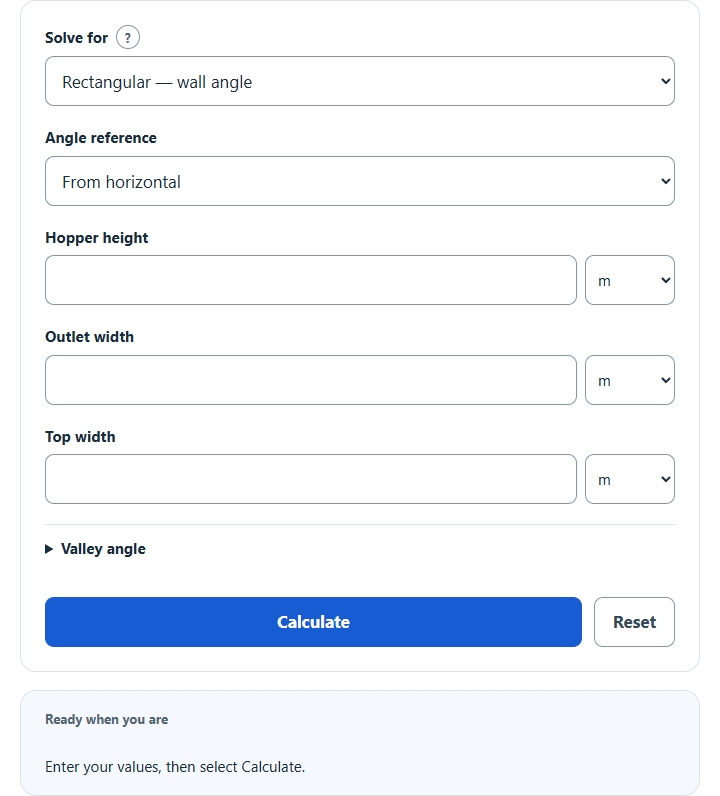
Calculate hopper wall angle and valley angle from height, top and outlet width, or solve the height or opening size for rectangular and conical hoppers.
- All Construction Calculators
- Linear Pair Angle Calculator
- Angle Addition Calculator
- Angle Between Bearings Calculator
- Hopper Design Calculator
Calculator Functions
| Function | What it does | What it requires |
|---|---|---|
| Rectangular — wall angle | Finds the slope of a rectangular hopper wall and the valley angle of its corners | Requires the hopper height, the outlet width and the top width |
| Rectangular — height | Finds the height a rectangular hopper needs for a chosen wall angle | Requires the wall angle, the outlet width and the top width |
| Rectangular — outlet opening | Finds the outlet width left by a chosen wall angle and height | Requires the wall angle, the hopper height and the top width |
| Rectangular — top opening | Finds the top width reached by a chosen wall angle and height | Requires the wall angle, the hopper height and the outlet width |
| Conical — wall angle | Finds the slope of a conical hopper wall | Requires the hopper height, the outlet diameter and the top diameter |
| Conical — height | Finds the height a conical hopper needs for a chosen wall angle | Requires the wall angle, the outlet diameter and the top diameter |
| Conical — outlet opening | Finds the outlet diameter left by a chosen wall angle and height | Requires the wall angle, the hopper height and the top diameter |
| Conical — top opening | Finds the top diameter reached by a chosen wall angle and height | Requires the wall angle, the hopper height and the outlet diameter |
Every function has an angle reference, From horizontal or From vertical, and reports the wall angle both ways. Lengths are entered in m, cm, ft or in. The rectangular functions take an optional other wall angle, the slope of the adjacent pair of walls, for the valley angle; when it is blank all four walls are taken to slope equally.
Hopper Angle Formulas
| θ | Wall angle measured from the horizontal |
| H | Hopper height, from the top opening down to the outlet |
| T | Top width, or top diameter for a cone |
| O | Outlet width, or outlet diameter for a cone |
The wall runs inward by (T − O) ÷ 2 on each side while it drops by H. The angle from the vertical is 90° − θ.
Rectangular — wall angle
A hopper 2 m high that narrows from 4 m to 2 m has a run of 1 m per side, so θ = atan(2 ÷ 1) = 63.4349° from horizontal, or 26.5651° from vertical. Equal top and outlet widths give vertical walls, 90°.
Rectangular — height
Walls at 60° that narrow from 2 m to 0.5 m need H = 0.75 × tan 60° = 1.299 m.
Rectangular — outlet opening
A 2 m top with 60° walls over a height of 1 m leaves O = 2 − 2 ÷ tan 60° = 0.8453 m. Values that would need an outlet below zero are rejected.
Rectangular — top opening
A 0.5 m outlet with 60° walls over a height of 1 m opens to T = 0.5 + 2 ÷ tan 60° = 1.6547 m.
Conical — wall angle
A cone uses the main formula with diameters measured through the center. A cone 1.5 m high from a 1.8 m top to a 0.3 m outlet has θ = atan(3 ÷ 1.5) = 63.4349° from horizontal.
Conical — height
The height formula is the rectangular one with diameters. A 70° cone from 1.8 m to 0.3 m is 0.75 × tan 70° = 2.0606 m high.
Conical — outlet opening
The outlet formula is the rectangular one with diameters. A 1.8 m top with a 70° wall over 1.5 m leaves an outlet of 1.8 − 3 ÷ tan 70° = 0.7081 m.
Conical — top opening
The top formula is the rectangular one with diameters. A 0.3 m outlet with a 70° wall over 1.5 m opens to 0.3 + 3 ÷ tan 70° = 1.3919 m. Entering the same wall as 20° from vertical gives the same answer.
Hopper valley angle
The valley angle γ is the angle of the corner of a pyramidal hopper, where two walls meet, measured from the horizontal [1]. θ₁ and θ₂ are the slopes of the two adjacent walls. The corner is always flatter than either wall: four walls at 60° meet in valleys of 50.7685°, and a 63.4349° wall beside a 70° wall gives 58.2655°. A cone has no corners, so the conical functions report no valley angle.
Limits of This Estimate
- The geometry assumes a centered outlet, straight walls and a symmetric cross-section. An offset outlet has a different angle on each side.
- The result is geometry only. Whether a material flows depends on the bulk solid and on its friction against the wall, which have to be measured.
- As a guide for gravity flow, the Indian Standard for steel storage bins recommends a hopper slope, taken as the valley angle for square and rectangular hoppers, about 15° steeper than the material's angle of internal friction and not less than 60° to the horizontal [1].
Sources
- Bureau of Indian Standards, IS 9178 (Part 1): 1979, Criteria for Design of Steel Bins for Storage of Bulk Materials, Part 1: General Requirements and Assessment of Loads: the definition of valley angle, the valley angle formula and the recommended hopper slope